


Business Management: The Complete Guide to Managing and Growing a Successful Business

Last Updated: July 23, 2026
Introduction
Good business management is arguably the pillar stone for success of an organization. Whether a new start up, a local small venture, or a huge conglomerate the manner by which resources and employees are controlled and goals are achieved will always the define the degree of success for a business. With intense competition and rapid technological advancements, the business ventures need a very effective system of business management to sustain productivity and revenue.
Business management does not only end up overseeing a business concern or employees working in it regularly, instead it broadly includes business planning and management, leadership skills, effective decision making, managing business financials, managing relationships with customers, operations, and continuous improvements. Business organization having a good management system generally face less difficulty adapting to changing markets, customers, and opportunities that lead to rapid growth of organization.
This article will shed light on the complete business management; importance, functions of business management, principles of business administration, business operations management skills, business management strategies, risks associated with the business management, future business management, etc.
Explore our comprehensive guide to business management software to learn how modern solutions can simplify workflows and increase productivity.
This Article is the part of Business Planning
Understanding Business Management
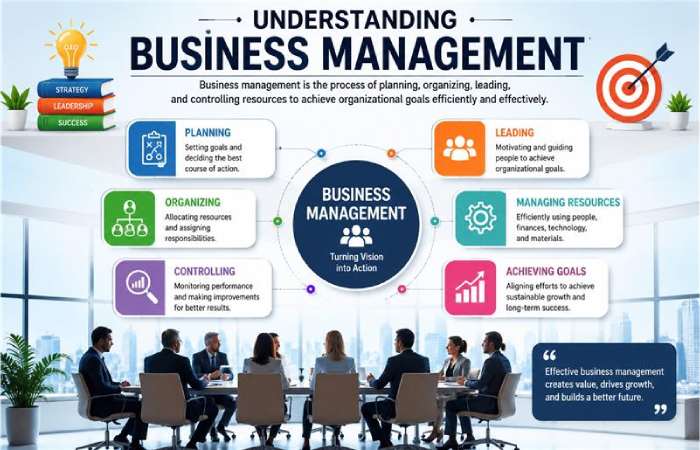
Business management is the function of planning organizing leading controlling and using the organization’s resources-employees financial resources technology information facilities operational systems and other elements-to manage the day-to-day operations and the day-to-day goals and long term goals of an organization efficiently and effectively. The main purpose of the business management function is that the manager is supposed to ensure that all the different entities of the organizations are collectively able to work towards the accomplishment of certain goals and objectives.
The competent managers coordinate their activities allot the resources correctly solve different business problems, and motivate their employees towards goal accomplishment and track all the performances and the functions within the organization so that the desired output comes forth.
The business management serves as the backbone that helps in coordinating organizational policy with action and organizational action with policy, and the role played by the management is like a coordinating element between the executive planning and execution functions.
The management not only lays the plans and determines the policies but it has also got to implement the same throughout the organization the day-to-day management plays role in several areas such as performance, employee satisfaction, financial status, competitive advantage and in fact all the major area of the organization.
Core Elements of Business Management
| Element | Purpose |
| Planning | Establish goals and strategies |
| Organizing | Structure resources and responsibilities |
| Leading | Motivate and guide employees |
| Controlling | Monitor and improve performance |
| Decision-Making | Select effective business solutions |
| Resource Management | Optimize use of assets |
| Coordination | Align organizational activities |
The effectiveness of these elements largely determines whether a company succeeds or struggles in a competitive marketplace.
Why Business Management is Important
The significance of business management for organizations can be attributed to the way in which it brings about a structure and focus to an organization that can allow for enduring advancement. Without sound administration, even organizations that offer items or administrations that are phenomenal can languish over operational problems, financial inconsistencies, the failure to convey productively and absence of order. As I’m attempting to demonstrate that you are seeing below business management has loads of importance.
Top motivation behind why the importance of business management in the organizations can be said is in it enhances overall productivity in the businesses. Managers can come up with systems and processes, also help their employees set up the workflows in the business to set them up to effectively take out their tasks. This will mean more efficiency in the organization and fewer wasted resources.
The importance of good business management is the further way to have great choices when it comes to decisions that affect the modern business. Organizations now amass enormous sums of data concerning business, financial information and the customers. Competent managers will need to sift through all of this to use that data and ensure wise choices are being made.
Benefits of Effective Business Management
| Benefit | Organizational Impact |
| Increased Productivity | Better operational efficiency |
| Improved Profitability | Higher revenue and cost control |
| Better Employee Retention | Reduced turnover costs |
| Stronger Customer Satisfaction | Improved loyalty and reputation |
| Enhanced Innovation | Greater competitiveness |
| Sustainable Growth | Long-term success |
Organizations that invest in effective business management are generally better prepare to handle uncertainty, competition, and market changes.
Business Administration and Its Relationship with Business Management
These terms of administration & management appear similar, yet the two functions vary significantly: The scope of Business Administration Business Administration emphasizes overall responsibility for policy formulation and organizational governance in a business setting. Planning and the direction of business policy in an organization fall under the purview of business administration. It also includes various processes associated with organizational governance such as business ethics, and law and compliance etc.
The Scope of Business Management Business management is largely focused on managing and coordinating organizational operations in day to day and tactical level.
It refers to all activities related to resource mobilization and the management of the resources toward the achievement of certain goals of the organization. A manager oversees operational, tactical or strategic matters of a division of a firm. Regardless of how they are distinct, there exists a lot of shared elements between the two that will integrate into a structure that effectively govern a business.
Business Administration vs Business Management
| Business Administration | Business Management |
| Focuses on policy and planning | Focuses on execution and leadership |
| Develops organizational frameworks | Implements business strategies |
| Emphasizes governance | Emphasizes operations |
| Supports long-term objectives | Manages daily activities |
| Coordinates departments | Leads employees |
Organizations require both business administration and effective business management to achieve long-term success.
The Business Management Process
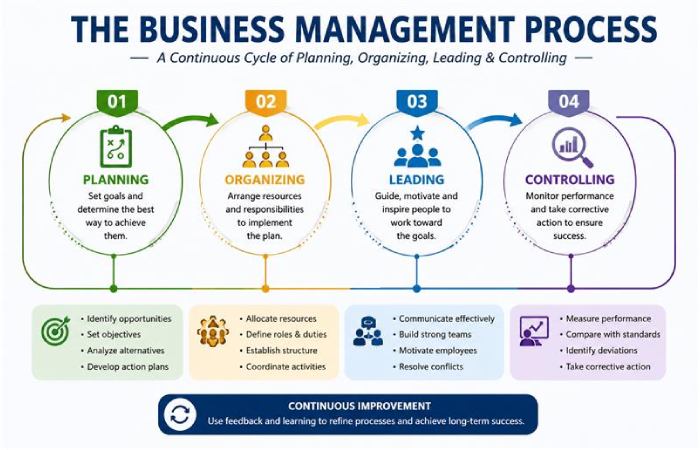
The business management process comprises a range of related functions or steps that lead organizations towards a successful conclusion. It enables management to be provided with a framework, by which decisions can be taken, and performance can be improved.
Planning
The initial process of management is planning. Planning is also refer to as the foundation for all other management tasks. It requires the establishment of objectives and strategies to achieve them, assessment of potential opportunities, future forecasts, and the consideration of conditions under which an event will occur.
One primary function of planning business enterprises helps reduce a firm’s uncertainty and more adequately utilize their scarce resources. In absence of this form of planning, management is often reactionary and does not control future happenings. With planning, managers will learn to delegate tasks accordingly, set out priorities and formulate a roadmap to achieve goals.
Types of Planning
| Planning Type | Description |
| Strategic Planning | Long-term organizational direction |
| Tactical Planning | Department-specific objectives |
| Operational Planning | Daily operational activities |
| Contingency Planning | Emergency and crisis preparation |
Effective planning ensures that all organizational activities contribute to broader business goals.
Organizing
The act of organizing a business entails devising processes to arrange resources so operations flow more smoothly and efficiently. Managers must take into account things such as what duties employees will perform, who reports to whom, how tasks will be organized within the production process and how duties will be delegated among departments. Such steps can get rid of confusing information and also clearly assigns authority.
Such arrangement clarifies jobs that an individual must do, streamlines the communication system between workers and efficiently utilize available resources of an enterprise.
Structure affects speed with which decisions can be made and with which tasks can be accomplished. Various organizations have different types of structures. Many corporations are built according to old, established structure models such as structure pyramid type, whereas, some more progressive enterprises use more innovative, flexible and flat company structure models.
Common Organizational Structures
| Structure | Characteristics |
| Functional | Organized by department |
| Divisional | Organized by products or markets |
| Matrix | Dual reporting relationships |
| Flat | Minimal management layers |
| Team-Based | Collaborative work groups |
Effective organization creates a framework that supports growth and operational efficiency.
Leading
One of the greatest responsibilities and key components to running a business comes in the way of leadership. The reason why business leaders are critical to a company’s success and growth is due to the impact leadership has on employee attitudes, motivations and behavior. The role of leadership involves things like; directing team members, setting workplace standards and expectations, mediating disagreements and generally encouraging teamwork and cooperation among their staff.
An inspiring leader has the ability to boost a team member’s confidence and the level of commitment they bring to a project. Today’s leadership also looks past directing the team; instead they support the employees in all their personal and professional efforts, considering a number of important factors like employee growth, emotional connection and innovation, building relationships and fostering open communication channels. The impact strong leadership can make on an organization is immense: higher staff morale, better customer loyalty, and even better bottom line, is all a result of great leadership.
Leadership Styles
| Leadership Style | Description |
| Democratic | Encourages employee participation |
| Autocratic | Centralized decision-making |
| Transformational | Focuses on innovation and growth |
| Transactional | Performance-based rewards |
| Servant Leadership | Prioritizes employee development |
The most effective leadership style depends on organizational culture, industry conditions, and workforce characteristics.
Controlling
Control maintains alignment with strategic goals at all organizational levels. In this process, managers define performance goals, compare actual results to established goals, analyze and explain deviations from objectives, and take corrective actions if needed.
Poorly functioning controls allow problems to be overlooked and reactions to altered conditions to be delayed. Management can enhance efficiency and effectiveness and achieve consistent quality of goods or services and other positive outcomes through accurate and consistent monitoring of their actual performance levels.
Control Mechanisms
| Method | Purpose |
| Budget Control | Monitor financial performance |
| KPI Measurement | Track progress |
| Performance Reviews | Evaluate employees |
| Audits | Ensure compliance |
| Quality Control | Maintain standards |
The controlling function supports continuous improvement and long-term organizational success.
Business Operations Management
This element represents one aspect of overall business management. Business operations management (BOM) is a function in which management determines the design, operation, monitoring, controlling and implementation of the business in order to make up any likenesses to strategy that is considered in business management, which is about where the firm will be situated as well as how it is likely to position itself as far as a way of getting to where the company should be. This function oversees how a business organization actually turns resources into goods or services efficiently to increase profits.
BOM the ability to create efficiency in operations to enhance customer service, achieve customer loyalty and make the operations more valuable.
Business operations management involves production of planning of goods or services production, management of inventory, managing the supply chain, managing quality control processes, supply chains, transportation, ordering process, customer logistics and many others processes. Operations manager balances the productivity, managing cost and ensuring customer order fulfillment, the efficiency, quality, timely delivery and the value of an organizations products.
Key Areas of Business Operations Management
| Area | Purpose |
| Production Management | Efficient creation of products and services |
| Inventory Management | Maintain optimal stock levels |
| Supply Chain Management | Coordinate suppliers and logistics |
| Quality Management | Ensure customer satisfaction |
| Process Improvement | Increase efficiency and reduce waste |
| Logistics Management | Deliver products effectively |
| Capacity Planning | Manage production capabilities |
Operations management can have an enormous impact on a business’s profitability since inefficacies mean costs go up and productivity falls. Good management involve analyzing workflows and looking to optimize them.
Essential Business Management Skills
An organizations’ effectiveness is entirely influence by the proficiency of her managers. In the area of business management, it takes a skillful manager who possesses analytical, interpersonal, planning, organizational, and leadership skills. These skillful managers will be able to address complex situations, encourage their employees and help achieve the goals of the organization.
The skill of leadership one of the important skills that could help in managing the business.
The leadership skills will help to drive and persuade the employees towards a positive goal and help provide vision and purpose. Managers at all level should be in position to exercise leadership skills.
Communication skills for business management another key business management skill is that of communication. Managers need to use these skills to convey their instructions and plans to workers in a straightforward manner and they are also likely to gather positive feedback. Where workers communication with their managers is effective, employees are able to understand instructions well and managers are better placed to get there point across or they risk to get to a point to get very frustrated workers who produce less.
Essential Business Management Skills
| Skill | Importance |
| Leadership | Guides teams toward goals |
| Communication | Improves collaboration |
| Financial Management | Supports informed decisions |
| Problem-Solving | Resolves challenges efficiently |
| Time Management | Increases productivity |
| Strategic Thinking | Supports long-term success |
| Negotiation | Improves business relationships |
| Adaptability | Responds to changing conditions |
These skills need practical application along with experience so it helps build effective management. Effective managers will go to lengths in making their skills bigger and learn more about managing.
Business Management Strategies for Sustainable Growth
In order to grow and be competitive, every prosperous entity must utilize business management strategies with precision. It may seem complicated, but strategy helps organizations plan and allocate their financial resources efficiently to adjust to the rapidly changing environment of a market. In every business organization there is the implementation of strategies.
For most, the best strategy involves setting clear business goals, which lead the business to succeed because workers clearly comprehend what they are aiming to do.
These strategic goals should conform to the mission and vision of your company and need to have defined parameters that enable measurement of overall performance. In addition to having strategic goals, businesses require consumer focused strategy plans.
Because today’s market includes a plethora of options for each consumer, most consumers have become increasingly value seeking. Thus, most organizations are beginning to consider the best practices in delivering optimal customer satisfaction by making strategic plans that involve learning what consumer wants and needs are.
Effective Business Management Strategies
| Strategy | Primary Benefit |
| Strategic Planning | Clear organizational direction |
| Customer-Centric Approach | Improved customer loyalty |
| Employee Development | Enhanced productivity |
| Innovation Management | Increased competitiveness |
| Data-Driven Decisions | Better business outcomes |
| Risk Management | Reduced uncertainty |
| Digital Transformation | Improved efficiency |
| Continuous Improvement | Sustainable growth |
Successful organizations rarely rely on a single strategy. Instead, they integrate multiple approaches to create a comprehensive framework for growth and performance improvement.
Managing a Business in the Digital Age
Running a company is not the same as it was twenty years ago. Technology is now deeply entrench in every area of business, communication, marketing, and client relations. Digital transformation Digital transformation is a high priority in all industry sectors with enterprises migrating to cloud, artificial intelligence, data analytics and automation to enhance efficiency, client service and much more.
Cloud Computing It is simple: Companies today need constant access to their information in real-time, and the only way to accomplish this without significantly increasing infrastructure expenses is with a business-wide cloud migration.
Technologies Transforming Business Management
| Technology | Business Impact |
| Cloud Computing | Greater flexibility and accessibility |
| Artificial Intelligence | Automation and insights |
| Data Analytics | Improved decision-making |
| ERP Systems | Integrated operations |
| CRM Platforms | Better customer management |
| Automation Tools | Increased productivity |
| Cybersecurity Solutions | Protection against threats |
Organizations that embrace digital technologies often achieve higher efficiency, stronger customer relationships, and greater competitiveness.
Common Challenges in Managing a Business
No matter how thorough your business plan, even the best-run companies will face hurdles. In running a business, you’ll be tasked to navigate market fluctuations, operational concerns, fiscal realities and staff issues. Most of this sounds quite daunting, I’ll agree with you on this one. Employee retention has always been one of the most frequent challenges many businesses face these days.
Companies spend a substantial amount on recruitment and staff training and high rates of employee turnover have the tendency to cripple day to day operations and the company bottom line. Managers always try to build an environment where each staff member feels welcome and would want to stick around long-term. Like employee retention, the management of finances remains a crucial element in the success of a company and will forever be something that needs to be accounted for. Controlling the expenses, the costs and making decisions on investment is not all easy considering uncertain financial times.
Major Business Management Challenges
| Challenge | Impact |
| Employee Turnover | Increased hiring costs |
| Cash Flow Issues | Financial instability |
| Market Competition | Reduced market share |
| Technology Changes | Need for continuous adaptation |
| Regulatory Compliance | Increased operational complexity |
| Economic Uncertainty | Strategic planning difficulties |
| Customer Expectations | Pressure for constant improvement |
Effective managers anticipate challenges and develop strategies to address them before they become major problems.
The Role of Leadership in Effective Business Management
People are the engine that drive’s any successful business and nothing shapes this more than leadership. If your focus isn’t on leadership then you aren’t optimizing the full potential of your business, systems and your teams. Where managers lead through processes and performance, leaders guide through inspiration and vision.
Good leaders paint the picture of where an organization is going and inspire their teams to see themselves in this.
They help employees see their part and the impact that work plays, which drives engagement and purpose. Furthermore, the attitude of your team is driven heavily by the attitudes of their leaders and this is reflected in workplace culture, which can also play a massive part in the success of your company.
Characteristics of Successful Business Leaders
| Characteristic | Organizational Benefit |
| Vision | Clear direction |
| Integrity | Employee trust |
| Communication | Strong collaboration |
| Adaptability | Resilience during change |
| Empathy | Improved employee engagement |
| Decision-Making | Faster problem resolution |
| Accountability | Strong performance culture |
Leadership and management work together to create organizational success. While management provides structure, leadership provides inspiration and direction.
Future Trends in Business Management
The landscape of management isn’t static; it shifts with organizations adapting to technological growth, Globalization, demands for flexibility from workforces, and growing customer expectations. Those organizations that keenly sense forthcoming developments can better compete and ensure long-term growth. Among the most considerable impacts shaping the evolution of management, the notion of digital transformation will predominate.
As organizations are progressively subsuming nascent technologies into their core functions to augment their operational efficiency, slash down on operational expenses, and ameliorates their interactions with their customers, a digital-first mentality is becoming paramount to survival.
AI will continue to grow significantly as an integral decision-making component. Since these systems can readily process vast quantities of information to extract trends and forecast events and automate the completion of myriad of repetitive functions, managers can devote more attention to innovation.
Emerging Trends in Business Management
| Trend | Impact on Organizations |
| Artificial Intelligence | Faster and smarter decisions |
| Automation | Reduced operational costs |
| Remote Work | Increased workforce flexibility |
| Sustainability | Improved reputation and compliance |
| Data Analytics | Better business insights |
| Cloud Computing | Enhanced collaboration |
| Agile Management | Faster adaptation to change |
| Digital Transformation | Greater competitiveness |
Organizations that proactively embrace these trends will be better equipped to navigate future challenges and capitalize on emerging opportunities.
Best Practices for Effective Business Management
Each business organization will differ from the others in several ways. Some management techniques will be consistently use in a particular organization if it is to be managed properly in the long-term to enable it to realize all of its objectives and satisfy the people working in the company. It is for the purpose of managing well; business enterprises may need to adopt various practices.
To implement some general practices can improve some aspects of its operation like management of human resources or human capital.
The first best practice is that a manager of any enterprise must know the vision of the organization as well as mission it is operating. If employees do know the overall objective they are heading for; they perform better when their direction of operation is very explicit and provides with overall goals to be achieve.
Communication can be the best practice that helps businesses to improve on different aspects. Successful managing business enterprises ensure all employees are kept aware about what is happening in the company or organization because communication facilitates decision-making and ensures workers are aware of how they may impact the achievement of goals in.
Business Management Best Practices
| Best Practice | Benefit |
| Clear Vision and Mission | Organizational alignment |
| Effective Communication | Improved collaboration |
| Continuous Improvement | Increased efficiency |
| Performance Measurement | Better accountability |
| Employee Development | Higher productivity |
| Customer Focus | Greater satisfaction |
| Innovation Culture | Competitive advantage |
| Risk Management | Reduced uncertainty |
When consistently applied, these practices create a strong foundation for sustainable organizational growth.
Measuring Business Management Success
One of the critical functions that all managers must take on at some point is determining if what they’re doing is effective. Without the ability to measure success, a business cannot properly recognize its areas of strength or its areas of weakness, nor can it make informed business decisions on its overall future direction. It would not be uncommon that many management success metrics will focus on the bottom line, including growth in revenues, company profitability, cash-flow stability, and return on investment (ROI).
When looking at various success metrics related to the employees, any high turnover rates, lack of engagement, and low productivity can be indicators of areas of improvement for management.
Key Performance Indicators for Business Management
| KPI | Purpose |
| Revenue Growth | Measure business expansion |
| Profit Margin | Evaluate profitability |
| Customer Retention Rate | Assess customer loyalty |
| Employee Turnover Rate | Monitor workforce stability |
| Productivity Metrics | Measure operational efficiency |
| Customer Satisfaction Score | Evaluate service quality |
| Return on Investment (ROI) | Assess investment effectiveness |
| Market Share | Measure competitive position |
Organizations that consistently monitor these metrics are better equipped to achieve strategic objectives and maintain long-term success.
Career Opportunities in Business Management
Management is a truly versatile and fulfilling field. Most companies all over the world need employees who can lead and make teams productive and effective. If you have business management knowledge, you may have various career paths open in different fields like management, finance, marketing, operations, human resources, consulting, project management, and even as executive leaders.
Since management principles are quite general, you can find employment either private or public enterprises. When beginning a career you might start as the coordinator of a team or project, or even simply operate an entity while reporting to other. Soon you may graduate to manage a department or even an entire enterprise.
Popular Business Management Careers
| Position | Primary Responsibilities |
| Business Manager | Oversee overall operations |
| Operations Manager | Improve operational efficiency |
| Project Manager | Coordinate projects and teams |
| Marketing Manager | Drive brand growth |
| Human Resource Manager | Manage workforce development |
| Financial Manager | Oversee financial planning |
| General Manager | Lead organizational functions |
| Chief Executive Officer (CEO) | Direct strategic vision |
Business management careers offer opportunities for professional growth, leadership development, and financial advancement.
The Importance of Continuous Learning in Business Management
A commonality of high-achieving managers is their desire for continuous learning. Business changes rapidly; managers must be able to keep up with changes in their industry to remain effective in their role. Change, as technological developments, new regulations, shifting market trends, customer expectations etc create challenges and opportunities daily. Managers who seek out learning do so to make informed decisions and act efficiently in these dynamic conditions.
Continuous education comes in many forms: certifications, workshops, Conferences, online programs, mentoring and many other opportunities. A number of organizations sponsor ongoing internal training programs as a part of its focus on workforce development.
Benefits of Continuous Learning
| Learning Benefit | Organizational Impact |
| Updated Knowledge | Better decision-making |
| Improved Skills | Higher productivity |
| Innovation | Increased competitiveness |
| Leadership Growth | Stronger management teams |
| Adaptability | Faster response to change |
| Employee Engagement | Better retention |
A culture of learning helps organizations remain agile and competitive in an increasingly complex business landscape.
Conclusion
Business management is the framework for achieving success for organizations. It involves the planning, organizing, directing, and controlling of an organization as they make decisions to meet their goals and achieve desired results. Regardless of the nature and size of the company – from start-ups and small business to multinational corporations – successful business management is essential for driving performance and sustainable development.
An effective guide to business management not only covers classical management strategies but should also consider present-day issues and prospects, as a modern business administration includes business operations management, employee and leader development, financial management, customer interaction, as well as technology application.