

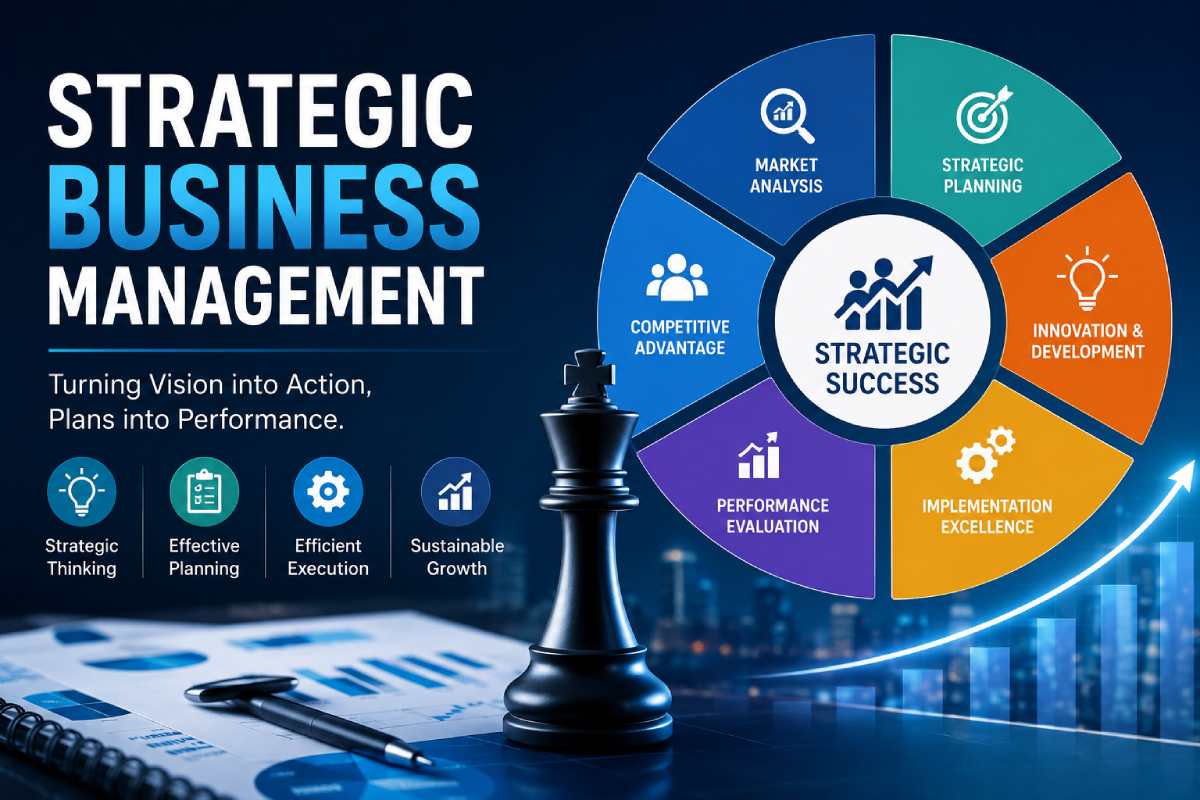
Strategic Business Management: A Complete Guide

In today’s extremely competitive environment, it is not sufficient that the company provides great products and services. It is required that it has proper vision, well-set goals and has a structured procedure to make the long-term vision come true. This is exactly where strategic business management comes into the picture.
Strategic business management (SBM) can be defined as an action of defining, constructing, implementing, analyzing, and continuously monitoring as well as adjusting business policies and plans in order to produce sustainable long-term value for all shareholders and the company as well. Unlike operational management, which covers just daily functioning of a business, it puts a lot of emphasis on business mission, strategic intent and its external position.
Regardless if your business is just starting, you’re a small business owner, or you’re a director of a multinational company, business strategy management will help your organization adapt to the business environment and continuously progress.
This Article is the part of Business Planning
What is Strategic Business Management?
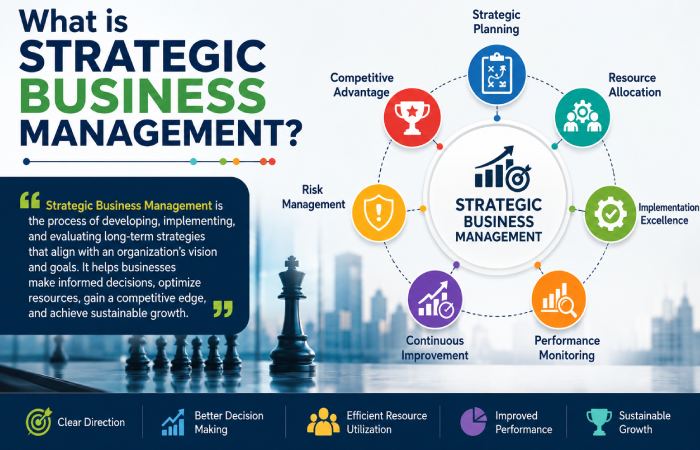
Strategic business management involves planning for, analysis of, implementation and evaluation of long-term business goals. It involves strategic business thinking, business leadership, financial management, business analysis, organizational management etc.
Businesses use strategic management to answer important questions such as:
- Where is the company today?
- Where should it be in the future?
- How will it achieve its goals?
- What resources are required?
- How will success be measured?
Businesses with effective strategic management approach to any change of markets in preparation rather than response.
Why Strategic Business Management Matters
In the same way that every great organization needs a strategy for maintaining its competitiveness, businesses of all kinds require a strategy in order to avoid indecision, mismanagement of resources, and misdirection of their objectives.
Key Benefits of Strategic Business Management
| Benefit | Description | Business Impact |
| Clear Direction | Establishes long-term vision | Better organizational focus |
| Improved Decision Making | Supports data-driven choices | Reduced business risks |
| Resource Optimization | Allocates people and budgets efficiently | Higher productivity |
| Competitive Advantage | Differentiates from competitors | Increased market share |
| Better Financial Performance | Matching Investments To Goals | Sustainable profitability |
| Adaptable | Acts Fast on market trends | Long-term business resilience |
Business Strategy Management
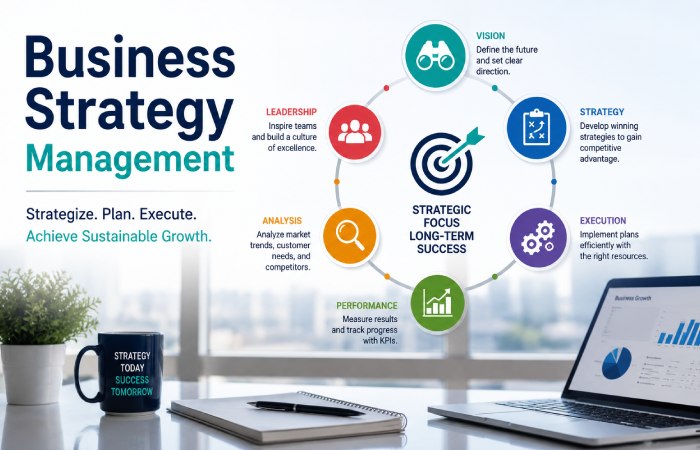
Business strategy management is the on-going, integrated planning, management, and evaluation of strategy by which the strategy is understood, adapted, improved and the desired goal of organizational mission is achieved, with a successful and ongoing attempt to achieve a strategic advantage over and above the competition. Strategic management also binds all functional areas within the company – in marketing, finance, operations, sales, human resource – into a common strategic perspective.
The process includes:
- Define
- Conducting market research
- Analyzing competitors
- Allocating resources
- Measuring performance
- Improving strategies continuously
Instead of isolated decision-making, strategy management creates organizational alignment.
Modern leadership also involves embracing technology to increase productivity and collaboration. Investing in the right business management software allows leaders to automate routine tasks, manage projects effectively, and make data-driven decisions.
The Strategic Planning Process
Through this, the organization follows a process plan for the goal and strategic objectives.
| Stage | Purpose | Key Activities |
| Vision & Mission | Define purpose | Create organizational vision |
| Environmental Analysis | IN | SWOT and market research |
| Goal Setting | Establish measurable objectives | SMART goals |
| Strategy Development | Design action plans | Resource allocation |
| In the | Execute strategic initiatives | Project |
| Warning | Measure results | KPIs and performance metrics |
| Continuous Improvement | Refine strategies | Feedback and adjustments |
Strategic Business Planning
Through strategic business planning the vision and aims for an organization are turned into working, practical goals.
A strong strategic business plan typically includes:
| Planning Component | Purpose |
| Executive Summary | Overall business direction |
| Mission Statement | Business purpose |
| Vision Statement | Future aspirations |
| Market Analysis | Industry opportunities |
| Competitive Analysis | Understand competitors |
| Financial Planning | Revenue and investment planning |
| Marketing Strategy | Customer acquisition |
| Operational Plan | Business execution |
| Performance Metrics | Measure success |
Strategic planning helps align everyone’s efforts toward shared company goals.
Business Growth Strategy
Business growth strategies need to boost revenue, widen market share, and increase customer satisfaction to be classified as successful while building on the company’s bottom line.
Common growth strategies include:
| Growth Strategy | Description | Example |
| Market Penetration | Sell more to existing customers | Loyalty programs |
| Market Development | Enter new markets | International expansion |
| Product Development | Launch new products | New product lines |
| Diversification | Expand into different industries | Technology company entering healthcare |
| Digital Transformation | Adopt digital technologies | AI-powered customer service |
| Strategic Partnerships | Collaborate with other businesses | Joint ventures |
There is more than one way and many routes for any company to grow – which road they take really depends on where they’re headed.
Competitive Business Strategy
Competitive strategy enables firms to be more profitable than rivals and better serve the customer value that their competitors are not.
Businesses generally compete using one or more of the following strategies.
| Strategy | Focus | Competitive Advantage |
| Cost Leadership | Lowest operating costs | Affordable pricing |
| Differentiation | Unique products or services | Premium value |
| Focus Strategy | Serve niche markets | Specialized expertise |
| Innovation Strategy | Continuous product improvement | Market leadership |
| Customer Experience | Superior service | Strong customer loyalty |
Companies often combine multiple competitive strategies to strengthen their market position.
Strategic Management Framework
A strategic management model is an organization which provides with an organized process of how to formulate, design and implement business strategies.
The framework ensures consistency throughout the organization
| Framework Stage | Objective |
| Strategic Analysis | Evaluate business environment |
| Strategy Formulation | Develop long-term plans |
| Strategy Implementation | Execute initiatives |
| Performance Evaluation | Monitor KPIs |
| Strategic Control | Adjust strategies based on outcomes |
This framework supports ongoing learning and improvement. As a result businesses become better equipped for evolving and fluctuating markets.
Essential Components of Strategic Business Management
Successful organizations typically focus on several interconnected components.
| Component | Importance |
| Leadership | Guides organizational direction |
| Corporate Vision | Inspires long-term goals |
| Organizational Culture | Encourages collaboration |
| Innovation | Drives future growth |
| Financial Management | Supports sustainable investment |
| Risk Management | Minimizes uncertainty |
| Customer Focus | Builds loyalty |
| Performance Measurement | Tracks strategic success |
Each component contributes to a comprehensive strategic management system.
Common Challenges in Strategic Business Management
Despite its benefits, implementing strategic management is not always straightforward.
| Challenge | Solution |
| Resistance to Change | Effective communication and training |
| Limited Resources | Prioritize high-impact initiatives |
| Poor Strategic Alignment | Improve cross-functional collaboration |
| Market Uncertainty | Regular environmental scanning |
| Weak Leadership | Develop leadership capabilities |
| Lack of Performance Metrics | Establish my |
Such proactive organizations are the ones, who will eventually remain at the forefront for quite some time to come.
Real-World Example of Strategic Business Management
Most successful global companies exhibit smart business strategy through relentless innovation and consistent strategic vision and long-range planning. Apple Inc has long set product strategy of integrating innovation, premium image, value proposition, customer-focused strategy and its business ecosystems in an integrated and consistent strategic framework. Instead of entering the markets by competing based on prices and products alone, Apple tries to create differences in branding and quality of their products and service to win market share.
The success of Apple can be largely attributed to their integration strategy and its strategy in providing value and excellent experience.
Similarly Amazon, by building on long-term investments in technology, logistic and cloud computing capabilities, and customer-oriented innovations, continues to compete successfully in entering into nascent market opportunities as well as defending their business bases. These successful examples are able to prove the effective contribution of strategy in innovation, efficient operations and building competitive advantage.
Measuring Strategic Success
Organizations should regularly evaluate the effectiveness of their strategic initiatives.
| Performance Indicator | Measurement |
| Revenue Growth | Annual sales increase |
| Profit Margin | Net profitability |
| Customer Satisfaction | Survey scores |
| Employee Engagement | Retention and feedback |
| Market Share | Industry comparison |
| Innovation Rate | New product launches |
| Operational Efficiency | Cost reduction |
| Return on Investment (ROI) | Investment performance |
Tracking these indicators helps leaders make informed strategic adjustments.
Future Trends in Strategic Business Management
The landscape of strategic business management is continually changing as technological advances and customer demands shift. Several major trends:
- Artificial intelligence for strategic decision-making.
- Predictive analytics and business intelligence.
- Sustainability and environmental responsibility.
- Digital transformation initiatives.
- Agile strategic planning.
- Remote and hybrid workforce management.
- Customer experience optimization.
- Increased focus on cybersecurity and risk management.
Organizations that embrace these trends will be better prepared for future market opportunities.
Conclusion
The success of a sustainable organization lies within effective business strategy management, effective strategic planning, and effective business strategy planning. This leads to consistent growth and long-term sustainable success as well as the ability to remain responsive to a constantly changing marketplace. A strategic business planning model allows you to be able to develop a strategy for your business that ensures responsible business growth and success in an increasingly competitive environment.
Implementing the appropriate strategic planning processes and models help your organization be more adaptable and competitive in its chosen market.