

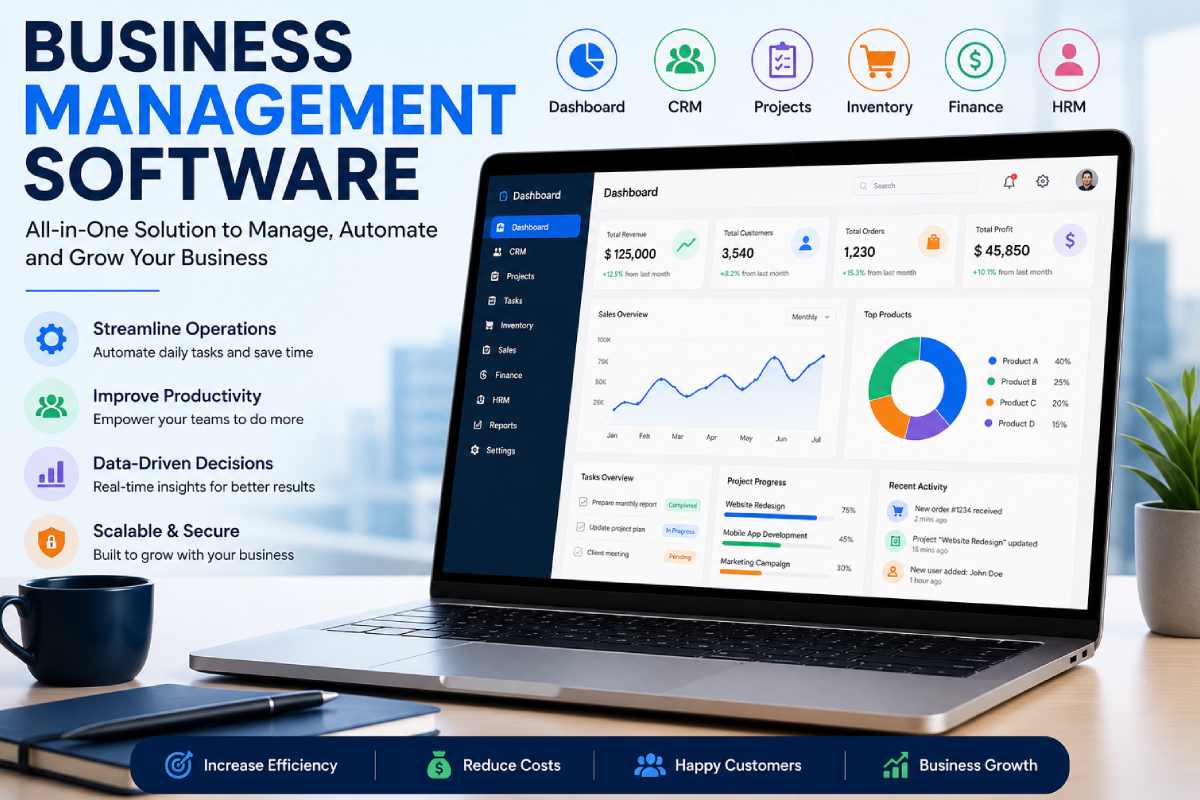
Business Management Software: A Complete Guide for Modern Businesses

In the competitive market of today, there is a need for organizations to invest in an appropriate solution to streamline business operations, maximize their efficiency, and generate more revenue. Business management software has become a necessity for businesses of all sizes and structures, offering a centralized platform to carry out a wide range of business activities ranging from customer service to managing your financial operations and keeping an eye on your projects, in addition to streamlining the performance of tasks repetitively, the Business Management solution will help in making everything happen smoothly.
Regardless of whether it’s about operating an e-business, small business, medium, large enterprises, making a decision on selecting the right Business Management software will help simplify the day-to-day activities in your company, also reducing the amount of work that is manually done. The modern businesses use Business Management tools, business management systems, Project Management software, ERP Software, CRM Software and automation business tools.
This Article is the part of Business Planning
What is Business Management Software?

Business management software refers to a package of digital applications intended to organize a business’s everyday actions through one integrated solution. In an effort to simplify their digital workflow, many businesses look towards business management software to bring all these different features, like accounting, human resources, project management, inventory tracking, CRM and even reporting together in one convenient location. This can help to keep information consistent, reduce the risk of duplicated effort and even supply insights as information updates happen in real-time.
Strong leadership skill is essential for guiding teams, making strategic decisions, and ensuring long-term success, especially when managing a growing company. Understanding the fundamentals of small business management can help entrepreneurs improve efficiency, strengthen operations, and build sustainable growth.
Why Businesses Need Management Software
Whether it is employee management, customer information, financial tracking, or deadlines, all organizations have challenges that, if not aided with software, will create a lot of time, frustration and errors.
Business management software offers several advantages:
- Improved productivity
- Better collaboration
- Centralized data management
- Faster reporting
- Enhanced customer service
- Workflow automation
- Better financial control
Businesses adopting efficient management systems have more operating efficiency and profitability.
Types of Business Management Software
| Software Type | Primary Purpose | Best For |
| Project Management Software | Task planning, scheduling, collaboration | Project-based businesses |
| ERP Software | Finance, inventory, HR, operations | Medium to large businesses |
| CRM Software | Customer relationship management | Sales and marketing teams |
| Accounting Software | Financial management | Businesses of all sizes |
| HR Management Software | Employee records and payroll | Growing organizations |
| Business Automation Tools | Automating repetitive tasks | Businesses seeking efficiency |
Key Features to Look For
When purchasing business management software, look for functions that assist with how you operate your business now and where you would like to be in the future.
| Feature | Benefits |
| Dashboard & Reporting | Real-time business insights |
| Cloud Access | Work from anywhere |
| Workflow Automation | Reduce manual tasks |
| Customer Database | Better customer management |
| Project Tracking | Monitor deadlines and progress |
| Financial Management | Budgeting and accounting |
| Team Collaboration | Improve communication |
| Mobile Accessibility | Manage business on the go |
| Third-Party Integrations | Connect existing applications |
| Security & Backup | Protect business data |
Business Management Tools That Improve Productivity
Daily routines in companies are supported by many types of business management software that allow you to work more productively in a team, effectively exchange information and carry out all sorts of tasks.
Popular categories include:
- Document management
- Team communication platforms
- Time tracking applications
- Inventory management systems
- Customer support software
- Financial reporting tools
By integrating applications with end-to-end business management solutions, organizations can simplify the entire workflow, minimize the bottlenecks and optimize the performance of their systems.
Understanding Business Management Systems
Business management systems enable you to manage the processes in an organization using a system in which all of them integrate. Instead of having independent software for different departments, business management systems bring together accounting, inventory, purchasing, sales, marketing, and human resources information. It results in consistent data as all departments use the same data, making it easier for decision-makers to know what is happening inside their organization. In addition, business management systems improve compliance and efficiency as well as strategic planning with real time data.
Project Management Software for Team Collaboration
Whether the project involves client work, the development of a new product, or a marketing endeavor, every growing business tackles them.
Project management software helps teams:
| Function | Business Benefit |
| Task Assignment | Clear responsibilities |
| Project Timeline | Meet deadlines |
| File Sharing | Centralized documentation |
| Progress Tracking | Monitor project status |
| Team Communication | Reduce misunderstandings |
| Resource Planning | Better workload distribution |
Companies who use project management software are more likely to finish projects more quickly, while simultaneously increasing the teamwork of employees in remote as well as office locations.
ERP Software: The Backbone of Enterprise Operations
ERP software (Enterprise Resource Planning) integrates multiple business functions into one unified platform.
Common ERP modules include:
| ERP Module | Purpose |
| Finance | Accounting and budgeting |
| Human Resource | Employee management |
| Procurement | Purchasing operations |
| Inventory | Stock management |
| Manufacturing | Production planning |
| Sales | Order processing |
| Reporting | Business intelligence |
ERP software reduces manual data entry, improves visibility across departments, and supports long-term business growth.
CRM Software for Better Customer Relationships
Business success relies heavily on customer satisfaction. With the use of CRM software, companies are able to manage all their customer information, as well as handle and organize the management of their prospects, sales opportunities and customer support.
Benefits include:
- Better lead management
- Faster sales processes
- Personalized customer interactions
- Marketing automation
- Customer support tracking
- Improved customer retention
Effective deployment of a CRM software can free your sales team up to nurture relationships and not deal with the day-to-day grunt of administrative tasks.
Business Automation Tools Save Time
Manual, repetetive task steal precious employees time. Use business automation tools to eliminate the need for the below automated workflows;
| Automated Process | Business Impact |
| Email Marketing | Faster customer communication |
| Invoice Generation | Reduced accounting workload |
| Employee Onboarding | Streamlined HR processes |
| Approval Workflows | Faster decision-making |
| Data Entry | Fewer manual errors |
| Report Generation | Instant business insights |
Employees can dedicate more time to tasks that bring value and improve your bottom line.
How to Choose the Right Business Management Software
Before selecting software, evaluate your organization’s specific requirements.
Consider these factors:
| Selection Criteria | Questions to Ask |
| Business Size | Will the software scale? |
| Budget | What is the total cost? |
| Ease of Use | Is training required? |
| Integration | Does it work with existing systems? |
| Cloud Support | Can employees access remotely? |
| Customer Support | Is technical assistance available? |
| Security | Are data protection measures strong? |
The decision of selecting the software based on the long term future business objectives than present need will save you a large investment in terms of replacement of software systems.
Conclusion
Business management software is a necessity in today’s competitive marketplace. In combining the management of your financials, customers, projects, and other automated processes in one convenient location, you have the potential to save costs, streamline operations and facilitate better business decision making. Whether the purchase of new business management tools, the installation of a fully implemented business management system, the deployment of new project management software, an ERP solution, CRM system or business automation tools the appropriate technology for your organization is critical for enhancing efficiency and sustained growth. As you consider the software options for your company, remember to focus on your current requirements, budget constraints, and future scalability.