


Small Business Management: A Complete Guide to Running and Growing a Successful Business

Introduction
Small business management means controlling the operational activities of a small business to ensure the long term prosperity and efficiency of the enterprise. You can run a shop, the internet store, a consultation business, or the small business company and your firm cannot be successful and profitable if you lack solid management of its operations. Managing the small business means more than simply offering the best of the product and solutions for sale; instead it is comprised of various business operations such as financing, customer interactions, sales, management of workforce as well as the efficient operation of a business.
Since many enterprises compete for more customers and attention these days, it should be in the interest of small company operators to seek out how they could increase their existing operations and also grow as per strategy for ensuring stable growth.
It discusses basic principles, proven approaches to management, operational improvements and the most important leadership aspects for building strong small businesses.
This Article is the part of Business Planning
What is Small Business Management?
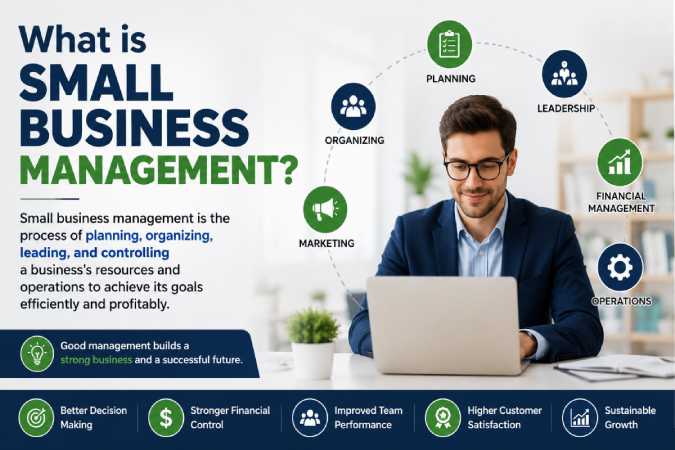
The process of managing every area of a business from finances to employees to operations to marketing to customer service to plans. Instead of a large corporation with specialized departments managing the different pieces of a company, most small businesses have an owner managing many hats simultaneously. This adds to the importance of organization, delegation, and smart decisions.
Core Areas of Small Business Management
| Management Area | Purpose | Business Impact |
| Financial Management | Manage income, expenditures, and the flow of cash | Improves profitability |
| Operations Management | Aids the completion of routine tasks | Increases efficiency |
| Marketing Management | Attracts and retains customers | Drives sales |
| Human Resource Management | Manages employees and hiring | Improves productivity |
| Customer Service | Builds loyalty | Encourages repeat business |
| Strategic Planning | Sets long-term goals | Supports sustainable growth |
Why Small Business Management Matters
A good management fosters stability and provides an opportunity for businesses to meet future demands. Poor management, however, can lead to financial crunch, lack of operational performance, and unsatisfied clients.
Benefits include:
- Better financial control
- Increased employee productivity
- Improved customer satisfaction
- Faster business growth
- Stronger competitive advantage
Managing a Small Business Effectively
Running a small business is all about navigating the day-to-day challenges without losing sight of the bigger picture. When problems hit, a great business owner doesn’t put out fires-they build repeatable processes, and constantly measure progress through KPIs.
Best Practices for Managing a Small Business
| Practice | Description | Benefit |
| Set Clear Goals | Define measurable business objectives | Better direction |
| Track Financial Performance | Review revenue and expenses regularly | Improved budgeting |
| Automate Routine Tasks | Use software for invoicing and scheduling | Saves time |
| Delegate Responsibilities | Empower employees | Increases efficiency |
| Monitor Customer Feedback | Improve products and services | Higher customer retention |
| Review Performance Monthly | Analyze business metrics | Continuous improvement |
Small Business Planning for Long-Term Success
Good small business plans can lead to the successful business of your dreams. It gives a road map including objectives, monetary forecasts, marketing approaches, clientele, and operation methods of a business. Planning assists businesses be equipped for abrupt shifts available in the market and in financial unknowns.
Essential Components of a Business Plan
| Component | Purpose |
| Executive Summary | Overview of the business |
| Business Objectives | Defines short- and long-term goals |
| Market Analysis | Understands competitors and customers |
| Marketing Strategy | Plans customer acquisition |
| Financial Forecast | Estimates revenue and expenses |
| Operations Plan | Explains daily business activities |
| Growth Strategy | Outlines expansion opportunities |
Organizations that continually renew their plans will respond to changing customer wants and business patterns more efficiently.
Improving Small Business Operations
Streamlining the internal operations of a small business can result in reduced operating costs, greater productivity, and improved reliability in delivering superior service to customers. Operational management involves areas like inventory, workflow, supplier, management, customer support and even technology adoption.
Ways to Improve Operations
| Operational Focus | Improvement Strategy | Result |
| Inventory | Monitor stock levels | Reduces waste |
| Workflow | Standardize processes | Faster operations |
| Technology | Use cloud-based software | Higher productivity |
| Customer Support | Respond quickly | Better satisfaction |
| Vendor Management | Build reliable partnerships | Stable supply chain |
| Performance Tracking | Measure KPIs | Better decision-making |
When operational costs get out of hand, even tiny gains in efficiency can result in enormous increases in profit.
Small Business Leadership
Empowering leadership builds workplace trust & boosts the morale of the people in small businesses. Leaders motivate, innovate and maintain transparency and accountability in the work environment.
Important leadership qualities include:
| Leadership Skill | Why It Matters |
| Communication | Prevents misunderstandings |
| Decision-Making | Solves business challenges quickly |
| Emotional Intelligence | Builds stronger teams |
| Adaptability | Responds to market changes |
| Accountability | Creates trust |
| Vision | Guides long-term growth |
A motivated employee who knows exactly what they need to do and feels appreciated by their leaders is productive.
Small Business Growth Strategies
Businesses doesn’t get going. If businesses wishes to broaden their activities they need to work on explicit small business growth strategies that aren’t merely increase earnings however without impacting the business in operation. To enhance it is necessary to balance it.
Effective Growth Strategies
| Strategy | Description | Expected Outcome |
| Expand Product Lines | Introduce complementary products | Higher sales |
| Digital Marketing | Improve online visibility | More customers |
| Customer Retention | Focus on repeat buyers | Stable revenue |
| Business Partnerships | Collaborate with other companies | Expanded reach |
| Employee Development | Train staff regularly | Better performance |
| Process Automation | Reduce manual work | Lower operating costs |
Sustainable business, in contrast to speedy growth, guarantees the financial good-being of companies.
Understanding Small Business Administration
Small business administration deals with arranging those administrative bits that enable a business to operate effectively.
Administrative responsibilities include:
- Financial recordkeeping
- Payroll management
- Compliance with regulations
- Employee documentation
- Contract management
- Business reporting
Modern business software has simplified many administrative processes making entrepreneur’s lives easier as these tedious processes have now been largely automated, thus freeing up entrepreneurs to grow their business.
Administrative Responsibilities
| Function | Importance |
| Accounting | Tracks financial health |
| Payroll | Pays employees accurately |
| Compliance | Meets legal requirements |
| Documentation | Maintains organized records |
| Tax Management | Reduces financial risk |
| Business Reporting | Supports strategic decisions |
Common Challenges in Small Business Management
Every Entrepreneur Faces Challenges Being aware of potential problems enables business owners to come up with ready-made fixes.
| Challenge | Possible Solution |
| Limited Budget | Prioritize high-impact investments |
| Cash Flow Problems | Monitor expenses and forecasting |
| Employee Retention | Create a positive work culture |
| Time Management | Delegate and automate tasks |
| Increasing Competition | Focus on customer experience |
| Technology Changes | Invest in digital tools |
Conclusion
Good management of small businesses entails having a strategy, good leadership, operational efficiency, financial order and good service for the customer. Small business owners who work strategically with their company can better cope with crises, take on the demands of the market, and achieve lasting growth. Working on good small business management through effective planning, leadership, growth, and good administration of the company will lead to strong and long-term businesses. Management isn’t a process, it’s a cycle, if you evaluate constantly and invests in people, companies grow.