


Market Research Fundamentals: A Complete Guide to Understanding Your Customers and Market

Introduction
Market research fundamentals every business should know. This research can assist businesses in meeting consumer needs, assessing business rivals, testing a product idea, assessing customer demand, making smarter decisions on solid data, not just instincts, to mention a few. Market research can reduce risk, raise satisfaction and improve customer offerings to market needs and expectations.
This process also empowers companies to make smarter, faster decisions by gathering and analysing actual market intelligence. With businesses being increasingly reliant on data to make educated guesses, marketers employ a variety of marketing research techniques to stay current with market trends and consumer behaviour. The principles and procedures for undertaking market research are provided here.
This Article is the part of Marketing Sales
What are Market Research Fundamentals?
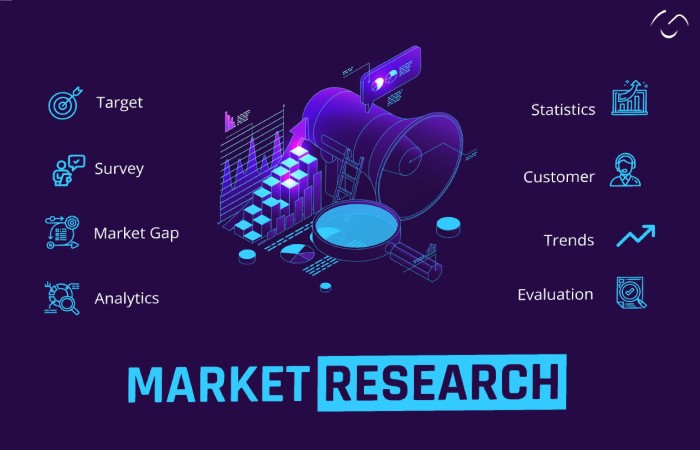
The basic of market research is to define the collecting, analyzing, and interpreting information for the market, consumer, competition and industry. The main purpose is to analyze consumer demands and opportunities of the market before making the business decisions.
The most efficient and best use of the customer research will merge together consumer research, behaviour analysis, consumer behaviour analysis and market analysis to answer such questions as:
- Who are the target customers?
- What problems do customers need solved?
- How large is the market opportunity?
- Who are the competitors?
- What factors influence purchasing decisions?
These findings help companies plan their marketing campaigns, improve products, make changes to price and also better the experience of the customer.
Why Market Research is Important
Reducing Risk in Business Market research helps minimize the unknown and guides businesses to make smart, factual decisions. Organizations rely on market data rather than guesses to develop strategies.
Some major benefits include:
- Understanding customer preferences
- Identifying market opportunities
- Reducing business risks
- Improving product development
- Creating effective marketing campaigns
- Increasing customer satisfaction
- Supporting business growth
When they invest in constant market research, the organizations have better preparedness in making adjustments to the current demands of consumers, as well as in adapting to future trends.
Types of Market Research Methods
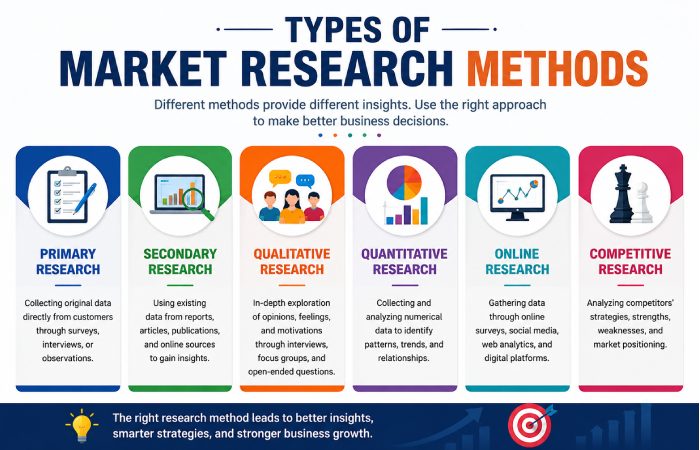
Various kinds of market analysis should be adopted depending upon varied business goals and types of market analysis required.
| Market Research Method | Description | Best Used For |
| Primary Research | Collecting original data directly from customers | Product testing, surveys |
| Secondary Research | Using existing reports and published data | Industry analysis |
| Qualitative Research | Focus groups, interviews, observations | Understanding opinions |
| Quantitative Research | Surveys, polls, statistical analysis | Measuring customer trends |
| Online Research | Digital analytics and online surveys | Website and digital marketing |
| Competitive Research | Studying competitors and their strategies | Market positioning |
Each method provides different perspectives that contribute to better decision-making.
Customer Research: Understanding Your Audience
Customer research refers to the activities undertaken to identify the preferences, expectations, motivation, and purchasing process of the potential customers. The more information a company gains on its customers, the better it will design products and advertising for it.
Common customer research techniques include:
| Customer Research Technique | Purpose |
| Customer Surveys | Measure satisfaction and preferences |
| Interviews | Gain detailed opinions |
| Focus Groups | Test new product ideas |
| Feedback Forms | Collect improvement suggestions |
| Social Media Monitoring | Understand customer conversations |
| Website Analytics | Track user behavior |
By enabling personalized experiences, customer research also improves customer retention rates and helps organizations cultivate deeper customer relationships.
Consumer Behavior Analysis
This type of analysis analyzes why customers make the decisions to buy products. Consumer analysis research can investigate psychological factors, sociological factors, and economical factors, as well as culture, and many other factors affecting how customers make buying decisions.
Businesses analyze consumer behavior to answer questions such as:
- Why do customers choose one brand over another?
- What motivates purchasing decisions?
- Which marketing messages generate the highest response?
- How do price changes affect buying habits?
Important factors influencing consumer behavior include:
| Factor | Impact on Buying Decisions |
| Personal Preferences | Brand loyalty and lifestyle |
| Income | Purchasing power |
| Culture | Values and traditions |
| Social Influence | Family, friends, online reviews |
| Emotions | Brand perception |
| Convenience | Ease of purchase |
Once a company understands these consumer behaviors it can enhance its products and the ways in which these products are promoted to market.
Marketing Research Techniques
Many different marketing research techniques are now employed by modern businesses to gain accurate and valid intelligence that will inform their decisions.
Some of the most widely used techniques include:
| Marketing Research Technique | Advantages |
| Online Surveys | Fast and cost-effective |
| Email Questionnaires | Easy customer outreach |
| Face-to-Face Interviews | In-depth responses |
| Focus Groups | Rich qualitative feedback |
| Observation Studies | Real customer behavior |
| A/B Testing | Measures marketing performance |
| Website Analytics | Tracks digital engagement |
Combining multiple research techniques often produces more accurate and comprehensive results.
Conducting an Effective Market Analysis
Market research is the detailed review of the whole commercial environment. It comes before getting into or making a business into a market.
A complete market analysis includes:
| Market Analysis Component | Purpose |
| Market Size | Estimate business potential |
| Market Growth | Identify future opportunities |
| Customer Segments | Define target audiences |
| Competitor Analysis | Understand competition |
| Industry Trends | Monitor market changes |
| Pricing Analysis | Evaluate pricing strategies |
| SWOT Analysis | Assess strengths and weaknesses |
Market analysis helps businesses identify profitable opportunities while minimizing potential risks.
Turning Data into Customer Insights
That doesn’t mean all you need is to gather as much data as you can, the real game is on in how to extract intelligence out of the gathered raw information. What are the things that a business needs to understand and know about the customers that will influence their strategies.
Customer insights help organizations:
- Develop customer-focused products
- Improve user experiences
- Personalize marketing campaigns
- Increase customer loyalty
- Predict future buying trends
- Improve customer service
This helps to unveil previously unseen trends and patterns by having analytics tools integrated with them.
Best Practices for Successful Market Research
To maximize research effectiveness, businesses should follow several best practices:
| Best Practice | Benefit |
| Define clear objectives | Keeps research focused |
| Use reliable data sources | Improves accuracy |
| Combine qualitative and quantitative research | Provides balanced insights |
| Update research regularly | Reflects changing markets |
| Analyze competitor activities | Supports strategic planning |
| Protect customer privacy | Builds trust and compliance |
Following these practices ensures research findings remain relevant and actionable.
Common Challenges in Market Research
Although market research is valuable, businesses may encounter several challenges.
| Challenge | Solution |
| Small sample sizes | Increase participant numbers |
| Biased survey questions | Use neutral wording |
| Outdated information | Regularly update research |
| Low response rates | Offer incentives |
| Data overload | Focus on key metrics |
| Budget limitations | Utilize affordable online research tools |
Recognizing these challenges early improves research quality and decision-making.
Conclusion
This means in order to operate the right businesses in the current competitive world, it is necessary to acquire market research basics. To this end, employing a robust strategy by adopting right methodologies of the market research, thorough analysis of the customers, analyzing the customers behavior, using the best known market research strategies can ensure smart business decisions which are supported by genuine data. Comprehensive market analysis allow businesses the opportunity to identify the available openings, limit exposure to the risks as well as maintain the edge over competitors.
Perhaps, it’s even more important to transform research results into actionable customer insights, that will help businesses the chance to design their products, their services as well as their promotion strategies to satisfy customer needs exactly.
Instead of a one-off undertaking, market research needs to be thought of like an operation which involves continuous process for refinement and innovation that guarantee business sustainability. Companies that invest more resources in research have a far greater capability of staying ahead of fluctuating markets and thrive on.