

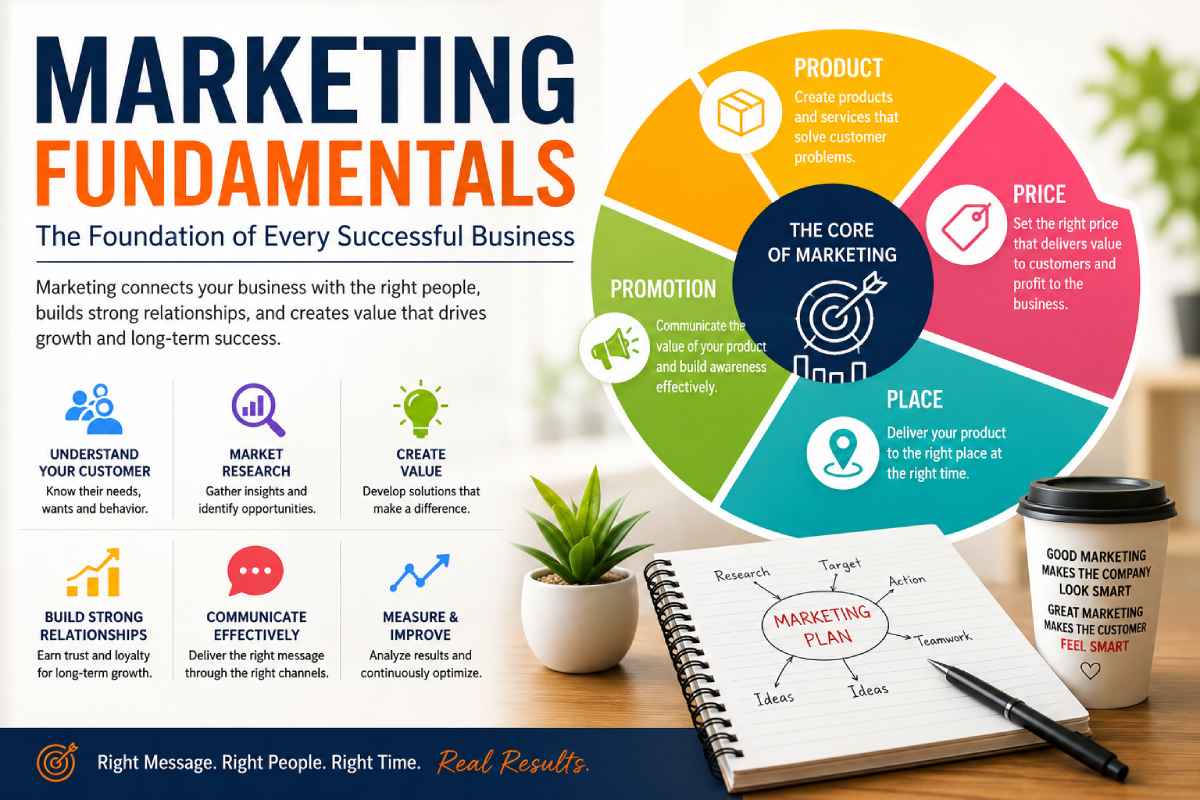
Marketing Fundamentals: The Complete Guide to Building a Strong Marketing Foundation

Introduction
At its very core, every business is fueled by marketing. Whether it’s an entrepreneur selling cupcakes or a massive global firm, a company can’t be successful without being able to attract customers, communicate its value, and make money – and all of this depends on marketing. If you’re an entrepreneur, business owner, manager, aspiring professional, or student looking to gain a real competitive advantage, a deep understanding of marketing principles is an absolute must.
In this fast-paced and cutthroat business world, marketing isn’t as simple as running an ad campaign or cutting prices on a particular product anymore; it is a complex interplay between understanding what consumers need, researching the market, and creating products, brands and customer experiences to ensure sustained business growth.
This guide will help you uncover the core elements of what it takes to get your company in front of the right people with the right message.
This Article is the part of Marketing Sales
What are Marketing Fundamentals?
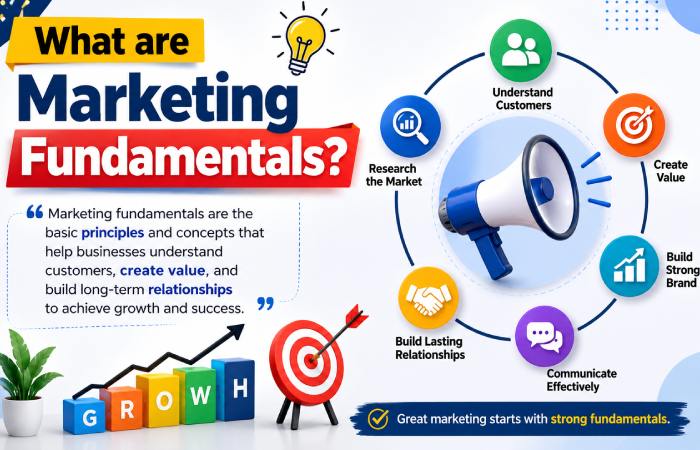
The term marketing fundamentals generally encompasses all of the basic principles, theories, and practical methods that companies and organizations utilize to recognize, define and satisfy the needs and wants of the customer and at the same time, to provide their customer with a product or a service which can deliver value and to get value in return from them.
Marketing is the essence for every single task that any business entity might perform in order to introduce and sell a new product, explore new territories and reach new customers, to retain and win the customers who can lead their business towards sustainable success. In plain terms, marketing, if stripped of all the complications and jargons, basically involves establishing a mutually beneficial relationship between an organization/business and the individual consumers which will allow customers get what they want and desire, while companies will make money out of that process.
Marketers consider “intro to marketing” to be more than selling a particular product in an effective way; it includes the entire research of your target audience and customers, making a plan for how to deliver the value to those customers and make profit at the end.
Key Objectives of Marketing
| Marketing Objective | Purpose |
| Customer Acquisition | Attract new customers |
| Brand Awareness | Increase visibility and recognition |
| Customer Retention | Encourage repeat purchases |
| Revenue Growth | Generate sales and profitability |
| Market Expansion | Reach new customer segments |
| Customer Satisfaction | Build loyalty and trust |
Marketing fundamentals help businesses achieve these objectives through strategic planning and execution.
The Evolution of Marketing
Studying the history of marketing helps one understand how marketing has evolved. In the old days, businesses were mainly interested in the production process. They assumed that customers buy any product which is made available and can be cheaply produced.
As the businesses grew and competition arises, these businesses started concentrating on the product as well as in increasing sales of the products. Businesses ultimately understood that success can only be obtained by focusing on the needs of the customer and adding value to the product, not just producing them efficiently.
Evolution of Marketing Approaches
| Era | Focus |
| Production Era | Manufacturing efficiency |
| Product Era | Product quality and innovation |
| Sales Era | Aggressive selling techniques |
| Marketing Era | Customer needs and satisfaction |
| Relationship Era | Customer loyalty and retention |
| Digital Era | Data-driven engagement and personalization |
Today’s marketing environment combines traditional principles with advanced technologies, creating opportunities for businesses to engage customers more effectively than ever before.
Marketing Basics Every Business Should Understand
They form the core for every marketing effort that a company makes to understand its customers, market opportunities, and competitive landscape. One of the foremost and essential marketing basics is the realization that customers do not purchase a product just because it is being offered for sale. Customers actually buy a product or service because it offers them a solution to an existing problem or fulfills a desire that they wish to have.
Another foundational element of marketing consists of the market research. Utilizing surveys, interviews, customer analysis, tracking website interactions, customer feedback etc., a company seeks information to assist in making informed marketing decisions. Marketing without data can be built on hypotheses, whereas using market research allows for educated and targeted efforts.
Moreover, understanding segmentation is one marketing basis which the business must pay attention to. All customers are not alike; they have varying needs, motivations and purchase behaviors. Effective marketing strategies recognize the differences amongst various customer segments.
Essential Marketing Basics
| Concept | Description |
| Customer Needs | Understanding problems and desires |
| Market Research | Collecting customer insights |
| Segmentation | Dividing customers into groups |
| Targeting | Selecting specific audiences |
| Positioning | Creating a unique market image |
| Value Proposition | Explaining customer benefits |
These basics serve as the starting point for developing successful marketing strategies.
Core Marketing Concepts
The following marketing concepts offer a theoretical background to contemporary marketing activity. Understanding these provides companies with a solid platform from which to pursue a customer focus. The First is Customer Value. This can be defined as the net benefits (outputs of goods/services and accompanying benefits) in relation to the costs of that product or service. A cost to the customer doesn’t just mean monetary cost.
Other types of cost are time cost, effort cost and risk cost, for instance. The job of many businesses is to provide as many benefits as possible to the customer at a reasonable cost. The Second is Customer Satisfaction. Customer satisfaction refers to the degree to which a products/services perceived performance matches to and in some cases exceeds that of the customer’s expectation of product performance. High satisfaction with a product leads to repeat buying behavior and word of mouth communication.
The Third concept of marketing practice. The Fourth is Customer Loyalty. When customers remain as a purchaser to a particular organization despite the availability of alternatives from competitors Loyalty means doing business together repeatedly.
Core Marketing Concepts Overview
| Concept | Importance |
| Customer Value | Encourages purchasing decisions |
| Satisfaction | Drives repeat business |
| Loyalty | Creates long-term revenue |
| Relationships | Strengthens customer retention |
| Exchange | Forms the basis of transactions |
| Trust | Builds brand credibility |
Organizations that consistently deliver value and maintain trust are more likely to achieve sustainable growth.
Marketing Principles That Drive Business Success
The greatest businesses use basic, established principles to run all their activities and make selections. These principles stand no matter the marketplace, the size of the enterprise, or the industry that the business operates in. At the most significant issue is client direction.
This indicates the needs of the consumer arrive initial in all the choices the organization takes. You shouldn’t assume about items or gain: feel about the needs of the buyers. This goes along with value development. You require to generate benefits that will matter to the buyer. Consistency.
Customers interact with a business in many distinct areas from a social media post to a commercial and a human email from a genuine person at the firm. Relationship creating: It’s no more economical to win over new purchasers to generate an account with you than it is to maintain on to present purchasers.
Building a Strong Marketing Foundation
Marketing activities are built upon a strong and successful business marketing strategy which is made up of planning, conducting, reporting and analysis. Researching your target market is a critical part of building the marketing base; researching helps businesses figure out what your customers want and like, what trends are evolving and emerging, what your competitor is doing and what are market opportunities that are arising. Companies that carry out research avoid having to make guess efforts.
The next element of this strategy process involves you taking your research data and planning exactly how marketing activities are to take place with clearly set targets, clear target consumer base, allocated budget and chosen channels of marketing.
Next is implementation which will involve rolling out a marketing plan, strategy, tactic or scheme. However, to achieve full marketing success, it requires management across all business sectors to work with a fully incorporated strategy. Finally The Final Component of the Marketing Foundation will be analysis. Measurement of the success of your marketing campaign(s) will ensure you determine how effective or ineffective.
Components of a Marketing Foundation
| Component | Purpose |
| Research | Understand market conditions |
| Planning | Define objectives and strategies |
| Execution | Implement campaigns |
| Measurement | Track performance |
| Optimization | Improve future results |
A strong foundation enables businesses to adapt to changing market conditions while maintaining strategic focus.
Understanding Market Segmentation
An integral aspect of present-day marketing is customer segmentation. As opposed to addressing all consumers as homogenous, it acknowledges diversity within target audiences by grouping those with distinct needs and priorities.
Such segmentation can occur according to various categories as specified herein: demographic (based on age, gender, income, level of education and profession), geographic (based on locale, climatic conditions, culture etc.), psychographic (based on lifestyle, value structure, attitudes, hobbies and personality characteristics) and behavioural (based on buying behavior, usage behaviour and loyalty towards brand). A relevant segmentation can assist businesses in modifying marketing efforts in an efficient manner.
Types of Market Segmentation
| Segmentation Type | Examples |
| Demographic | Age, gender, income |
| Geographic | Country, city, climate |
| Psychographic | Lifestyle, values |
| Behavioral | Buying habits, loyalty |
Organizations that effectively segment their markets often achieve higher conversion rates and stronger customer relationships.
The Marketing Framework: Understanding the 4 Ps
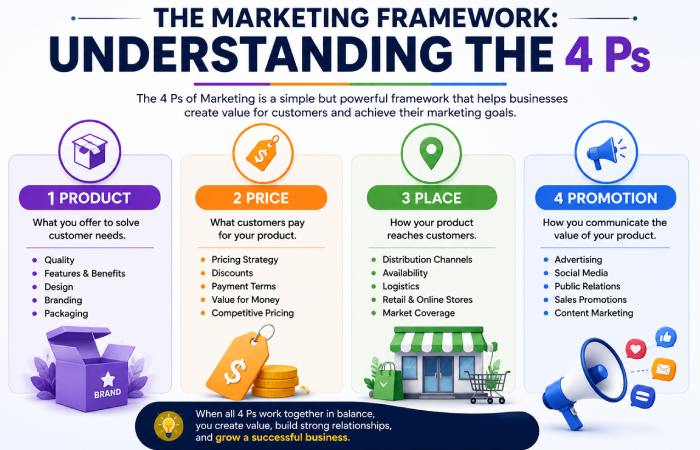
The most popular marketing framework ever is The Marketing Mix, or The 4 Ps of Marketing. These 4Ps are Product, Price, Place, and Promotion. Product – The product is the benefit that is offered to the customer. It can be used to satisfy need of people.
Businesses provide a product or service in exchange for something valuable from the customer in order to fulfil customer requirements. Price is what people pay for a product/ service to achieve the products/ service. Prices, if appropriately priced, influence 3 Cs (Customers, Company and Environment) along with cost. They have an impact on profit, customer behavior and competition.
The best marketing mix of a marketing 4Ps and of price should aim to keep pace with the marketplace or to be one jump ahead of them to take maximum possible profit from this aspect of market mix. The price should cater to what customer expects a profit and competitive strategy.
The 4 Ps Marketing Framework
| Element | Key Focus |
| Product | Customer solutions |
| Price | Value and profitability |
| Place | Distribution and accessibility |
| Promotion | Communication and awareness |
The 4 Ps remain a fundamental framework for developing effective marketing strategies.
Marketing Strategies for Beginners
Effective marketing plans for beginners don’t require hefty budgets or tons of experience. Rather, they’re about deeply understanding customers and making consistent progress. When marketing, beginners first determine their target customer.
Trying to communicate with the whole world results in muddled messages. Instead… Content marketing is among the most effective ways beginners can generate leads, rank in Google, and build credibility.
Social media marketing also presents a wonderful opportunity for new marketers. Businesses can build audiences on platforms like LinkedIn, Facebook, Instagram, and YouTube with little to no marketing investment. And while perhaps not the “hot” thing, email marketing is still among the highest-performing by-dollar marketing methods. Building a customer’s email list is the way to connect.
Branding: Creating a Memorable Business Identity
When it comes to a business, its most valuable asset is probably its brand. Although most people immediately think of branding when referring to a company’s logo and visuals, the truth of the matter is that the term ‘branding’ covers a much broader scope. The brand refers to the image of the company, its products/services, its principles and customer service.
Branding a company effectively aids the business stand out in any marketplace. Customers always look for brands they recognize, trust and admire. Customers build connections, either conscious or subconscious, with brands, and those connections determine their purchasing behaviour and also brand loyalty.
A strong brand is one that gives a clear guarantee of promise to its customers. Advertising, branding, packaging, as well as customer service, all impact the development of brand promise. It is why some of the best and biggest corporations invest a substantial portion of their resources in brand building-they all know it makes an impression on a client’s opinion and has long term positive effects on business profits.
Key Elements of Branding
| Branding Element | Purpose |
| Brand Name | Creates recognition |
| Logo | Visual identification |
| Brand Voice | Consistent communication |
| Brand Values | Build trust and authenticity |
| Customer Experience | Reinforce perceptions |
| Brand Promise | Communicate expectations |
Branding should be considered an investment in business for the future, not just an advertising expense for the present. Strong, consistent branding benefits our market position and our business objectives in the long-run.
Understanding Consumer Behavior
A core element of marketing relies on understanding the rationale behind customer purchases. Also referred to as customer buying behaviour, it delves into the psychology, social factors, cultural aspects and even financial reasons that play a role in consumer purchase decisions.
Each individual, from purchasing a cheap commodity to making a life-altering investment, goes through a structured buying decision process. Analysing such a process empowers marketers to construct meaningful marketing messages or even experiences to motivate buyers to transact with a business.
Influences include individual preferences, the customer’s family or kin, general social or cultural perspectives, overall income, lifestyle preferences, and past purchase behaviours and experience with particular products. Businesses leveraging these influences stand to develop stronger marketing strategies and customer satisfaction metrics.
The advent of technologies-primarily digital has changed behavior of the contemporary buyer. Buyers research much information, scan comments and opinions, shop around, analyze alternatives; they are likely to seek recommendations prior to the purchasing decisions; and so it would be very important for firms to convey relevant data during entire process.
Factors Influencing Consumer Behavior
| Factor | Impact on Purchasing Decisions |
| Psychological | Motivation, perception, beliefs |
| Social | Family, friends, communities |
| Cultural | Traditions and values |
| Economic | Income and purchasing power |
| Personal | Lifestyle and preferences |
Businesses that align their offerings with consumer motivations are more likely to achieve marketing success.
The Customer Journey and Marketing Success
The customer journey is one of the key elements in modern marketing. A customer journey describes the whole process a potential consumer or customer goes through, from the realization that they have an issue or a requirement to becoming a loyal advocate of a brand. Awareness is a customer journey stage when a consumer discovers the need or issue they may encounter and starts looking for a solution or answers.
The content creation, social media marketing, search engine optimization (SEO), etc. Play major role during this phase, when business can influence and help customers realize that they might face a problem.
Consideration is when a consumer evaluates his options by researching different products, services or business solutions available. At this point, customers are comparing your product/service with other available offers. Providing informative content, reviews, white papers, case studies are important at this stage so they understand the true value you offer. The decision stage is when customers are making their minds and finalize with the choice for a product or service.
To successfully navigate clients through this stage, a seamless buying experience and a strong value proposition are crucial in turning them into your loyal clients.
Post-purchase retention. Once you’ve converted your customer, you can still nurture that relationship. Focus on building loyalty, which often results in Repeat Purchasers, Brand Advocates, etc.
Customer Journey Stages
| Stage | Customer Activity |
| Awareness | Identifying needs |
| Consideration | Evaluating options |
| Decision | Making purchases |
| Retention | Continuing engagement |
| Loyalty | Repeat purchasing |
| Advocacy | Referring others |
Understanding the customer journey allows marketers to create relevant content and experiences at every stage.
Digital Marketing in Modern Business Management
Digital marketing is now crucial to the overall strategy of any organization. As more people have access to the internet, smartphones and social networking sites the way businesses and consumers relate to each other has altered significantly. As well as being cost effective, digitally marketing is targeted with precision.
There is ability to view the metrics which determine the success or otherwise of digital marketing, as such marketing teams have the ability to tweak and make necessary changes in real-time.
Digital marketing is comprised of a number of avenues, including website, social media, email marketing, paid advertising, and app store optimization for Mobile applications. One of the biggest benefits of digital marketing comes in the form of its ability to grow the organization and in particular enable small businesses to go up against larger competitors by using an effective online marketing strategy.
Major Digital Marketing Channels
| Channel | Primary Purpose |
| Website Marketing | Information and conversions |
| SEO | Organic visibility |
| Social Media | Engagement and awareness |
| Email Marketing | Relationship building |
| PPC Advertising | Immediate traffic generation |
| Content Marketing | Education and authority |
Businesses that effectively integrate these channels often achieve stronger marketing results.
Search Engine Optimization (SEO) Fundamentals
SEO is one of the most important part of digital marketing. The process of Search engine optimization, help to bring a business website to rank in a particular search engine with help to gain organic traffic for their websites. Customers are searching for something related to the most related product.
With the help of this search, customers is to gets the information by searching what he needed to search. Customers search for anything they need through searching engine website they shows you the 10 search result for the given query which comes from those websites which were rank top in the search engine results. This is the SEO what does on this. Every businessman knows search engine optimization.
There are various components of Search Engine Optimization (SEO which is one of them of the on page SEO and off-page SEO.
On-page optimization is mostly based on the quality of content, keywords, heading on the pages. Off-page optimization is basically concerned about authority of website building by the link and reputation. Technical optimization helps search to analyze the website and help the customer to find website on search engine through that.
SEO needs patience and consistent effort. It needs to be understood that SEO is not magic. It need persistent efforts, time to give better result in search engine as comp to paid advertisements.
Key SEO Components
| SEO Area | Focus |
| On-Page SEO | Content optimization |
| Technical SEO | Website performance |
| Off-Page SEO | Authority building |
| Local SEO | Geographic visibility |
| Mobile SEO | Mobile user experience |
Businesses that invest in SEO often benefit from increased visibility, credibility, and long-term traffic growth.
Content Marketing as a Long-Term Strategy
Content marketing is all about making awesome, useful content that gets you in front of the right people. Instead of being all up in everyone’s business and trying to push your wares down their throat, you help them out a little bit first. It also just helps to show that you’re good at what you do.
After all, if you demonstrate what your know-how is good for then folks will want some of it. Content can really do some pretty much anything including blogs, vids, articles, podcasts, case studies, info graphics and probably tons of other formats. Good content will answer customer’s questions and then answer all there following question by answer questions the follow-up questions by… well, you know. Content is really important in terms of doing Search Engine Optimization because you do want your web-site to show up for lots of cool Search Engine key-words.
Content Marketing Formats
| Format | Purpose |
| Blog Articles | Education and SEO |
| Videos | Demonstrations and engagement |
| Podcasts | Thought leadership |
| Infographics | Visual learning |
| Webinars | In-depth education |
| Case Studies | Building credibility |
A consistent content strategy can generate long-term marketing results and strengthen customer relationships.
Social Media Marketing and Customer Engagement
Marketing can’t live without social media. That’s the new reality. Whether it’s an e-commerce brand that’s trying to engage an audience for sales or a local B2C that’s looking to build a strong community, a social media presence and a social media marketing strategy is essential.
Social media marketing specifically offers some unique opportunities: The two-way conversation-social media, at its best, enables two-way conversation, two-way engagement between the company, the employees and the people who follow the business.
Platforms like YouTube and Instagram for B2C and LinkedIn for B2B (a more niche use, but effective) are key here, and have their own distinct audiences and strengths for getting messaging out to their communities. The ability to promote and engage in two-way conversations can improve customer relationships, brand reputation and can make people much more likely to buy from you.
Popular Social Media Platforms
| Platform | Best Use |
| Community building | |
| Visual storytelling | |
| Professional networking | |
| YouTube | Video marketing |
| X | Real-time engagement |
Social media can significantly amplify brand awareness and customer engagement when used strategically.
Email Marketing and Relationship Building
The most important and reliable channels of promotion: the advantages and pitfalls of email marketing If social media has become the standard of our modern world, it’s not really about email marketing. Indeed, through a well-written email, you can achieve excellent results in promotion and engagement of your target audience. Direct communication with customers cannot be replaced.
Email helps communicate the desired information to the customer individually. With email, you are sure that they will read and respond. The focus of email marketing is to give value, not promotional offers. The main mistake is filling the inbox with meaningless messages. The goal is to fill it with something useful. A brand that sends out educational, business information, special offers or personal recommendations using email gets a big plus in the face of clients.
Segmentation of the mailing lists works great Email marketing segmentation helps you send your customers messages that most of them are going to like. Personalized e-mails generate higher opening and click-through rates and, ultimately, better sales.
Types of Email Campaigns
| Campaign Type | Purpose |
| Welcome Emails | Introduce new subscribers |
| Newsletters | Share updates and insights |
| Promotional Emails | Drive sales |
| Educational Emails | Build authority |
| Re-engagement Emails | Reactivate inactive customers |
Email marketing remains one of the highest-return investments in digital marketing.
Marketing Analytics and Performance Measurement
Probably one of the biggest revolutions to marketing in recent years is the ability to precisely track the impact of marketing activities. It’s about how marketers know what works well, and where to do better. Instead of making wild guesses, marketing analytics enables a marketer to effectively assess the results of campaign. They look at how customer react to campaign activities and to measure return on investment (ROI).
Marketing analytics leads to better insights into decisions making, and enables us to continually optimize and enhance campaigns to be more effective. KPIs depends on marketing goals of your brand; Awareness metrics can include reach on social media or number of website visitors; while conversion related KPI would include the number of sales.
Essential Marketing Metrics
| Metric | Significance |
| Website Traffic | Audience reach |
| Conversion Rate | Effectiveness of campaigns |
| Cost Per Lead | Acquisition efficiency |
| Customer Acquisition Cost | Marketing profitability |
| Customer Lifetime Value | Long-term customer value |
| Return on Investment | Overall performance |
Regular analysis helps businesses allocate resources more effectively and maximize marketing results.
Conclusion
A business requires a deep knowledge and grasp of all marketing basics for continued success. This requires gaining an understanding and application of marketing basics, application of all marketing principles, and building upon a firm and comprehensive understanding of marketing basics. Businesses also have to provide customer value and offer relationship management in today’s fast-changing world.
In the current day, marketing mixes digital marketing to all the modern principles. Concepts of customer value, market segments, branding, SEO and social media marketing, along with analytics, continue to be a critical part of marketing.