


Entrepreneurial Skills: The Complete Guide to Entrepreneurship Skills and Successful Entrepreneur Traits

Introduction
Every type of business – from the small home-based business to the large online or global corporation and also including family operated business all of the business ventures rely on some key entrepreneurial skills for entrepreneurial development. The entrepreneurial skill is one that every entrepreneur must learn in the highly challenging and technological environment that dominates our global society. These entrepreneur traits are what separates the successful from the unsuccessful entrepreneurs from one venture or industry to the next and they help entrepreneur success to bloom in all kind of different forms.
Entrepreneurs are defined by several characteristics of which all must be continuously practiced. These entrepreneur competencies consist of such thing as effective communication skill, fiscal control, business management skill, leadership skill, innovative thinking skill and excellent strategic planning as well as the ability to anticipate problems before they happen so that they can create a problem solution that can ensure their business’s success.
Learn about essential entrepreneur skills, entrepreneurial competencies, entrepreneurial development skills, successful entrepreneurs, entrepreneurial and also some of the business skills that every entrepreneurial personality must need.
This Article is the part of Entrepreneurial
What are Entrepreneurial Skills?

Entrepreneurial skills are the various skill sets required to seize opportunity, build the structure and manage a business or an enterprise from idea, planning and organization of resources until the accomplishment of the ultimate business goal.
It means skills that the entrepreneur uses in decision making and coping with risk in his business to build a lasting company. In the context of the enterprise, entrepreneurial skills are those who identify the venture, innovation, leadership, independence and initiative compared with the job skills that basically focuses on tasks assigned for its execution.
Definition of Entrepreneurial Skills
| Skill Category | Purpose |
| Leadership Skills | Guide teams and organizations |
| Communication Skills | Build relationships and trust |
| Financial Skills | Manage budgets and profitability |
| Strategic Thinking | Create long-term business plans |
| Problem-Solving Skills | Address business challenges |
| Innovation Skills | Develop unique solutions |
| Networking Skills | Build valuable connections |
| Adaptability Skills | Respond to market changes |
Why Entrepreneurial Skills Matter
The environment for business is ever changing as a result of technology, globalisation, consumer changes and economic upheaval. As such, entrepreneurs who master these entrepreneurial business abilities can deal with such developments and be ready for any changes that the economy brings.
Entrepreneurial skills provide numerous benefits, including:
- Better decision-making
- Increased business growth
- Stronger leadership
- Improved financial management
- Enhanced customer relationships
- Greater innovation
- Increased resilience during challenges
To the other extent, they try to measure entrepreneurship among founders to gauge their competencies as to these traits directly define business success and survival.
Benefits of Entrepreneurial Skills
| Entrepreneurial Skill | Business Benefit |
| Leadership | Improved team performance |
| Communication | Better stakeholder relationships |
| Financial Management | Increased profitability |
| Innovation | Competitive advantage |
| Networking | More business opportunities |
| Strategic Thinking | Sustainable growth |
| Adaptability | Faster response to change |
Essential Entrepreneurial Skills Every Business Owner Needs
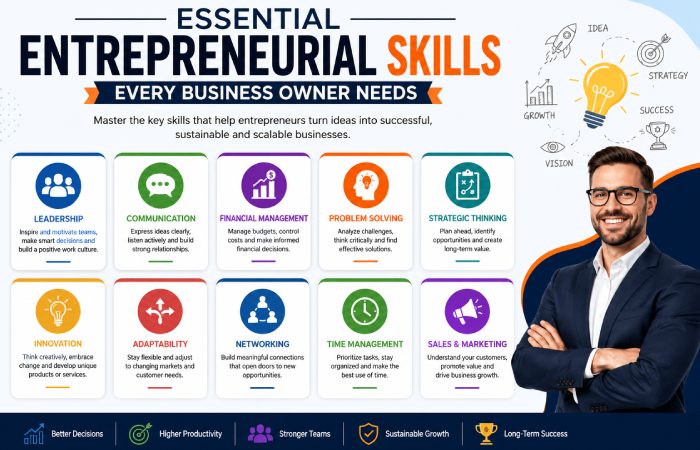
Leadership Skills
One of the more significant entrepreneurial traits entrepreneurs can master involves leadership. Entrepreneurship is all about guiding employees in a business and shaping that company to fit the entrepeneur’s overall vision. Strong, good leaders make positive and proactive working environments and the work environment leads the innovation process, group and personal responsibility among workers.
Effective entrepreneurial leadership involves:
- Vision setting
- Team management
- Conflict resolution
- Motivation
- Delegation
- Accountability
Good companies generally emulate their leaders. Entrepreneurs can do a fantastic job leading their employees and helping the business fulfill the goals they set while ensuring that their customers get all that they want and even a little bit more!
Leadership Traits of Successful Entrepreneurs
| Leadership Trait | Impact on Business |
| Vision | Creates strategic direction |
| Confidence | Inspires trust |
| Accountability | Improves performance |
| Integrity | Builds credibility |
| Empathy | Enhances workplace culture |
| Decisiveness | Accelerates progress |
Communication Skills
Perhaps you’re a solo entrepreneur working part time. Even at this scale you’re in regular communication. Communication ranks very high in terms of crucial entrepreneur skills as entrepreneurs interact with customers and clients, potential investors and donors, suppliers and vendors, employees and teammates, as well as other entrepreneurs and partners all the time.
Strong communication skills help entrepreneurs:
- Present ideas effectively
- Negotiate contracts
- Resolve conflicts
- Build customer trust
- Lead teams successfully
These communication methods can be through speaking or writing and in this current age of business, through online mediums such as emails, social media, video calls or an online presentation to name a few.
Communication, at the professional level, allows business minded individuals with superior abilities in the subject; to develop better connections, greater connections leading to higher chances for expansion of any business in progress.
Financial Management Skills
Financial savvy is one of the absolute key business skills any entrepreneur needs to cultivate. Entrepreneurs may have great ideas and superior products but without smart money management, they are still bound to failure.
Entrepreneurs must understand:
- Budgeting
- Cash flow management
- Profit margins
- Revenue forecasting
- Investment analysis
- Financial reporting
Entrepreneurs manage financial activities like resources allocation and utilization, waste elimination and strategic decisions.
Financial Skills Required by Entrepreneurs
| Financial Skill | Purpose |
| Budgeting | Control spending |
| Cash Flow Management | Maintain operations |
| Forecasting | Plan future growth |
| Cost Analysis | Improve profitability |
| Investment Planning | Support expansion |
| Risk Assessment | Reduce losses |
Problem-Solving Skills
Whether you are a new or existing enterprise, problems will occur: inefficiencies in operations, complaints from customers, competition from competitors, and recessions. So, is there a better way of overcoming business problems?
Problem solving skills is certainly one of the best entrepreneurship development skills there is out there, simply because it’s a fundamental tool that entrepreneurs can employ while facing any business problems to get to a solution.
Entrepreneurs with strong problem-solving abilities can:
- Improve efficiency
- Reduce costs
- Enhance customer satisfaction
- Increase productivity
- Manage crises effectively
The true entrepreneur sees failure as an opportunity to create and make things better.
Strategic Thinking Skills
Strategic thinking enables entrepreneurs to evaluate long-term opportunities and risks.
While focusing on what a business does day to day, strategic entrepreneur focuses on:
- Market trends
- Industry developments
- Competitive positioning
- Customer needs
- Future growth opportunities
A entrepreneur can develop strategic plan to have synergy between the resources of the firm with firm’s objectives. This helps to manage an organization in such a sustainable growth.
Strategic Thinking Components
| Component | Purpose |
| Vision Development | Define future goals |
| Market Analysis | Understand competition |
| Goal Setting | Establish priorities |
| Resource Planning | Optimize investments |
| Risk Management | Minimize uncertainty |
| Performance Measurement | Track success |
Creativity and Innovation
Innovation is often the driving force behind entrepreneurship.
Creative entrepreneurs develop:
- New products
- Improved services
- Better business models
- Unique customer experiences
Innovation gives a company the ability to stand out against its competition as well as provide solutions for evolving market desires. To see the type of companies that have grown into global giants, look at entrepreneurs who simply set out to redefine how the market worked
Innovation Benefits
| Innovation Activity | Business Outcome |
| Product Development | Increased sales |
| Service Improvement | Better customer retention |
| Automation | Reduced costs |
| Digital Transformation | Greater efficiency |
| Process Optimization | Improved productivity |
Networking Skills
Networking is a core Entrepreneurship skill. It can create many opportunities; such as establishing joint venture partners, seeking investor for fundraising, recruiting mentorship and advisors as well as generating clients for businesses.
Successful entrepreneurs build relationships with:
- Investors
- Customers
- Industry experts
- Suppliers
- Mentors
- Business partners
Networking can help entrepreneurs tap into resources and make business grows stronger, because strong networks can bring to you opportunities and insights. Networking avenues may range from industry conventions and trade shows to associations and websites like Linkedin.
Adaptability and Flexibility
Business is a fast paced world and businesses must try and keep pace with the developments occurring in the world today. This can occur through developments in technology, the changes made by the public as well as new laws and regulations and the prevailing economic conditions.
Adaptability enables entrepreneurs to:
- Pivot strategies
- Adopt new technologies
- Respond to competition
- Manage uncertainty
Businesses that remain flexible are more likely to survive disruptions and capitalize on emerging opportunities.
Examples of Entrepreneurial Adaptability
| Situation | Entrepreneurial Response |
| Market Decline | Develop new revenue streams |
| Technology Changes | Adopt digital tools |
| Customer Feedback | Improve products |
| Economic Challenges | Reduce costs |
| New Competition | Differentiate offerings |
Time Management Skills
There are a lot of things an entrepreneur is required to do at the same time and managing this efficiently can boost their productivity and manage stress level.
Important time management practices include:
- Prioritization
- Scheduling
- Delegation
- Goal setting
- Task management
Those who are entrepreneurs and manage time better can invest their energy on activities of more value that would result to growth for the business.
Time Management Techniques
| Technique | Benefit |
| Time Blocking | Improves focus |
| Daily Planning | Increases productivity |
| Delegation | Saves time |
| Automation | Reduces repetitive tasks |
| Goal Tracking | Maintains accountability |
Sales and Marketing Skills
Businesses do not survive without customers so sales and marketing techniques should be one of the most critical entrepreneurial skills a business person must have.
Entrepreneurs should understand:
- Customer behavior
- Branding
- Lead generation
- Digital marketing
- Sales processes
- Customer retention
Having excellent selling skills assist the entrepreneurs in establishing a strong connection with customers by explaining them benefits and value. Also it plays an important role in convincing and turning them into the loyal followers. Being a good Marketer in business you will get the opportunities in creating the business visible through the target audiences.
Entrepreneurial Competencies for Long-Term Success
Entrepreneurial Competencies the specific skills related to entrepreneurial performance are measured by entrepreneurial competencies. They integrate and apply both behaviors and knowledge.
Core Entrepreneurial Competencies
| Competency | Description |
| Opportunity Recognition | Identifying market gaps |
| Decision Making | Choosing effective solutions |
| Risk Management | Evaluating uncertainty |
| Leadership | Guiding teams |
| Innovation | Creating value |
| Customer Focus | Meeting customer needs |
| Financial Literacy | Managing resources |
| Strategic Thinking | Planning growth |
Having well-defined entrepreneurial skills gives a businessperson an advantage in the battle of success especially in a difficult terrain.
Entrepreneurial Development Skills
These Entrepreneurial development skills can be described as competencies that enhance their journey as an entrepreneurial professional.
These include:
- Learning agility
- Self-awareness
- Continuous improvement
- Critical thinking
- Emotional intelligence
- Personal discipline
Entrepreneurs who invest in lifelong learning often achieve higher levels of business performance.
Entrepreneurial Development Areas
| Development Area | Benefit |
| Leadership Training | Better team management |
| Financial Education | Improved decision-making |
| Marketing Knowledge | Increased customer acquisition |
| Technology Skills | Enhanced efficiency |
| Emotional Intelligence | Stronger relationships |
| Strategic Planning | Sustainable growth |
Successful Entrepreneur Traits
Successful business leaders don’t just build businesses, they also have personal qualities that allow them to surmount business obstacles. These personal leadership traits may seem very intuitive to most leaders, but a new business person needs to be aware of these 11 traits and characteristics to help the entrepreneur excel. Entrepreneurship traits allow entrepreneurs to effectively utilize the lessons learned about entrepreneurship.
By studying successful leader traits, a budding business person may be able to focus on his or her own personal strengths and weaknesses.
Resilience
Success trait: Resilience The #1 defining trait of a successful entrepreneur is Resilience. You cannot avoid bumps, turns, or failures as you navigate entrepreneurship. It will be something all entrepreneurs come across at some point or another on there entrepreneurs journey.
Business owners may face:
- Financial difficulties
- Market downturns
- Product failures
- Customer complaints
- Competitive pressures
- Economic uncertainty
Resilient entrepreneurs will not be held back by failure – they learn from it, adapt their business model and get back on the horse. Think about how many of the well-known companies out there had several failures prior to even generating revenue, because resilient people push through those challenges.
Benefits of Entrepreneurial Resilience
| Resilience Factor | Business Benefit |
| Persistence | Sustained progress |
| Recovery Ability | Faster adaptation |
| Positive Mindset | Improved decision-making |
| Stress Management | Better leadership |
| Learning Orientation | Continuous improvement |
Confidence
Building Entrepreneurial Success Confidence Self-belief- Another factor which will guide an individual toward the road of an entrepreneurial success is confidence. Many entrepreneurs operate under uncertain circumstances. The entrepreneurs should believe in them while proposing various products to investors, deciding new ventures, arranging discussions with clients and guiding employees.
Confident entrepreneurs are more likely to:
- Pursue opportunities
- Take calculated risks
- Lead effectively
- Build partnerships
- Communicate persuasively
Confidence helps entrepreneurs maintain credibility with employees, customers, and stakeholders.
Persistence
Entrepreneurs’ drive for achievement is not always accompanied by instant, massive returns, a trait that can determine whether a business grows or dwindles in its early phases. It often takes several years for an entrepreneur to nurture a business until it gains traction with consumers, creates adequate returns, and runs efficiently-a testament to persistence and grit, characteristics typically required for a business’s ultimate success.
Persistence allows entrepreneurs to:
- Stay committed to goals
- Overcome temporary setbacks
- Maintain focus during challenges
- Continue learning and improving
A lot of entrepreneurs are not willing to say it aloud but many of them owe their achievements not to high talents but only to steady and lasting hard work.
Persistence in Entrepreneurship
| Challenge | Persistent Entrepreneur Response |
| Product Failure | Improve and relaunch |
| Customer Loss | Refine strategy |
| Funding Rejection | Seek alternative sources |
| Market Changes | Adapt business model |
| Competition | Differentiate offerings |
Curiosity
Curiosity drives innovation and continuous learning.
Entrepreneurs who remain curious constantly ask questions such as:
- What problems need solving?
- How can processes improve?
- What opportunities exist?
- What do customers want?
- What technologies are emerging?
Curiosities entrepreneurs will monitor market changes and industry growth. They crave a strong learning drive will result in new products and services, and even business designs. Help Entrepreneurs to Develop New Skills Entrepreneurship Curiosity also builds entrepreneurial ability through a lifelong curiosity of learning.
Self-Motivation
Entrepreneurs can spend a lot of time alone and encounter situations where little encouragement is received from outside forces.
Self-motivation can keep entrepreneurs driving when things aren’t going well.
Motivated entrepreneurs:
- Set ambitious goals
- Take initiative
- Remain productive
- Pursue opportunities
- Focus on long-term success
Without drive, many entrepreneurs would find it nearly impossible to achieve true success or even a steady rhythm.
Vision
Vision is one of the most apparent qualities of a good entrepreneur. These entrepreneurs can easily envision possibilities that others fail to recognize. They see the opportunity even before others can sense its presence and devise plans that set their companies up for long-term success.
A strong vision provides direction and purpose. It helps entrepreneurs:
- Set goals
- Inspire teams
- Attract investors
- Guide decision-making
- Build sustainable businesses
Emotional Intelligence
Knowing your emotions will help you better communicate, manage others and be the most popular person on earth.
Traits of Successful Entrepreneurs
| Trait | Business Value |
| Resilience | Overcomes setbacks |
| Confidence | Supports decision-making |
| Persistence | Maintains progress |
| Curiosity | Encourages innovation |
| Self-Motivation | Drives productivity |
| Emotional Intelligence | Improves leadership |
Digital Entrepreneur Skills for Modern Businesses
Technology has transformed entrepreneurship.
Modern entrepreneurs should develop digital capabilities such as:
- Search Engine Optimization (SEO)
- Social Media Marketing
- Data Analytics
- Artificial Intelligence Applications
- Customer Relationship Management (CRM)
- E-commerce Management
Digital Skills for Entrepreneurs
| Digital Skill | Business Application |
| SEO | Improve website visibility |
| Social Media Marketing | Reach customers |
| Analytics | Support decision-making |
| CRM Systems | Manage customer relationships |
| AI Tools | Automate operations |
| E-commerce Platforms | Increase online sales |
Entrepreneurs that know online skills will assist business thrive on internet based services and products.
How to Develop Entrepreneurial Skills
Entrepreneurial ability does not stand still. Entrepreneurship abilities are trained; this happens through experience, education, mentoring and ongoing education.
Education
Business courses have all the financial expertise as well as sales, supervision and business development knowledge.
Practical Experience
Project, freelance work, internship and startups provides you with hands-on experience.
Mentorship
Mentors do share knowledge and give advice on their hands on expertise.
Networking
Entrepreneurs benefit greatly by learning from other professional network.
Continuous Learning
For entrepreneurs, getting updated is a challenge, and through reading books, attending seminars and conferences, subscribing to podcasts or going through to industry events, entrepreneurs try and gain this vital information.
Methods for Building Entrepreneurial Skills
| Method | Outcome |
| Business Education | Knowledge development |
| Mentorship | Practical guidance |
| Networking | Expanded opportunities |
| Experience | Real-world learning |
| Workshops | Skill enhancement |
| Industry Research | Market awareness |
Common Challenges Entrepreneurs Face
Entrepreneurs encounter numerous obstacles while building businesses.
Common challenges include:
- Limited capital
- Competition
- Market uncertainty
- Time constraints
- Talent acquisition
- Technological changes
Entrepreneurial skills can give individuals the power to avoid this to some extent.
Challenges and Solutions
| Challenge | Solution |
| Limited Funding | Financial planning |
| Competition | Innovation |
| Customer Acquisition | Marketing strategies |
| Time Management | Delegation |
| Economic Changes | Adaptability |
| Talent Retention | Leadership development |
Future of Entrepreneurial Skills
In future business environment, uniquely human traits will be highly valued which support technology.
Key future-focused entrepreneurial skills include:
- AI literacy
- Digital transformation leadership
- Strategic innovation
- Data-driven decision-making
- Sustainability planning
- Global collaboration
Ultimately, entrepreneurs best placed to succeed will be those who learn to navigate the current business landscape using technological savvy, a trait honed through their conventional understanding.
Future Entrepreneurial Skills
| Future Skill | Importance |
| AI Integration | Increased efficiency |
| Data Analytics | Better decisions |
| Sustainability Leadership | Long-term growth |
| Innovation Management | Competitive advantage |
| Global Networking | Market expansion |
| Digital Strategy | Business scalability |
Conclusion
Entrepreneurs with a strong sense of entrepreneurial skill sets can readily turn a business concept into a profit generating entity. These are entrepreneurial skills such as leadership and communication abilities; sound financial management skills; creative problem solving; an awareness of market and customer needs; strategic awareness and an open mind that makes one amenable to changes and new ideas.
The highly accomplished entrepreneur constantly work to nurture his/her entrepreneurship skill, entrepreneurial competency and developing a persona that includes characteristics such as tenacity, self-confidence, persistence and emotionally intelligent as Entrepreneur traits.
The Entrepreneurs in present economic climate need a blend of skills to get there, a bit of classical business for entrepreneurial persons with a bit of current technology skills. The entrepreneur will invest in entrepreneurship development for entrepreneurial skill development for sustained growth and creation of economic value.