


High-Balance & Large-Transaction Guides: Rules for Keeping and Transferring Large Amounts in India

Keeping a substantial amount in a bank account can raise important questions: Can I keep 10 lakh in savings account? Can I keep 50 lakh in savings account? What are the large bank transfer rules in India? And is it better to keep a large amount in a savings account or a fixed deposit?
The good news is that there is generally no universal RBI ceiling on the balance you can maintain in a regular savings account. However, large deposits and transactions can attract reporting, KYC and tax scrutiny depending on their nature and source. Understanding these rules can help you manage a large amount in savings account more confidently.
Important: A high balance itself is not automatically taxable. The source of the money and the income/transaction behind it are what matter.
This Article is the part of Savings Accounts
Can I Keep ₹10 Lakh in a Savings Account?

Yes you can usually maintain 10 lakh in a savings account. There is no rule that says that you can’t maintain the balance of 10 lakh and this balance will automatically attract tax.
Now, an account balance differs from cash deposit. As per the present reporting laws of Income Tax Department, all cash deposits of 10 lakh and above in a financial year in one or more accounts, not being current accounts and time deposits are being reported by banks as Statement of Financial Transactions (SFT).
It doesn’t imply that when you deposit 10 lakh, it is immediately a taxable event for you. But, this can be shown to the Income Tax people.
Can I Keep ₹50 Lakh in a Savings Account?
Again, yes you can have 50 lakhs in a savings account as long as it is genuine money and you can explain the sources of funds if the need arises.
For example, the money could come from:
- Sale of an asset
- Salary or business income
- Investment redemption
- Inheritance
- Gift, where applicable
- Previous savings
- Bank-to-bank transfer
- Maturity of an investment
The key issue is maintaining documentation that establishes the source of funds.
| Savings Account Situation | Is It Generally Allowed? | Important Point |
| ₹10 lakh balance | Yes | Balance itself isn’t automatically taxable |
| ₹50 lakh balance | Yes | Keep proof of source of funds |
| ₹10 lakh+ cash deposits in a year | Possible, but reportable | Bank SFT reporting may apply |
| Large electronic transfer | Generally possible | Bank-specific limits/KYC checks may apply |
| Large unexplained deposit | Risky | Source may need to be explained |
Large Amount in Savings Account: What Should You Know?
A large amount in savings account is not necessarily a problem. But banks have obligations to monitor unusual or unusually large transactions under their KYC/anti-money-laundering framework. RBI guidance specifically requires banks to pay attention to transactions that are unusually large or inconsistent with a customer’s normal account activity.
Therefore, someone who normally receives ₹50,000 per month but suddenly receives ₹40 lakh may receive questions from the bank.
This is why keeping documents such as sale agreements, investment statements, loan documents, inheritance records or income-tax records can be useful.
Cash Deposits vs Electronic Transfers
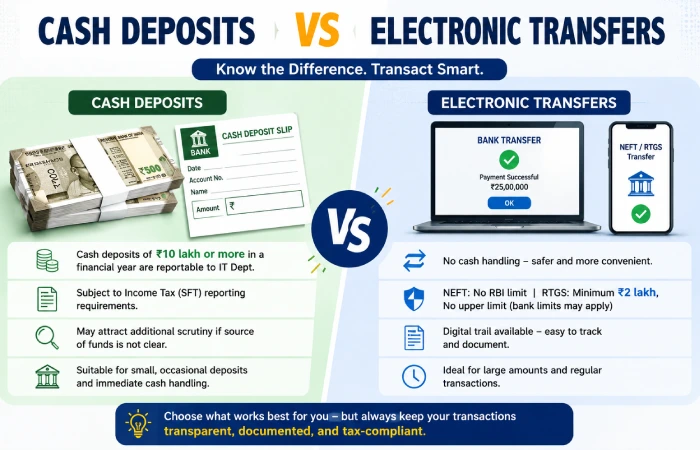
One of the most important points is that cash and electronic transfers are not treated identically for reporting purposes.
| Transaction | Relevant Threshold/Rule | What It Means |
| Cash deposits in savings/other non-current accounts | ₹10 lakh+ in a financial year | Reportable under SFT |
| Cash deposits/withdrawals in current accounts | ₹50 lakh+ in a financial year | Reportable under SFT |
| RTGS transfer | Minimum ₹2 lakh; no RBI maximum ceiling | Bank may have its own limits |
| NEFT | No RBI-imposed amount limit | Bank may impose its own limits |
The Income Tax Department currently lists ₹10 lakh or more in aggregate cash deposits in one or more non-current/non-time-deposit accounts as an SFT-reportable transaction.
Large Bank Transfer Rules in India
For large electronic transactions, it is important to understand the applicable banking rules and transaction limits before transferring money. The Reserve Bank of India (RBI) provides official guidance on NEFT and RTGS transactions, including applicable limits and requirements. RBI – NEFT and RTGS FAQs.
The minimum value of the transaction is R 2 Lakh and there is no prescribed upper limit for a RTGS transaction. However, banks can impose their own limits at a client level and establish their own security limits.
For a large transfer, make sure:
- Your KYC details are updated.
- The beneficiary’s account details are correct.
- You have documents supporting the source and purpose of funds.
- You use appropriate banking channels rather than unnecessary cash transactions.
- You retain transaction receipts and bank statements.
RBI has also introduced beneficiary account-name lookup facilities for NEFT and RTGS to help customers verify the beneficiary before transferring money.
Savings Account vs Fixed Deposit
If you have ₹10 lakh, ₹25 lakh or ₹50 lakh that you do not need immediately, comparing a savings account with a fixed deposit can make sense.
| Feature | Savings Account | Fixed Deposit |
| Liquidity | Very high | Lower than savings |
| Interest | Usually lower | Generally higher |
| Suitable for | Emergency/regular funds | Longer-term surplus |
| Withdrawal | Easy | Premature withdrawal may have conditions |
| Interest calculation | Based on bank’s savings rules | Based on FD rate/tenure |
| Tax treatment | Interest generally taxable | Interest generally taxable |
A practical approach can be to keep your emergency fund and short-term expenses in savings, while considering an FD for money that you do not need immediately.
Is Keeping ₹50 Lakh in Savings Account a Good Idea?
Although keeping ₹50 lakh in savings may be legally possible, it may not always be financially efficient.
If the money is sitting idle, you may earn less interest than you could potentially earn through appropriate deposits or investments. On the other hand, putting everything into an FD can reduce liquidity.
A balanced strategy could involve:
- Keeping emergency funds in savings.
- Keeping near-term requirements readily accessible.
- Using FDs for money with a defined time horizon.
- Considering diversified investments for long-term goals, depending on risk tolerance.
- Maintaining proper documentation for large transactions.
Final Takeaway
The answer to “Can I keep 10 lakh in savings account?” and “Can I keep 50 lakh in savings account?” is generally yes. There is no general rule that automatically prohibits these balances in a regular savings account.
The bigger concern is how the money entered the account and whether the source can be explained. Cash deposits of ₹10 lakh or more in a financial year in qualifying non-current accounts are reportable under SFT rules, while large electronic transfers can be made through NEFT or RTGS subject to bank-specific controls.