


Beginner Stock Market & Investing Education

Getting started with investing can be somewhat confusing with all these phrases buzzing around-NSE, BSE, demat account, trading account, shares and market index. The upside is that you can learn how to invest in stock market in India for beginners if you master the simple fundamentals first.
This guide covers everything a beginner needs to know about the stock market. It will introduce you to the Indian market and outline the procedures of investing in shares, along with explanations on demat and trading accounts.
This Article is the part of Stock Market
What is the Stock Market?

A stock market is an exchange where stocks-shares in publicly traded companies-can be bought and sold. If you buy a stock, you hold a tiny share of ownership in that company.
The company can raise funds for example issuing shares. Stock investment may provide with the opportunity to profit through capital gains and in some cases dividends. On the stock prices can change. There is always a risk involved in it.
Stock Market Basics for Beginners
| Term | Simple Meaning |
| Share | A small ownership portion of a company |
| Stock Exchange | Marketplace where securities are traded |
| Index | A group of stocks used to track market performance |
| Dividend | Part of a company’s profit distributed to shareholders |
| Portfolio | Collection of investments owned by an investor |
How Indian Stock Market Works
The first thing you need to do is learn about the way Indian stock markets function. In India, there are two main stock exchanges – the National Stock Exchange (NSE) and BSE Ltd. (BSE).
Usually an investor would give buy or sell order to the broker. Once, investor gives an order the broker platform then communicates this with the exchange. Once, order is matched, then the entire trade is carried out by the market clearing and settlement systems.
Stock prices can change because of company performance, economic conditions, interest rates, investor sentiment, news, and supply and demand.
NSE and BSE Explained
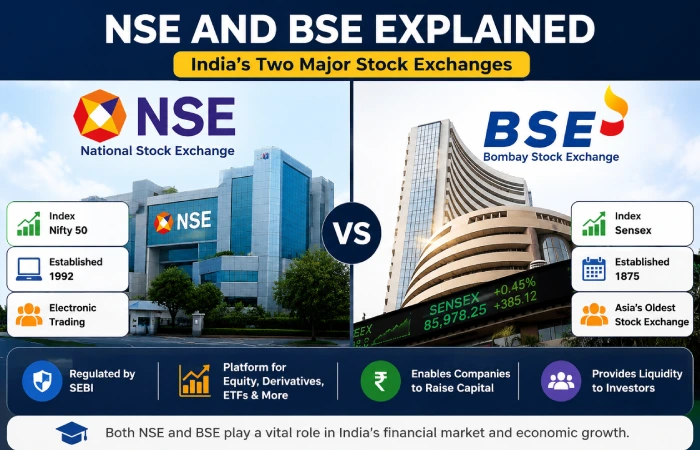
NSE and BSE explained simply means understanding India’s two major stock exchanges. The NSE Investor Education resources provide helpful information about investing, trading, and investor awareness.
The NSE is renowned for its index, the Nifty 50, while the BSE is best known for its index, the Sensex. Each offers to investors their shares for buying and selling, though the specific stocks traded are different.
| Feature | NSE | BSE |
| Full Name | National Stock Exchange | BSE Ltd. |
| Major Index | Nifty 50 | Sensex |
| Location | Mumbai | Mumbai |
| Main Function | Securities trading | Securities trading |
How to Invest in Stocks
If you want to know how to invest in stocks, you need to take stock of education before purchasing stock. If you are interested, you should know the company’s business model, its financial performance, business valuation, its competitive condition and its relevant risks.
A basic process is:
- Set an investment goal.
- Open a Demat and trading account.
- Complete the required KYC process.
- Add funds to your trading account.
- Research companies or investment products.
- Decide how much you can afford to invest.
- Place an order through your broker.
- Monitor your portfolio periodically.
Don’t put money into something that you might have to withdraw for necessities or use in the very near future.
Demat Account vs Trading Account
Demat account is an online account where your shares are held digitally along with other eligible securities. This is basically an account with the help of which you can place buying and selling of the orders.
So, basically the trading account for executing transactions and demat account for holding investment.
| Account | Primary Purpose |
| Demat Account | Holds securities electronically |
| Trading Account | Enables buying and selling |
| Bank Account | Provides funds for investment transactions |
Several Indian brokers have integrated both trading as well as demat account offerings, there by simplifying the investor experience.
Investing for Beginners India: What Should You Learn First?
If one is new in investing for beginners India, learning to differentiate between investment and short trading could be helpful.
If the strategy aims to own valuable holdings over a longer period, investment strategy should dominate while if you focus to utilize short to short-term fluctuations price changes for profit trading has to come forward. Trading strategies may require more effort and involves greater risk, especially to the newcomers.
For new traders, it is imperative that they familiarize themselves with diversification, risk tolerance, asset allocation, compounding, fundamental analysis, market volatility.
| Beginner Principle | Why It Matters |
| Diversification | Helps reduce concentration risk |
| Long-term approach | Can reduce the importance of short-term price movements |
| Research | Helps investors understand what they own |
| Risk management | Prevents excessive exposure to one investment |
| Regular learning | Builds better financial decision-making |
Common Mistakes Stock Market Beginners Should Avoid
Mistakes are very commonly observed among new investors as they follow market rumors or take decisions based on their sentiments. These include some of the most common mistakes such as: Trading without prior study investing all capital in single stock Following sky rocketing prices Excessive trading without strategy Investing for sure returns
Another big mistake is not factoring in costs and taxes on investment. Every investor should familiarize themselves with brokerage and other applicable taxes and levies before undertaking an investment process.
Final Thoughts
Beginner Stock Market & Investing Education to equip with Knowledge before you put all Your money to risk. If you wish to Learn more about stock market for beginner, how Indian stock market works, what inseam what is NSE and BSE and roles of demat account and trading account, you will surely get benefits.
In summary, begin slowly, study investment thoroughly, diversify carefully when it make sense, and concentrate on your individual financial goals rather than the transient emotions of the market. Above all else, there is no assurance that your stock market investments will provide positive returns.