

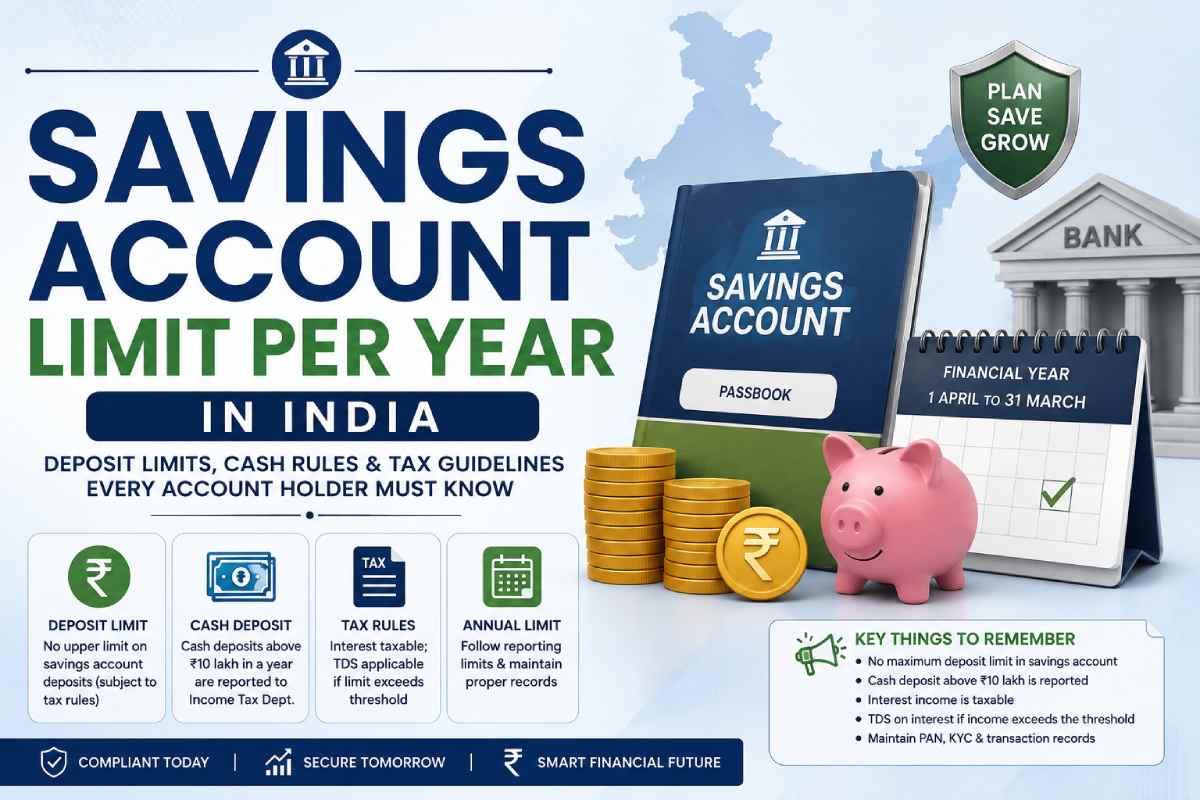
Savings Account Limit Per Year in India: Deposit Limits, Tax Rules & Bank Restrictions

Introduction
Out of all the financial products, savings account is the most popular one in India. Salaried people receive their income in their savings account, they use their savings accounts to keep their emergency fund, pay their bills through their account, transfer money, receive money for their business from customers, save for education, manage household expenses and also for investments. Since a savings account is used for such numerous purpose, one question that people keep on raising is how much is the saving account limit per year in India.
In simple terms there is no such uniform annual deposit limit for an ordinary savings account that is applicable for every individual account holder. An individual can maintain, and keep large amount in their ordinary savings bank accounts as per the bank’s account terms and conditions, KYC norms, transaction monitoring and the relevant income tax laws. It does not mean that every deposit is unmonitored by the banks and tax authorities.
It is to be noted that the deposit limit and tax liability are totally two different concepts. If you are depositing Rs.10, 00,000/- in savings account it does not imply that the Rs.10, 00,000/- is necessarily a taxable income. You may deposit the Rs. 10, 00,000/- from legitimate & explainable sources like salary, from business receipts already accounted for, from the sale of assets, from a loan or from a Gift with properly attested documentation, and so accordingly their Tax will be treated.
In this article we will discuss regarding saving account limit per year in India, cash deposit rule and PAN requirements, reporting thresholds, treatment of the interest generated in savings bank accounts, TDS on interest earned, documentation required for saving account deposits and sample cases.
This Article is the part of Savings Accounts
Quick Answer: What Is the Saving Account Limit Per Year?

There isn’t any standard annually prescribed limit by the RBI for the number of deposits that any average customer can make in a regular savings account.
Instead, several different limits and reporting thresholds may apply depending on:
- The type of savings account
- Whether the transaction is cash or digital
- The amount deposited
- PAN and KYC status
- The source of funds
- The bank’s internal policies
- Whether transactions become reportable under tax rules
- Whether the account is a special “small account”
- Whether the money represents taxable income
So it is false to claim that ‘you can only deposit 10 lakh a year in savings account.’ the 10 lakh was the sum discussed because cash deposits amounting to 10 lakh and above that are made to savings/non-current accounts may be subject to the financial transaction reporting rules. This is different from a Savings account limit. Reporting allows the authorities to be given information, but not necessarily to block deposits beyond a certain figure.
Savings Account Limits at a Glance
| Item | Commonly discussed threshold/rule | What it means |
| Normal savings account annual deposit | No universal RBI ceiling | Regular accounts can generally receive deposits subject to KYC, bank policies and tax rules |
| Cash deposits in savings/non-current accounts | ₹10 lakh aggregate in a financial year | Significant cash deposits can be reported under SFT rules |
| Cash deposit requiring PAN quoting | More than ₹50,000 in a day | PAN requirements apply to specified cash transactions |
| Small account total credits | ₹1 lakh per year | Special restriction for simplified-KYC small accounts |
| Small account maximum balance | ₹50,000 | Applies to eligible small accounts, not ordinary fully KYC-compliant savings accounts |
| 80TTA deduction | Up to ₹10,000 | Eligible savings-account interest deduction for qualifying non-senior citizens under the applicable regime |
| 80TTB deduction | Up to ₹50,000 | Eligible deposit-interest deduction for qualifying resident senior citizens under the applicable regime |
| Bank-interest TDS threshold | ₹50,000 for others; ₹1 lakh for senior citizens | Threshold for TDS under the amended interest provisions; TDS rules and account/institution conditions matter |
The figures above should not be interpreted as a single “annual savings account limit.” Each threshold serves a different legal or regulatory purpose.
What Does “Saving Account Limit Per Year” Actually Mean?
The phrase saving account limit per year can refer to several different things.
Someone asking this question might actually want to know:
- How much money can be deposited into a savings account annually?
- How much cash can be deposited?
- At what point does the bank report the transaction?
- How much money can remain in the account?
- How much interest can be earned tax-free?
- When does the Income Tax Department become interested in deposits?
- Is depositing more than ₹10 lakh illegal?
- Is there a separate limit for digital transfers?
- Does the limit apply to each account or all accounts?
- Does depositing money above a threshold automatically create tax liability?
These questions have different answers. The most important distinction is:
A reporting threshold is not necessarily a deposit limit.
For example, a bank may report certain cash deposits once the aggregate amount reaches the applicable reporting threshold. That does not necessarily mean the customer is prohibited from depositing more money.
The tax authorities are primarily interested in whether the transaction can be explained and whether the taxpayer has correctly reported taxable income.
Is There a Savings Account Deposit Limit in India?
For a normal, fully KYC-compliant savings account, there is no universal rule saying that every individual can deposit only a fixed amount per year.
Banks may, however, have their own operational limits for:
- Cash deposits
- ATM cash deposits
- Mobile banking transfers
- Internet banking
- UPI transactions
- Third-party transfers
- Branch transactions
- Daily transaction values
- Number of transactions
These are different from income-tax reporting thresholds.
For example, a bank could impose a particular daily cash-deposit limit through its product terms or channel limits. Another bank could have a different limit. A premium account may have different transaction facilities from a basic account.
Therefore, customers should check their bank’s current account terms instead of assuming that a government-wide annual savings-account ceiling exists.
Savings Account Cash Deposit Limit

The savings account cash deposit limit is one of the most misunderstood areas of personal banking.
There are two different questions:
Question 1: How much cash can I physically deposit?
The answer depends on the account, bank, branch, deposit channel and applicable rules. There is not one universal annual cash-deposit ceiling for every ordinary savings account.
Question 2: When does a cash deposit become reportable?
This is where the ₹10 lakh figure becomes important.
Under the financial transaction reporting framework, cash deposits aggregating to ₹10 lakh or more in a financial year in one or more accounts other than current accounts and time deposits have been reportable by banks/co-operative banks and relevant reporting institutions. The Income-tax Rules, 2026 also contain the framework for furnishing statements of financial transactions.
This means:
₹10 lakh is not a “maximum cash deposit limit.”
It is better understood as an important reporting threshold.
Example
Suppose you deposit:
- ₹2 lakh in April
- ₹1.5 lakh in June
- ₹3 lakh in September
- ₹2 lakh in December
- ₹1.5 lakh in February
Total cash deposits = ₹10 lakh.
The fact that the deposits were made in several transactions does not necessarily prevent aggregation for reporting purposes.
This is why splitting a large cash deposit into multiple smaller deposits does not automatically make the activity invisible.
What Is the Savings Account Limit in India for Cash Deposits?
For most people, the correct way to understand the savings account limit in India is through several layers.
| Situation | What to understand |
| Regular fully KYC savings account | No universal annual deposit ceiling |
| Large cash deposit | May attract bank monitoring and reporting |
| ₹10 lakh or more cash deposits in savings/non-current accounts | Important SFT reporting threshold |
| Cash deposit above ₹50,000 in a day | PAN quoting requirements can apply |
| Digital transfer | No ₹10 lakh “cash deposit” threshold because it is not cash |
| Small account | Special lower limits apply |
| Large unexplained deposit | May create tax scrutiny regardless of whether the amount is below or above ₹10 lakh |
| Legitimate documented funds | Deposit itself is not automatically taxable |
The source of money matters much more than the simple fact that money entered the bank account.
How Much Money Can Be Deposited in a Savings Account?
The answer to “how much money can be deposited in savings account?” is not simply ₹10 lakh.
A regular savings account can potentially receive amounts significantly higher than ₹10 lakh, depending on the bank’s policies and the nature of the transactions.
For example, a person might receive ₹20 lakh from the sale of a property. If the sale is legitimate and properly documented, depositing the proceeds into a savings account does not automatically turn the ₹20 lakh into taxable income.
However, the property sale itself may have capital-gains tax implications.
Similarly, a person could receive ₹15 lakh from a genuine loan. The loan amount itself is not automatically taxable income merely because it was credited to a savings account, but the taxpayer should retain appropriate loan documentation and banking records.
Examples of legitimate sources
Money deposited into a savings account may come from:
- Salary
- Pension
- Business income
- Professional income
- Sale of investments
- Sale of property
- Maturity proceeds
- Existing savings
- Bank transfer from another account
- Loan proceeds
- Gift
- Inheritance
- Agricultural receipts, where applicable
- Refunds
- Insurance proceeds
- Other legitimate sources
The tax treatment differs for each category.
Why ₹10 Lakh Is Commonly Mentioned
Searches for “saving account limit per year” often return the ₹10 lakh number.
This happens because cash deposits of ₹10 lakh or more in a financial year in savings/non-current accounts have been covered by the Statement of Financial Transactions framework.
The reporting mechanism is designed to give tax authorities information about significant financial activity.
It is important to understand the difference between these three terms:
| Term | Meaning |
| Deposit limit | Maximum amount the bank or regulator allows under a particular account/product/channel |
| Reporting threshold | Amount at which a transaction or aggregate activity may have to be reported |
| Taxable amount | Amount that is actually chargeable to tax under applicable tax law |
These three numbers can be completely different.
For example:
₹10 lakh cash deposit reporting threshold ≠ ₹10 lakh tax-free limit.
Likewise:
₹10 lakh reporting threshold ≠ ₹10 lakh maximum savings-account balance.
PAN Requirement for Cash Deposits
PAN is an important part of high-value financial transactions. The Income Tax Department’s reporting guidelines state that PAN is required for cash payments/deposits above Rs 50,000 on any single day, in accordance with the respective rules. This doesn’t imply that it is illegal for you to deposit 50,000 or more.
Instead, PAN requirements help financial institutions identify and report transactions correctly.
Why PAN matters
PAN connects financial transactions with the taxpayer’s identity and tax records.
When substantial transactions occur, the taxpayer should make sure:
- PAN details are correctly linked with the bank account
- KYC is up to date
- Name and date of birth are correctly recorded
- Mobile number and email are updated
- Tax returns accurately reflect relevant income
- Supporting documents are retained
A mismatch between income declared in an ITR and substantial bank activity can create questions.
Does Depositing More Than ₹10 Lakh Mean You Will Pay Tax?
No.
This is probably the most important answer in this article. A bank deposit is not automatically taxable income. Suppose someone has accumulated ₹12 lakh over several years from salary savings and deposits the money into a bank account.
The ₹12 lakh is not automatically new income in the year of deposit simply because it entered the account. Similarly, if someone sells a property and receives ₹30 lakh, the amount credited to the bank account is not automatically treated as ₹30 lakh of taxable income. Instead, the relevant tax rules apply to the underlying transaction.
Example 1: Existing savings
You have ₹8 lakh in an account and ₹4 lakh in cash that you previously saved from documented salary income.
You deposit ₹4 lakh.
The deposit itself is not automatically taxable income.
Example 2: Property sale
You sell a property and receive ₹40 lakh.
You deposit ₹40 lakh into your savings account.
The tax question relates to the property transaction and applicable capital-gains rules, not simply the bank credit.
Example 3: Loan
You receive a ₹20 lakh genuine loan from a bank.
The amount enters your savings account.
The loan proceeds are not automatically salary or business income merely because they appear as a bank credit.
Example 4: Unexplained money
You deposit ₹15 lakh in cash but cannot explain where it came from and have no supporting documents.
This situation can create serious tax questions.
The key principle is:
Explainability and documentation matter.
Savings Account Tax Rules
The term savings account tax rules generally covers several different issues.
1. Tax on savings-account interest
Banks pay interest on savings balances. That interest can be taxable income under the applicable tax provisions.
For some taxpayers, there are other deductions that might be eligible, such as Sec 80TTA or 80TTB, subject to age, status, and type of tax regime. According to the I-T Department, non-senior citizens entitled for this benefit may claim exemption of interest up to Rs 10,000 on any amount paid by a bank for interest in any savings account (in which savings accounts), as per Sec 80TTA.
Whereas, for senior citizens, Sec 80TTB ensures a benefit on interest income on amount up to Rs 50,000 on deposits from Banks, Co-Operative Banks and Post office deposits of such an asses see, as per 80TTB section.
2. TDS on interest
TDS rules are different from income-tax liability.
The 2025 Budget increased the threshold under the bank-interest TDS provision to:
- ₹50,000 for persons other than senior citizens
- ₹1,00,000 for senior citizens
for the specified bank/co-operative-bank/post-office interest category.
A person should not confuse this TDS threshold with a tax-free income limit.
TDS is a mechanism for collecting tax at source. Final tax liability depends on total taxable income and applicable provisions.
3. Tax on the source of deposits
If the deposited money represents:
- Salary
- Business income
- Professional income
- Rental income
- Capital gains
- Interest income
- Other taxable receipts
The underlying income may need to be reported and taxed according to the applicable rules.
Section 80TTA and Savings Account Interest
Section 80TTA is often searched alongside savings-account limits.
For eligible individuals other than senior citizens and eligible HUFs, the provision allows a deduction for interest from savings deposits, subject to the applicable conditions and a maximum of ₹10,000.
Example
Suppose you earn:
₹18,000 savings-account interest during the year.
Section 80TTA applicable to you and tax benefits covered under the current tax laws – you can get up to ₹10,000 tax deduction on interest from savings account.
The remaining ₹8,000 would remain relevant for tax computation.
Another example
Savings interest = ₹7,500.
Eligible deduction = ₹7,500.
Taxable savings interest after the deduction = ₹0, assuming all conditions are satisfied.
That is not to say that this interest should not be included when preparing your return. It’s only a matter of correctly reporting it.
Section 80TTB for Senior Citizens
Senior citizens have a separate deduction provision.
The Income Tax Department says that eligible resident senior citizen are allowed to claim deduction up to Rs 50,000 on deposit interest subject to meeting certain conditions for claims u/s 80TTB.
This provision is more comprehensive than the provisions u/s 80TTA because this provision is also applicable on qualifying deposit interest on saving account and not only fixed deposits.
Example
Suppose an eligible senior citizen receives:
- Savings interest: ₹15,000
- Fixed-deposit interest: ₹35,000
Total qualifying interest = ₹50,000.
Subject to qualifying conditions applicable, the entire of 50,000 can fall within the section 80TTB deduction limit.
In this case where qualifying interest is of say 70,000 then deduction limit would not be greater than 50,000.
Is There a Tax on the Money Kept in a Savings Account?
Generally, you are not taxed simply because you have a large balance in a normal savings account.
For example, having:
- ₹5 lakh
- ₹10 lakh
- ₹25 lakh
- ₹50 lakh
in a savings account does not by itself mean that the balance is taxable as income merely because of the amount.
Tax generally concerns income and specified taxable transactions, not simply the existence of money in a bank account.
However, a large balance can attract questions if the source is inconsistent with the taxpayer’s known income or financial profile.
For example, someone declaring very low income but suddenly depositing ₹50 lakh in unexplained cash may need to establish the source.
Does a Savings Account Have an Annual Balance Limit?
A normal savings account does not generally have a single government-prescribed annual balance ceiling.
However, certain specialized accounts have restrictions.
One important example is a small account under simplified KYC arrangements.
According to the RBI guidelines, there are limits on small accounts such as Rs 1 lakh in annual total credits, Rs 50,000 as account balance at any time and Rs 10,000 per month as total cash withdrawal and transfer. Don’t confuse it with the norms set for normal fully KYC-compliant savings accounts.
Small Account vs Regular Savings Account
| Feature | Small Account | Regular Savings Account |
| KYC | Simplified/limited KYC conditions | Full KYC |
| Annual total credits | ₹1 lakh | No universal annual government ceiling |
| Maximum balance | ₹50,000 | Depends on account/product and bank policies |
| Monthly cash withdrawals/transfers | Restricted | Depends on bank/product |
| Purpose | Financial inclusion/simplified account | General banking |
| Large transactions | Restricted until conditions are met | Subject to KYC, monitoring and reporting rules |
What Is the Difference Between Cash and Online Deposits?
This is another area where people often misunderstand the ₹10 lakh figure. The SFT threshold discussed above specifically concerns cash deposits in specified non-current accounts.
That does not mean receiving ₹10 lakh through NEFT, RTGS, IMPS or other electronic channels is automatically prohibited. Digital transactions create a clear banking trail, but that does not mean they are outside tax rules.
If you receive ₹25 lakh digitally as business income, the amount still has to be accounted for correctly.
Cash vs Digital Transactions
| Transaction | Is it a cash deposit? | Can it be monitored/reported? | Is it automatically taxable? |
| Cash deposit at branch | Yes | Yes, depending on thresholds/rules | No |
| Cash deposit at CDM | Yes | Yes, subject to applicable rules | No |
| NEFT credit | No | Yes, bank records exist | No |
| RTGS credit | No | Yes | No |
| IMPS credit | No | Yes | No |
| UPI receipt | No | Yes | No |
| Salary credit | No | Yes | No, salary is taxed under applicable rules |
| Business payment | May be cash or digital | Yes | Depends on business income rules |
Why Banks Monitor Large Cash Deposits
Banks operate under KYC and anti-money-laundering requirements. Large or unusual cash transactions can therefore receive additional attention.
The purpose of monitoring is not to punish ordinary customers who legitimately deposit their money. It helps banks identify transactions that may require further review.
For example, a business owner who regularly deposits cash consistent with the nature of the business may have an understandable transaction pattern.
On the other hand, a person with no apparent cash-based activity who suddenly deposits very large amounts may need to explain the source. This is why keeping documentation is important.
Documents You Should Keep for Large Deposits
If you regularly deal with substantial amounts, maintain records supporting the source of funds.
Useful documents can include:
| Source of Money | Possible Supporting Documents |
| Salary savings | Salary slips, Form 16, bank statements |
| Business income | Invoices, books of account, GST records where applicable, ITR |
| Property sale | Sale deed, agreement, bank statement, capital-gains calculation |
| Loan | Loan agreement, sanction letter, bank statement |
| Gift | Gift documentation, donor’s financial records where appropriate |
| Inheritance | Will, succession documents, probate/legal documents where applicable |
| Fixed-deposit maturity | FD receipt and bank statement |
| Investment sale | Contract notes, statements, redemption records |
| Insurance maturity | Policy documents and maturity statement |
| Agricultural receipts | Relevant land/income records |
| Transfer from another bank | Source account statement |
The exact documentation needed depends on the transaction.
Does Splitting Cash Deposits Avoid the ₹10 Lakh Rule?
You should not assume that it does.
The reporting framework can consider aggregate transactions across relevant accounts of the same person.
The Income Tax Department’s SFT guidance specifically explains aggregation across accounts of the same nature for the financial year.
For example, suppose someone deposits:
- Account A: ₹4 lakh cash
- Account B: ₹3 lakh cash
- Account C: ₹3 lakh cash
Total = ₹10 lakh.
All that we do here is distribute the cash over various savings accounts. It does not eliminate the reporting obligation.
Also, in case we deposit 2 lakh each month compared to 10 lakh on a given day, the treatment at the reporting level would likely remain the same.
Is ₹10 Lakh Cash Deposit Illegal?
No, not automatically.
A ₹10 lakh cash deposit is not automatically illegal merely because it crosses the commonly discussed reporting threshold.
The important questions are:
- Where did the money come from?
- Can you explain the source?
- Is the income properly accounted for?
- Are the applicable tax obligations fulfilled?
- Is the transaction consistent with your financial profile?
- Are appropriate records available?
A legitimate cash receipt from a business may have a very different tax treatment from unexplained cash.
Savings Account Limit Per Year vs Tax-Free Limit
These are two completely different concepts.
A person may hear:
“₹10 lakh is the savings-account limit.”
Then assume:
“I can deposit ₹10 lakh without tax.”
Both conclusions can be wrong.
The ₹10 lakh figure commonly relates to reporting of specified cash deposits.
A tax-free threshold depends on:
- Type of income
- Total taxable income
- Tax regime
- Applicable deductions
- Exemptions
- Nature of transaction
- Taxpayer category
Comparison
| Concept | Example | Meaning |
| Savings deposit | ₹10 lakh | Money credited to account |
| Cash reporting threshold | ₹10 lakh | Certain cash deposits may be reportable |
| 80TTA deduction | ₹10,000 | Eligible savings interest deduction |
| 80TTB deduction | ₹50,000 | Eligible senior-citizen deposit-interest deduction |
| Bank-interest TDS threshold | ₹50,000/₹1 lakh | TDS threshold for specified bank interest |
| Taxable income | Varies | Depends on overall tax computation |
Savings Account Interest and TDS
A common misconception is:
“If the bank doesn’t deduct TDS, my interest isn’t taxable.”
That is not necessarily correct.
TDS and final tax liability are separate.
The 2025 Budget increased the bank/co-operative-bank/post-office interest threshold for TDS under Section 194A to ₹50,000 for non-senior citizens and ₹1 lakh for senior citizens.
For example, suppose an eligible non-senior citizen earns ₹40,000 in qualifying bank interest.
No TDS may be required merely because the interest is ₹40,000 under the applicable threshold.
However, the interest may still be relevant in the taxpayer’s income-tax computation.
The taxpayer should therefore distinguish:
No TDS ≠ No tax.
Does the New Income-Tax Framework Change the Basic Savings Account Concept?
India’s income tax legislation switched from The Income Tax Act, 1961 to The Income tax Act, 2025 with effect from April 1, 2025. Subsequently the Income Tax Rules, 2026 were also introduced and published in the official gazette for Income tax which mention to have “come into force from April 1, 2026”.
This becomes crucial if you have searched for ‘saving accounts in 2026’ since many articles online may still reference the old Income tax act name of ‘The Income Tax Act, 1961.’
The fundamental practical lesson remains:
- A normal savings account does not suddenly become capped at ₹10 lakh.
- Significant financial transactions can be reported.
- Cash deposits can receive greater scrutiny.
- The source of funds remains important.
- Interest income has its own tax treatment.
- Special account types may have separate restrictions.
When publishing or relying on tax information, it is therefore better to check the latest official rules instead of relying on an old article.
What Happens If Your Bank Asks About a Large Deposit?
A bank may ask for information or documents about a large or unusual transaction.
Do not assume that this means you have committed a tax offence.
The bank may simply be performing KYC, transaction monitoring or compliance checks.
You should provide truthful information and appropriate supporting documents.
For example:
If you deposited ₹15 lakh from the sale of property, you may be able to provide:
- Sale agreement
- Sale deed
- Bank statement
- Relevant tax documents
Suppose amount came from a loan:
- Loan agreement
- Bank sanction letter
- Loan disbursement statement
If it came from business receipts:
- Invoices
- Books of account
- Relevant returns
- Business records
Good documentation can make financial transactions much easier to explain.
How to Safely Deposit a Large Amount in Your Savings Account
If you have a legitimate large amount to deposit, follow these practical steps.
Step 1: Identify the source
Before depositing the money, identify exactly where it came from.
For example:
- Salary savings
- Sale proceeds
- Investment redemption
- Loan
- Gift
- Business receipts
Step 2: Keep supporting documents
Do not wait until a bank or tax authority asks for proof.
Maintain the documentation in advance.
Step 3: Prefer traceable banking channels where practical
Where appropriate and legally permissible, use documented banking channels instead of unnecessary cash transactions.
Electronic transfers generally create clearer records.
Step 4: Keep your tax return consistent
If the money represents taxable income, make sure the income is properly accounted for.
Step 5: Do not split transactions simply to avoid attention
Artificially breaking transactions into smaller amounts may not solve the reporting issue and can create additional questions.
Step 6: Keep bank statements
Download and Preserve bank statements for important financial years.
Savings Account Limits: Regular Account vs Small Account
This distinction deserves special attention.
RBI’s “small account” framework is designed for simplified KYC situations and contains significantly lower limits. Reserve Bank of India(RBI) guidance states that total credits should not exceed ₹1 lakh in a year, the maximum balance should not exceed ₹50,000 at any time, and specified cash withdrawals/transfers are restricted to ₹10,000 per month.
These limits are sometimes mistakenly quoted as the general savings account limit.
They are not.
Example
Suppose you have a fully KYC-compliant regular savings account with ₹5 lakh.
The small-account ₹50,000 balance restriction does not automatically apply to your regular account.
Conversely, if you actually hold a qualifying small account, its special restrictions matter.
Annual Savings Account Limit: A Practical Guide
The phrase annual savings account limit should therefore be broken into categories.
| Question | General answer |
| Can I deposit more than ₹10 lakh in a regular savings account? | Generally yes, subject to bank/account policies and compliance |
| Is ₹10 lakh a tax-free limit? | No |
| Is ₹10 lakh a reporting threshold for specified cash deposits? | Yes, it is an important SFT threshold |
| Can I deposit ₹20 lakh digitally? | There is no universal ₹10 lakh prohibition on digital credits |
| Will large deposits be monitored? | They can be |
| Is a large legitimate deposit automatically taxable? | No |
| Is unexplained money risky? | Yes |
| Does every account have the same limit? | No |
| Does a small account have lower restrictions? | Yes |
| Is savings interest taxable? | Generally yes, subject to applicable deductions/exemptions |
| Is TDS the same as tax liability? | No |
How Banks and Tax Authorities May View Large Deposits
A transaction’s context matters.
Consider two people:
Person A
Annual declared income: ₹20 lakh
Cash deposit: ₹12 lakh
Source: documented business receipts
This may be explainable based on the person’s business.
Person B
Annual declared income: ₹3 lakh
Cash deposit: ₹20 lakh
Source: cannot be explained
This is much more likely to raise questions.
The issue is not simply the amount.
It is the relationship between:
income + transaction pattern + source + documentation + tax reporting.
What Should You Do If You Expect Large Cash Deposits?
If you operate a cash-intensive business or regularly handle significant amounts, good financial discipline becomes particularly important.
Maintain:
- Daily cash records
- Sales invoices
- Purchase records
- Cash book
- Bank statements
- GST records where applicable
- Income-tax records
- Supporting agreements
- Receipts
- Loan documents
- Gift documentation
- Property documents
The exact records depend on the nature of your activity.
A properly maintained accounting trail is much more useful than trying to memorize a single “savings account limit.”
Is There a Limit on Savings Account Transactions?
Transaction limits can exist even when there is no universal annual deposit ceiling.
Banks may specify:
- Daily transfer limits
- Monthly transaction limits
- Cash deposit limits
- ATM limits
- UPI limits
- Mobile banking limits
- Net banking limits
- Third-party transfer restrictions
These are often product-specific.
For example, a bank’s standard savings account may have a different cash-deposit facility from its premium savings account.
Therefore, if your question is about the exact operational limit for a particular bank, check that bank’s current schedule of charges and account terms.
Savings Account Tax Rules for Different Sources of Money
| Source | Is bank credit itself automatically taxable? | What matters? |
| Salary | No separate tax merely because credited | Salary tax rules |
| Existing savings | No | Source and prior taxation |
| Bank loan | Generally no | Genuine loan documentation |
| Gift | Depends | Relationship, amount and applicable gift-tax provisions |
| Inheritance | Generally different from taxable income | Inheritance documentation and subsequent income |
| Property sale | No, not simply the gross bank credit | Capital gains |
| Business receipts | Underlying income matters | Business income/profit |
| Investment redemption | Depends | Capital gains/investment rules |
| Fixed-deposit maturity | Principal and interest have different treatment | Interest and source records |
| Unexplained cash | Potentially problematic | Ability to establish source |
How to Calculate Savings Account Interest for Tax Purposes
Suppose your bank pays:
₹12,000 savings interest.
If you are eligible for Section 80TTA and the applicable tax regime allows the deduction, the deduction can be up to ₹10,000.
Therefore:
Interest = ₹12,000
Potential Section 80TTA deduction = ₹10,000
Balance = ₹2,000
This example is simplified. Actual tax calculations should consider all applicable provisions and the taxpayer’s chosen tax regime.
For senior citizens, Section 80TTB can provide a deduction of up to ₹50,000 for qualifying deposit interest, subject to the relevant conditions.
Important Difference Between Financial Year and Tax Year
Older tax articles commonly refer to a financial year (FY) and assessment year (AY).
With the Income-tax Act, 2025 applying from 1 April 2026, the framework uses the concept of a tax year. The Income-tax Rules, 2026 state that the Rules came into force on 1 April 2026.
This matters when reading older online content.
An article written before April 2026 may use:
- FY 2025-26
- AY 2026-27
A current article may use the newer terminology under the 2025 Act.
Readers should therefore check the relevant period before applying a rule.
Final Takeaway
The biggest misconception surrounding the saving account limit per year is the belief that India has a universal rule allowing or prohibiting only a fixed amount of deposits in every savings account.
For a normal, fully KYC-compliant savings account, there is no universal ₹10 lakh annual deposit ceiling.
The ₹10 lakh figure is important because specified cash deposits aggregating to ₹10 lakh or more in a financial year can fall under financial transaction reporting requirements. That is a reporting threshold, not a maximum deposit limit and not a tax-free limit.