

Cash Deposit & Transaction Limits in India: Rules, Daily Limits and Tax Reporting

While cash deposit in banks continue to be a significant mode to transfer funds to your account, particularly for individuals, small businesses, or cash-based earners. The banks and Income Tax Department keep watch on high-value transactions.
Here, we need you to be aware of a Savings Account cash limit per day, overall limit for daily cash deposits, and other relevant bank deposit rules.
This Article is the part of Savings Accounts
What is the Cash Deposit Limit in a Savings Account?
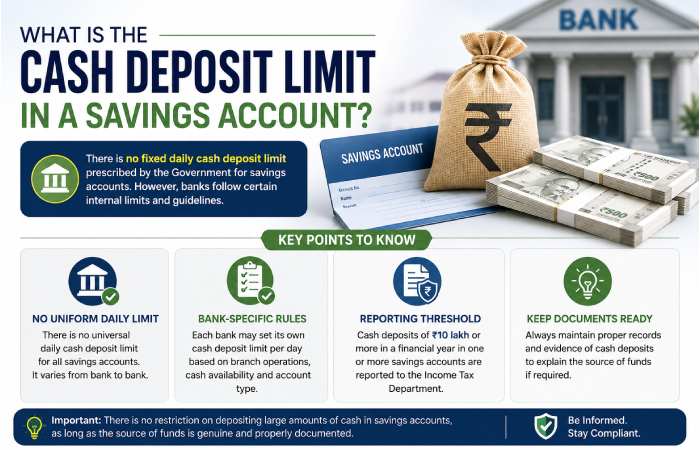
As a general rule, there is no single pan-India limit on a day-to-day cash deposit applicable to all savings accounts. The amount that you will be able to deposit with each bank could be a function of the bank, the type of account you hold, the branch and the cash management practices of that particular branch.
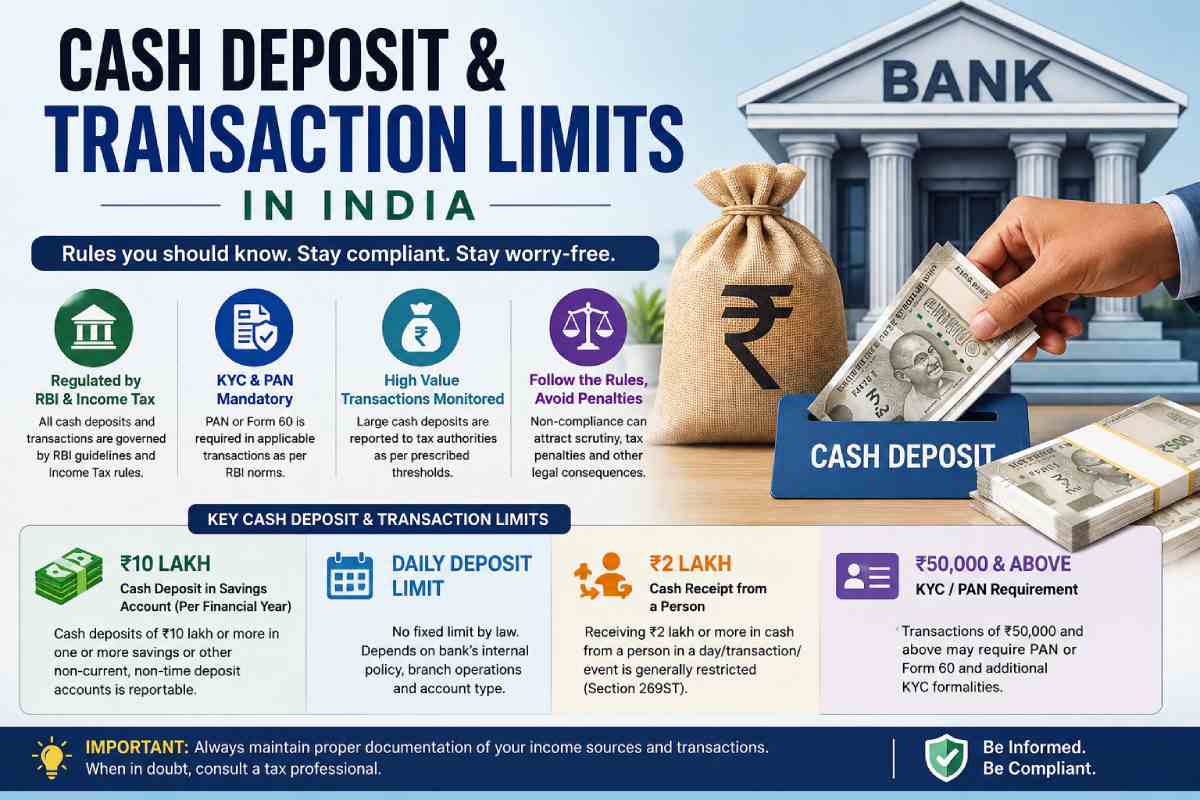
The reporting regime for taxation becomes pertinent here. Under the current income tax reporting system, every deposit in the nature of cash to one or more savings or other non-current, non-time deposit accounts, amounting to ten lakh or more in a financial year must be reported to the bank or cooperative banks. It is in this context, that the figure of ten lakh better be seen not as a cap for depositing greater than ten lakh but a threshold for reporting to the revenue authorities.
| Transaction | Important threshold/rule |
| Cash deposits in savings/non-current accounts | ₹10 lakh or more in a financial year is reportable |
| Cash deposit limit per day | Depends on the bank/account and its internal policy |
| Cash transaction involving PAN/KYC requirements | ₹50,000 and above can trigger specific KYC/PAN requirements in applicable transactions |
| Cash receipt from a person under Section 269ST | ₹2 lakh or more is generally restricted, subject to exceptions |
The Income Tax Department specifically lists cash deposits of ₹10 lakh or more in one or more accounts, other than current and time-deposit accounts, as reportable high-value transactions.
Cash Deposit Limit Per Day: Is There a Fixed Limit?
People often search for a cash deposit limit per day, but there is no universal daily limit prescribed for every savings account in India.
Banks may impose their own operational limits for branch deposits, cash-deposit machines and particular account types. Therefore, customers should check their bank’s current terms before making a very large cash deposit.
A high daily deposit is not automatically illegal. What matters is whether the transaction is genuine, properly documented and consistent with the account holder’s financial profile.
For example, if a person regularly earns business income in cash, maintaining invoices, sales records and other supporting documents can help explain the source of substantial deposits.
Bank Cash Deposit Limit and Tax Reporting
The bank cash deposit limit should not be confused with the income-tax reporting threshold.
If cash deposits in eligible accounts reach ₹10 lakh or more during a financial year, the bank reports the transaction information under the applicable high-value transaction reporting framework.
Reporting does not automatically mean that the deposited amount is taxable or that the account holder has violated the law. The tax treatment depends on the source and nature of the money.
For example:
- Salary savings deposited in cash may need appropriate explanation and documentation.
- Business cash receipts should generally be supported by business records.
- Cash received as a genuine gift or other legitimate source may have separate tax implications.
- Undisclosed income deposited into a bank account can attract scrutiny and potential tax consequences.
Cash Deposit Rules India: Important Points to Know
The cash deposit rules India framework involves banking KYC requirements as well as income-tax provisions.
RBI’s KYC framework requires banks to obtain and verify PAN or Form 60 in applicable circumstances, and transactions of ₹50,000 and above can be subject to specific identification requirements.
Another important provision is Section 269ST of the Income-tax Act. It generally restricts a person from receiving ₹2 lakh or more in cash from another person in a day, for a single transaction, or for transactions relating to a single event or occasion, subject to specified exceptions. Importantly, the provision itself excludes receipts by banking companies, post-office savings banks and cooperative banks.
| Situation | What you should know |
| Large cash deposit into savings account | Keep evidence of the source of funds |
| ₹10 lakh+ cash deposits in a financial year | Reportable by the bank under applicable rules |
| Cash deposit at branch | Bank-specific operational limits may apply |
| Cash deposit through CDM | Daily/per-transaction limits can vary by bank |
| Cash received from another person | Section 269ST restrictions may apply |
| Cash from business activity | Maintain invoices, books and supporting records |
What Happens After a Large Cash Deposit in Bank Account?
A large cash deposit in bank account may be reviewed by the bank as part of its KYC and anti-money-laundering monitoring processes. Banks are required to maintain appropriate customer due diligence and monitor transactions for unusual or suspicious activity.
If the deposit is legitimate, the best approach is to maintain clear evidence showing where the money came from. Depending on the circumstances, this could include sale invoices, business records, withdrawal records from another account, agreements or other relevant documentation.
It is also important not to deliberately split deposits into smaller amounts simply to avoid reporting or monitoring. Such structuring can itself attract scrutiny.
How to Safely Deposit Large Amounts of Cash
Before making a substantial cash deposit:
- Confirm your bank’s applicable cash deposit limits and charges.
- Keep documents supporting the source of the cash.
- Ensure your income-tax records accurately reflect taxable income.
- Avoid unexplained or artificial splitting of transactions.
- Retain deposit slips and bank statements.
- Consult a tax professional if the amount is unusually large or relates to a complex transaction.
Final Takeaway
There is no universal daily cash deposit limit for all savings accounts in India. Banks may have their own operational limits, while tax rules introduce important reporting thresholds.
The key figure to remember is ₹10 lakh in aggregate cash deposits in eligible non-current/non-time-deposit accounts during a financial year, which is a reportable threshold for banks—not an automatic ban on depositing that amount.
If you are making a large cash deposit in bank account, the most important consideration is not simply the amount but whether you can clearly establish the legitimate source of the money and comply with applicable banking and tax rules.