

Pre-Open, Normal & Post-Market Sessions in India: Timings, Process & Key Differences

The Indian stock market functions in different trading sessions to suit the needs and time of diverse stakeholders. For the purpose of investment and trading, it is useful to gain an insight into the pre-open market session, regular trading session and post-market hours of the Indian stock market; doing so can enable you to place your order appropriately and understand how the opening and closing rates are determined.
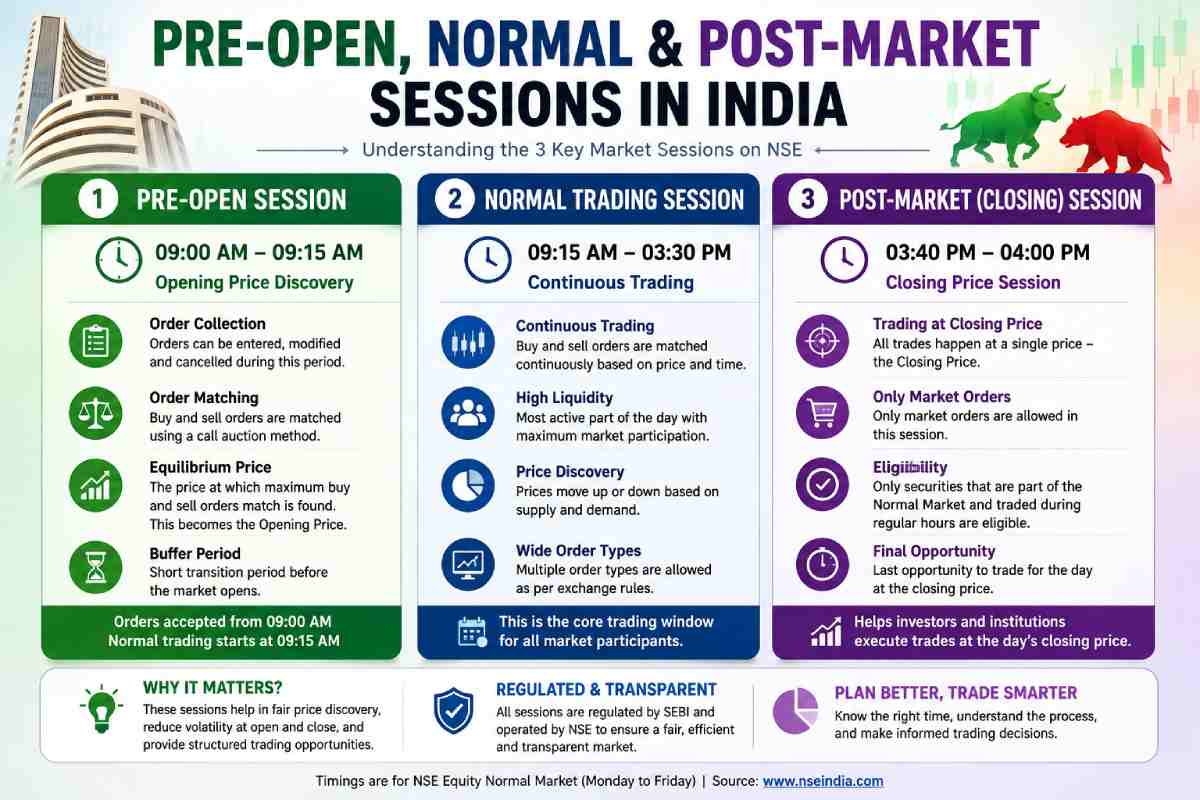
On the National Stock Exchange (NSE), the regular equity market follows a structured schedule. The pre open market timing begins before continuous trading, while the normal session runs from 9:15 AM to 3:30 PM. A closing session is then available from 3:40 PM to 4:00 PM.
This Article is the part of Stock Market
What is the Pre-Open Market Session?
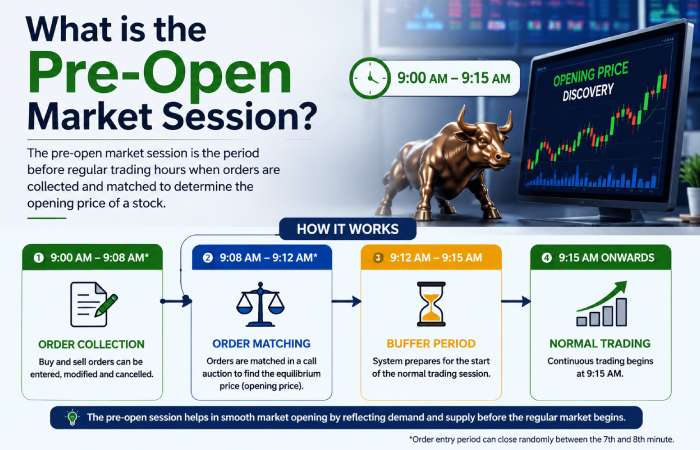
The stock market pre-open session is a special trading period used primarily to determnseine the opening price of eligible stocks. It helps the market absorb orders placed before regular trading begins and reduces the impact of sudden order imbalances at market opening.
The NSE pre open session for the regular equity market starts at 9:00 AM. The order collection period runs for approximately eight minutes, with the system able to close the order-entry period randomly between the seventh and eighth minute. This is followed by order matching and a short buffer period before normal trading begins.
Pre-Open Market Timing
| Phase | Time | Purpose |
| Pre-open order entry | 9:00 AM–9:08 AM* | Orders can be entered, modified and cancelled |
| Order matching | Around 9:08 AM–9:12 AM | Opening price is determined and orders are matched |
| Buffer period | 9:12 AM–9:15 AM | Transition to normal trading |
| Normal market | 9:15 AM onwards | Continuous trading begins |
The order-entry period can close randomly between the seventh and eighth minute.
What Is Pre Market India?
The term pre market India is commonly used to describe trading activity or order placement before the regular market opens. However, investors should distinguish between the general phrase “pre-market” and the official NSE pre-open session.
During the official pre-open session, orders are collected and matched through a call-auction mechanism. An equilibrium price is determined based on available buy and sell orders, and this price becomes the opening price where applicable. NSE also disseminates information such as indicative equilibrium prices and buy/sell quantities during the process.
This mechanism is particularly useful because significant overnight developments—such as company announcements, global market movements or major corporate news—can create large differences between the previous closing price and the expected opening price.
What Are Normal Trading Hours in India?

The normal trading hours India investors generally refer to for the NSE equity market are 9:15 AM to 3:30 PM, Monday through Friday, excluding exchange holidays.
Once the normal session begins, stocks trade continuously through the regular order-matching system. Investors can place different types of eligible orders according to their broker and exchange rules.
| Market Session | NSE Equity Timing | Main Purpose |
| Pre-open session | 9:00 AM–9:15 AM | Opening price discovery |
| Normal trading session | 9:15 AM–3:30 PM | Continuous buying and selling |
| Closing session | 3:40 PM–4:00 PM | Trading at the closing price |
The NSE currently lists the normal/odd-lot market opening at 9:15 AM and closing at 3:30 PM, followed by a closing session from 3:40 PM to 4:00 PM.
What is the Post Market Session India?
The post market session India generally refers to the closing session conducted after the regular market closes. On NSE, the official closing session runs from 3:40 PM to 4:00 PM for the normal market segment.
During this period, only market-price orders are permitted, and trades take place at a single price—the closing price of the security. The facility is available for securities eligible for the normal market, provided they were traded during the normal market session.
It is important to note that the post-market or closing session should not be confused with simply placing an after-market order through a broker. Broker-specific after-market order facilities may allow investors to submit orders outside exchange trading hours, but actual execution depends on the applicable exchange session and rules.
Pre-Open vs Normal vs Post-Market Sessions
Understanding the differences between these sessions can make market timing easier for new investors.
| Feature | Pre-Open Session | Normal Session | Post/Closing Session |
| Timing | 9:00–9:15 AM | 9:15 AM–3:30 PM | 3:40–4:00 PM |
| Main objective | Opening price discovery | Continuous trading | Trading at closing price |
| Price mechanism | Call auction | Continuous order matching | Single closing price |
| Order activity | Entry, modification and cancellation during order collection | Regular trading | Market-price orders |
| Best suited for | Understanding opening demand/supply | Regular trading and investing | Trading eligible securities at closing price |
Why Should Investors Understand These Sessions?
Knowing the different market sessions can help investors interpret price movements correctly. For example, a stock may show a significant indicative price during the pre-open period, but that does not necessarily mean the stock will trade at exactly that price throughout the day.
Similarly, the first few minutes after 9:15 AM can experience considerable volatility as accumulated orders are processed through continuous trading.
The closing session also has a specific purpose. Since eligible trades take place at the security’s closing price, it differs from the continuous price discovery that occurs during normal trading.
Final Thoughts
The Indian equity market is divided into clearly defined phases to facilitate orderly price discovery and trading. The NSE pre open session runs before regular trading and helps determine opening prices. The normal trading hours India investors commonly use are 9:15 AM to 3:30 PM, while the NSE closing session operates from 3:40 PM to 4:00 PM.
Understanding pre open market timing, pre market India, and the post market session India can help investors understand how prices are established at the beginning and end of the trading day. However, trading decisions should not be based solely on pre-open or closing-session movements; investors should also consider liquidity, market conditions, company fundamentals and their individual investment objectives.