

Indian Stock Market Timings: NSE & BSE Trading Hours, Sessions & Holidays

Everyone who aims to trade or invest in India shares must first understand Indian stock market timings. Regardless if you’re a rookie trader about to purchase shares for the first time, or an intraday trader attempting to pinpoint the best time to engage in the trades, or a seasoned investor intending to monitor trading patterns-identifying opening and closing hours, the window period for trading order placing and overall trading timeline would enable for a systematic planning.
This Article is the part of Stock Market
NSE & BSE Trading Hours
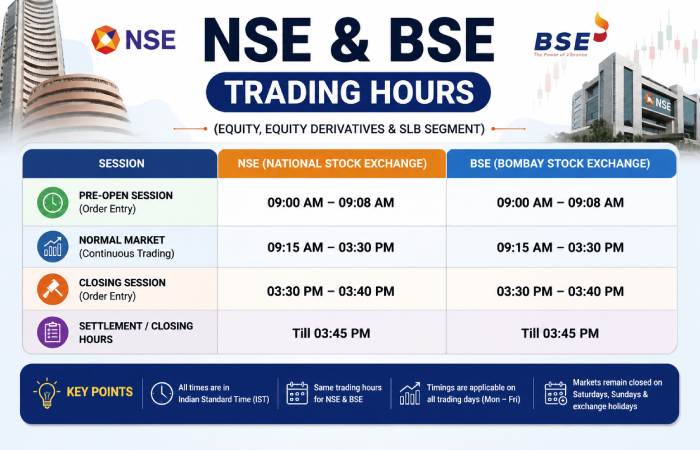
In India, the major two stock exchanges are the National Stock Exchange (NSE) and BSE(BSE Ltd.). As far as the regular equity segment is concerned, generally, both exchanges share similar core opening and closing hours. Specifically, for the regular continuous trading, the regular open market trading timing is generally between 9.15am to 3.30pmIST during normal trading days. Nevertheless, overall trading day encompasses beyond simply this period of 6 hours and 15 minutes.
Additionally there are special trading sessions like a pre-open market timing, that opens as early as at 9:00am and is aimed at deciding opening prices for securities of interest and other market conditions. Additionally, one could see or deal with other specific windows like those of block deals, auction markets, post closure trading, different trading timings in derivatives, currency, commodities, debt and the others segments too.
This guide is intended to discuss the following regarding Indian share market hours: Indian stock market timings, NSE market timings, BSE market timings, opening time of Indian share market, Indian share market closing hours, pre-open market timing in India and general trading hours for India share markets.
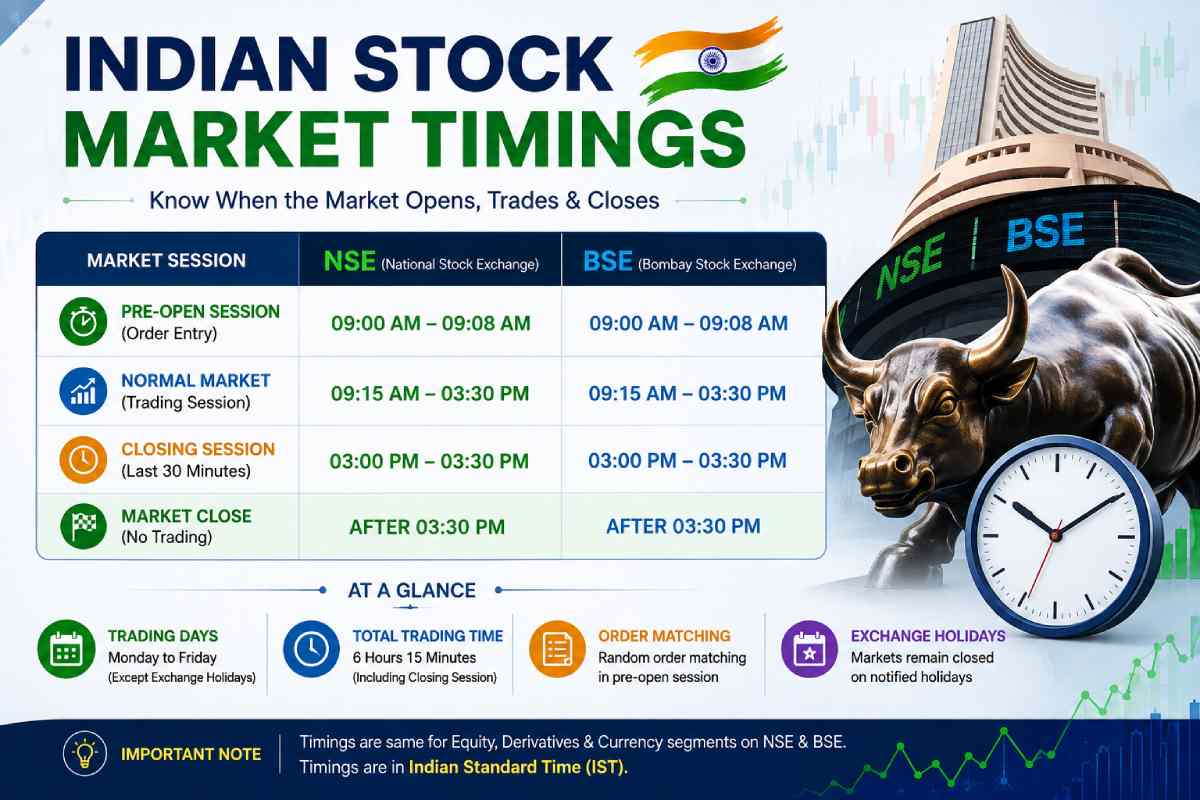
Short & to the point: The normal open of Indian stock exchange hours (regular equity segment) is from 9:15 AM to 3:30 PM IST, from Monday to Saturday except for bank holidays or holidays declared by the Indian Stock Market(s). Trading can be done even earlier through the pre-open market, from 9:00 AM.
Indian Stock Market Timings at a Glance
The easiest way to understand the Indian stock market schedule is to divide the trading day into different sessions.
| Market Activity | Typical Timing | Purpose |
| Pre-open session | 9:00 AM – 9:15 AM | Order collection, matching and opening-price discovery |
| Normal equity trading | 9:15 AM – 3:30 PM | Continuous buying and selling |
| Closing session | 3:40 PM – 4:00 PM | Post-market/closing-session activity |
| Normal equity market closing | 3:30 PM | End of continuous trading |
| Equity derivatives | 9:15 AM – 3:30 PM | Trading in eligible equity derivatives |
| Currency derivatives | Generally from 9:00 AM | Currency futures and options |
| Commodity derivatives | Generally from 9:00 AM into evening | Commodity trading |
NSE’s published market-timing schedule lists the regular equity pre-open session from 9:00 AM and normal/odd-lot market trading from 9:15 AM to 3:30 PM. (NSE India)
The exact timings can vary by market segment, security category, special trading session, exchange circular, or holiday schedule. Therefore, traders should always check the latest exchange notification before relying on a special session.
What Are Indian Stock Market Timings?
Indian stock market timings refer to the hours during which India’s stock exchanges accept, process, match and execute orders.
For the regular equity market, the main trading window is:
9:15 AM to 3:30 PM IST
Trading doesn’t just kick into gear all at once on most exchanges when the market open is at 9.15am. The exchange run the pre-opening auction prior to the main continuous trading session:
At 9.00am the order book for eligible orders for the opening auction is created and a calculation for an equilibrium open price is created. At 9.15am, trading then commences normally.
This distinction is important because someone searching for the stock market opening time may find two answers:
- 9:00 AM – beginning of the regular pre-open session
- 9:15 AM – beginning of normal continuous equity trading
Both times are correct, but they refer to different parts of the trading process.
Indian Share Market Timings: Complete Schedule
The phrase Indian share market timings usually refers to the equity trading hours of NSE and BSE.
Here is the standard schedule:
| Session | Time | What Happens |
| Pre-open begins | 9:00 AM | Orders can be entered in the pre-open session |
| Order entry period | 9:00 AM – 9:08 AM | Orders are entered, modified or cancelled |
| Order matching | Approximately 9:08 AM – 9:12 AM | Orders are matched and opening price is determined |
| Buffer/transition | 9:12 AM – 9:15 AM | Transition to continuous trading |
| Normal market | 9:15 AM – 3:30 PM | Continuous equity trading |
| Closing session | Around 3:40 PM – 4:00 PM | Post-market/closing activities |
NSE describes its regular equity pre-open session as a 15-minute session from 9:00 AM to 9:15 AM, with order entry, matching and a buffer period.
The important point is that the normal stock market opening time is 9:15 AM, while the broader market process begins at 9:00 AM.
NSE Market Timings
The NSE market timings are particularly important because NSE is one of India’s largest securities exchanges and handles substantial trading activity across equities and derivatives.
For the regular equity segment, NSE’s published schedule is:
- Pre-open session: 9:00 AM
- Normal market opens: 9:15 AM
- Normal market closes: 3:30 PM
- Closing session: 3:40 PM to 4:00 PM
- Trade modification cut-off: 4:15 PM
NSE’s official market-timing page currently lists normal/odd-lot market opening at 9:15 AM and closing at 3:30 PM.
NSE Pre-Open Market Timing
The NSE pre-open session is designed to help establish a fair opening price before normal continuous trading begins.
According to NSE, the regular pre-open session is divided into three broad phases.
| Phase | Timing | Activity |
| Order entry | 9:00 AM – 9:08 AM | Order entry, modification and cancellation |
| Matching | Approximately 9:08 AM – 9:12 AM | Order matching and opening-price determination |
| Buffer | Approximately 9:12 AM – 9:15 AM | Transition to normal trading |
The order-entry period may close earlier within the specified randomization window, according to the exchange mechanism.
This means traders should not assume they can submit or modify a pre-open order right up to exactly 9:08:00 AM.
BSE Market Timings
The BSE market timings for the regular equity market are also centered around the same core schedule.
BSE’s published equity-segment master circular specifies:
- Pre-open order entry: 9:00 AM – 9:08 AM
- Matching period: 9:08 AM – 9:15 AM
- Continuous trading: 9:15 AM – 3:30 PM
- Closing: 3:30 PM – 3:40 PM
- Post-closing: 3:40 PM – 4:00 PM
Therefore, for most retail investors, the practical difference between NSE market timings and BSE market timings for normal equity trading is minimal.
| Feature | NSE | BSE |
| Pre-open begins | 9:00 AM | 9:00 AM |
| Normal equity trading begins | 9:15 AM | 9:15 AM |
| Normal equity trading ends | 3:30 PM | 3:30 PM |
| Closing/post-market period | Available | Available |
| Time zone | IST | IST |
| Regular trading days | Monday–Friday, excluding holidays | Monday–Friday, excluding holidays |
What Is the Stock Market Opening Time in India?
The answer depends on what you mean by “opening.”
The pre-open market begins at 9:00 AM IST, while normal continuous equity trading starts at 9:15 AM IST.
For most investors, the answer to “What is the stock market opening time?” is therefore:
Stock market opening time: 9:15 AM IST
But investors who want to participate in the pre-open process should understand the 9:00 AM session as well.
The pre-open mechanism exists because prices can change significantly between the previous day’s close and the next day’s opening. News, earnings announcements, global markets, corporate announcements and other events can affect the expected opening price.
Instead of allowing all orders to immediately execute at potentially unstable prices, the pre-open process allows the exchange to collect orders and determine an equilibrium price.
What Is the Stock Market Closing Time?
The standard stock market closing time for the regular Indian equity market is:
3:30 PM IST
At 3:30 PM, normal continuous trading in the equity market ends.
However, this does not necessarily mean every exchange-related activity stops immediately.
For example, NSE lists a closing session from 3:40 PM to 4:00 PM, while its trade modification end time is listed as 4:15 PM.
BSE similarly lists a closing period from 3:30 PM to 3:40 PM followed by post-closing activity from 3:40 PM to 4:00 PM.
Therefore:
| Question | Answer |
| When does normal equity trading open? | 9:15 AM |
| When does normal equity trading close? | 3:30 PM |
| When does pre-open begin? | 9:00 AM |
| Does all exchange activity stop at 3:30 PM? | No |
| Is post-market activity possible? | Yes |
What Is the Pre-Open Market Timing?
The pre-open market timing is one of the most important concepts for new investors.
The regular pre-open session generally runs from 9:00 AM to 9:15 AM.
The objective is to help discover the opening price of eligible securities in an organized manner.
During this period, the exchange collects buy and sell orders and uses the available order information to determine an equilibrium price.
Why Does the Pre-Open Session Exist?
Imagine a company announces unexpectedly strong quarterly results after the previous day’s market closes.
Before the next session opens, investors may suddenly want to buy the stock.
If the stock immediately opened with unrestricted continuous trading, the opening price could experience extreme volatility.
The pre-open mechanism provides a structured process for collecting orders and determining an opening price.
This can help produce a more orderly opening.
How Does the Pre-Open Session Work?
The process can be simplified into three stages.
Stage 1: Order Collection
During the first part of the pre-open session, eligible participants can enter orders.
Orders may generally include:
- Buy orders
- Sell orders
- Limit orders
- Market-related instructions where permitted
- Order modifications
- Order cancellations
The exchange collects the available orders.
Stage 2: Order Matching
After order collection ends, the exchange moves toward matching.
The objective is to identify an equilibrium price at which the maximum possible quantity can be traded while considering the applicable rules.
Stage 3: Transition to Normal Trading
After the pre-open mechanism ends, the exchange transitions into the regular continuous market.
Normal trading begins at approximately 9:15 AM.
NSE specifically describes the pre-open session as a 15-minute call-auction process.
Why the Opening Price Matters
The opening price is important because it establishes the starting reference point for the regular trading session.
Suppose a stock closed at ₹500 yesterday.
Overnight, the company announces a major business development.
At 9:15 AM, the stock may not necessarily begin at ₹500.
Depending on the demand and supply represented in the pre-open session, the opening price could be substantially higher or lower.
For example:
| Previous Close | Potential Opening Price | Possible Reason |
| ₹500 | ₹540 | Strong positive news |
| ₹500 | ₹515 | Mild positive sentiment |
| ₹500 | ₹500 | Limited change |
| ₹500 | ₹485 | Mild negative sentiment |
| ₹500 | ₹450 | Major negative news |
These are illustrative examples rather than predictions.
Indian Trading Hours Explained
Indian trading hours differ depending on the market segment.
Many beginners assume that every financial product trades from 9:15 AM to 3:30 PM. That is not correct.
The regular equity market follows the 9:15 AM–3:30 PM schedule, but derivatives, currency, commodities, debt and securities lending may have different hours.
According to NSE’s published market timings, equity derivatives normally trade from 9:15 AM to 3:30 PM. Currency derivatives generally begin at 9:00 AM and have later closing times depending on the contract/category. Commodity derivatives can trade into the evening.
Different Market Segment Timings
| Segment | Typical Opening | Typical Closing |
| Equity | 9:15 AM | 3:30 PM |
| Equity derivatives | 9:15 AM | 3:30 PM |
| Currency derivatives | 9:00 AM | Later than equity |
| Securities lending & borrowing | 9:15 AM | 5:00 PM |
| Debt segment | 9:00 AM | 5:00 PM |
| Commodity derivatives | 9:00 AM | Evening |
These timings are segment-specific and can change. Always verify the exchange’s current schedule before trading.
NSE Equity Derivatives Market Timings
For equity derivatives, NSE lists the normal market opening time as 9:15 AM and normal market closing time as 3:30 PM.
This includes eligible futures and options contracts.
| Equity Derivatives Activity | Time |
| Normal market opens | 9:15 AM |
| Normal market closes | 3:30 PM |
| Trade modification end | 4:15 PM |
Traders should distinguish between the time when a position can be actively traded and the later administrative or modification cut-off.
Currency Market Timings in India
Currency derivatives follow a different schedule from the normal equity market.
NSE’s market-timing information lists currency futures and options involving currencies such as USDINR, EURINR, GBPINR and JPYINR with a normal market opening time of 9:00 AM. The closing time depends on the product/category.
| Product | Opening | Closing |
| Currency derivatives | 9:00 AM | Product-specific |
| Equity market | 9:15 AM | 3:30 PM |
This is why someone trading currency derivatives should not automatically use equity market timings.
Commodity Market Timings in India
Commodity trading operates for considerably longer hours than the normal equity market.
NSE’s published schedule indicates commodity derivatives generally begin at 9:00 AM. Non-agricultural commodities may trade into late evening, with closing times affected by the U.S. daylight-saving schedule.
This longer schedule exists because many commodities are internationally linked and global markets remain active outside India’s normal equity-market hours.
For commodity traders, the relevant timing should always be checked for the specific commodity and trading day.
Why Indian Stock Market Timings Matter for Traders
Knowing the market schedule is not simply about knowing when to log into a trading app.
Timing can influence:
- Liquidity
- Bid-ask spreads
- Volatility
- Order execution
- Intraday trading opportunities
- Slippage
- Risk management
- News reactions
- Opening gaps
- Closing volatility
A trader who does not understand the market schedule may accidentally place an order in a different session or misunderstand why an order has not executed.
The First 15 Minutes of the Market
The opening period is often one of the most active portions of the trading day.
At 9:15 AM, accumulated overnight information begins influencing the regular market.
Important overnight factors may include:
- U.S. market movements
- Asian market movements
- Global futures
- Crude oil prices
- Currency movements
- Interest-rate developments
- Company announcements
- Earnings results
- Government announcements
- Geopolitical developments
As a result, some stocks can experience significant volatility shortly after the market opens.
For beginners, this means that simply being available at 9:15 AM does not mean one must immediately trade.
The Midday Trading Period
After the opening volatility settles, market activity can change.
The period around the middle of the trading day can sometimes have lower activity in individual securities compared with the opening or closing periods.
However, this is not a fixed rule.
Market activity depends on:
- News
- Institutional activity
- Global markets
- Sector-specific developments
- Economic announcements
- Expiry days
- Corporate events
- Liquidity
Therefore, investors should not assume that a specific time automatically guarantees better trading opportunities.
The Final Hour of the Market
The final part of the regular trading session can also be important.
As the market approaches 3:30 PM, traders may adjust positions before the session ends.
Factors influencing late-day activity can include:
- Intraday position squaring
- Institutional orders
- Portfolio adjustments
- Futures and options activity
- Global market movements
- Closing-price requirements
- News released during the session
This can sometimes result in increased volatility toward the end of the trading session.
Best Time to Trade Indian Stocks
There is no universally “best” time to trade.
The most suitable time depends on the investor’s strategy.
For Intraday Traders
Intraday traders may focus heavily on the opening and closing portions of the market because volatility and liquidity can be significant.
For Long-Term Investors
Long-term investors generally do not need to obsess over a specific minute of the trading day.
Their focus is more likely to be:
- Company fundamentals
- Valuation
- Business quality
- Growth
- Debt
- Cash flow
- Management
- Industry outlook
For Technical Traders
Technical traders may pay attention to:
- Opening range
- Volume
- Breakouts
- Support and resistance
- VWAP
- Price momentum
- Market breadth
The appropriate trading window depends on the strategy rather than a universal clock.
NSE vs BSE Market Timings
For regular equity trading, NSE and BSE market timings are largely aligned.
| Timing Feature | NSE | BSE |
| Pre-open starts | 9:00 AM | 9:00 AM |
| Continuous trading starts | 9:15 AM | 9:15 AM |
| Continuous trading ends | 3:30 PM | 3:30 PM |
| Closing/post-closing activity | Yes | Yes |
| Time zone | IST | IST |
BSE’s published equity-segment schedule confirms 9:00 AM pre-open order entry, 9:15 AM continuous trading start and 3:30 PM continuous trading end.
NSE’s published market timings similarly show the regular equity market running from 9:15 AM to 3:30 PM.
Is the Stock Market Open on Saturday and Sunday?
Normally, the Indian equity market is closed on:
- Saturday
- Sunday
- Exchange-declared trading holidays
Regular trading therefore generally takes place Monday through Friday.
However, exchanges can announce special trading sessions.
For example, Mahurat Trading around Diwali is a special session. NSE has noted that November 8, 2026 will be a trading holiday associated with Diwali Laxmi Puja and that Mahurat Trading will be conducted on that day, with timings to be notified separately.
This is a good example of why investors should not assume that every Saturday, Sunday or festival-related date follows the normal schedule.
Indian Stock Market Holidays
Stock market timings are meaningful only when the exchange is open.
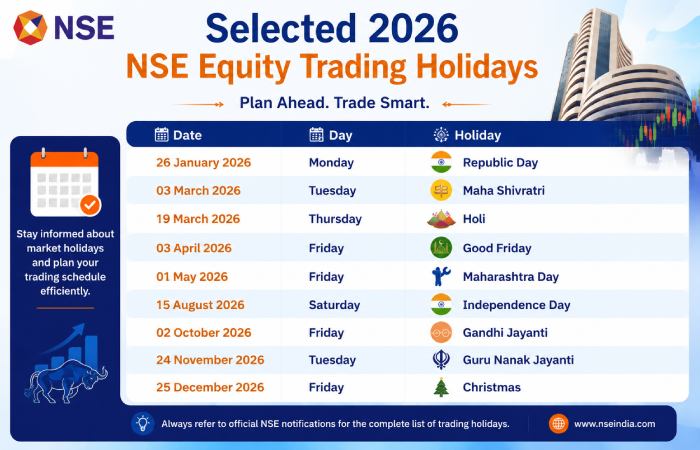
The 2026 circular for the capital-market holiday from NSE specified trading holidays such as Republic Day, Holi, Ram Navami, Mahavir Jayanti, Good Friday, Ambedkar Jayanti, Maharashtra Day, Bakri Id, Muharram, Ganesh Chaturthi, Gandhi Jayanti, Dussehra, Diwali–Balipratipada, Guru Nanak Jayanti and Christmas.
Selected 2026 NSE Equity Trading Holidays
| Date | Day | Holiday |
| January 26, 2026 | Monday | Republic Day |
| March 3, 2026 | Tuesday | Holi |
| March 26, 2026 | Thursday | Shri Ram Navami |
| March 31, 2026 | Tuesday | Mahavir Jayanti |
| April 3, 2026 | Friday | Good Friday |
| April 14, 2026 | Tuesday | Ambedkar Jayanti |
| May 1, 2026 | Friday | Maharashtra Day |
| May 28, 2026 | Thursday | Bakri Id |
| June 26, 2026 | Friday | Muharram |
| September 14, 2026 | Monday | Ganesh Chaturthi |
| October 2, 2026 | Friday | Gandhi Jayanti |
| October 20, 2026 | Tuesday | Dussehra |
| November 10, 2026 | Tuesday | Diwali-Balipratipada |
| November 24, 2026 | Tuesday | Guru Nanak Jayanti |
| December 25, 2026 | Friday | Christmas |
The exchange may also conduct special sessions or issue changes through subsequent circulars. Investors should consult the current NSE or BSE holiday calendar before planning trades.
Mahurat Trading and Indian Stock Market Timings
Mahurat Trading is a special trading session associated with Diwali.
Unlike a normal trading day, its schedule is separately announced by the exchange.
NSE’s 2026 holiday information specifically states that Mahurat Trading will be conducted on November 8, 2026, with the exact timings to be notified separately.
This is a prime example of why when you Google “Indian stock market timings” for a particular date and you get an answer other than 9:15 AM-3:30 PM.
What Happens Before 9:00 AM?
The period before the formal pre-open session should not be confused with normal exchange trading.
Investors may still:
- Read overnight news
- Analyze global markets
- Check company announcements
- Prepare watchlists
- Review futures
- Calculate support and resistance
- Set trading plans
- Decide order levels
Some brokerage applications give traders the ability to specify certain types of orders for execution before the exchange’s usual trading session, but whether such an order is acted upon before then depends on how your broker treats it, the type of order and the rules for any given exchange. So, “I can place my order in my app at 8:30 AM” isn’t always the same as “the stock market opens at 8:30 AM.”
Can You Buy Stocks Before 9:15 AM?
The answer depends on the session and order type.
During the official pre-open period, eligible securities can participate in the pre-open process.
However, pre-open trading is different from normal continuous trading.
An investor should understand:
- The exchange must be accepting the relevant order.
- The security must be eligible for the session.
- The order type must be permitted.
- The order may not execute immediately.
- Matching takes place according to the exchange’s mechanism.
The exact facilities offered through a broker can also vary.
Can You Buy Stocks After 3:30 PM?
The regular continuous equity market ends at 3:30 PM.
That does not mean all post-market mechanisms disappear immediately.
Some brokers may offer post-market order facilities, commonly known as AMO or after-market orders. However, an after-market order is not the same thing as an order executing in the normal market at 4:00 PM.
The broker may hold the order and submit it according to the applicable exchange session or next trading opportunity.
Therefore, investors should check their broker’s specific AMO rules.
What Is AMO in the Indian Stock Market?
AMO stands for After Market Order.
It allows investors to place orders outside normal market hours through participating brokers.
For example, an investor may research a stock after the market closes and prepare an order for the next trading session.
The important distinction is:
AMO availability does not extend normal stock-market trading hours.
Instead, the broker schedules or processes the order according to its rules and the exchange’s applicable trading session.
How Market Timing Affects Intraday Trading
Intraday traders open and close positions within the same trading day.
Because their positions are sensitive to short-term price movement, market timing can be especially important.
For example:
Opening phase
Potential characteristics:
- Higher volatility
- Overnight news reaction
- Large price gaps
- Rapid order flow
Mid-session
Potential characteristics:
- Consolidation
- Lower activity in some securities
- Technical setups developing
Closing phase
Potential characteristics:
- Position squaring
- Increased activity
- Rebalancing
- Strong price movements in some stocks
These are general market observations, not guaranteed patterns.
Market Gaps and the Opening Session
A stock can open substantially above or below its previous closing price.
This is called a gap.
For example:
| Previous Close | Next Opening | Gap |
| ₹1,000 | ₹1,050 | ₹50 upward gap |
| ₹1,000 | ₹980 | ₹20 downward gap |
| ₹1,000 | ₹1,000 | No meaningful gap |
Gaps can occur because of:
- Earnings
- Corporate announcements
- Global market movements
- Government policy
- Economic data
- Sector developments
- News events
The pre-open session helps incorporate available buying and selling interest into the opening price.
Why Beginners Should Understand Pre-Open Timing
A beginner might think:
“Yesterday the stock closed at ₹800, so I will buy it at ₹800 tomorrow morning.”
That assumption can be wrong.
If the stock receives significant overnight news, it may open at a completely different price.
The pre-open process helps determine where the market is willing to establish the opening price based on eligible orders.
Therefore, understanding pre-open market timing can help investors avoid confusion about opening prices.
Difference Between Opening Price and Previous Closing Price
These are two different values.
Previous closing price
The price established at the end of the previous regular trading session.
Opening price
The price established for the new trading session through the applicable opening mechanism.
The opening price may be:
- Higher than the previous close
- Lower than the previous close
- Similar to the previous close
This is why the stock market does not necessarily continue exactly where it left off the previous afternoon.
Stock Market Timings for Beginners
If you are completely new to the Indian stock market, remember these five numbers:
| Key Time | Meaning |
| 9:00 AM | Pre-open session starts |
| 9:08 AM | Main pre-open order-entry period generally ends, subject to exchange mechanism |
| 9:15 AM | Normal equity trading starts |
| 3:30 PM | Normal equity trading ends |
| 3:40–4:00 PM | Closing/post-market session activity |
For most beginner investors, the most important number is 9:15 AM to 3:30 PM.
Common Mistakes About Indian Stock Market Timings
Mistake 1: Assuming the market opens at 9:00 AM for normal trading
The pre-open session starts at 9:00 AM, but normal continuous equity trading begins at 9:15 AM.
Mistake 2: Assuming everything stops at 3:30 PM
Normal continuous equity trading ends at 3:30 PM, but exchange-related closing and post-market processes can continue.
Mistake 3: Treating every segment the same
Equity, currency, commodity, debt and other segments can have different schedules.
Mistake 4: Ignoring holidays
The market may be closed even though it is Monday through Friday.
Mistake 5: Assuming AMO is regular trading
An after-market order does not mean the stock is continuously trading outside official hours.
Mistake 6: Assuming NSE and BSE have completely different schedules
For regular equity trading, their core timings are broadly aligned.
Indian Stock Market Timings vs Global Markets
Indian investors often monitor global markets because international movements can influence domestic sentiment.
The major difference is that each country has its own time zone and trading schedule.
For example:
| Market | Approximate Normal Hours | Time Zone |
| India | 9:15 AM – 3:30 PM | IST |
| U.S. markets | Varies by exchange | U.S. Eastern Time |
| London | Varies | UK time |
| Japan | Varies | Japan Standard Time |
| Hong Kong | Varies | Hong Kong Time |
Because international markets may be open while Indian markets are closed, significant developments can occur overnight from an Indian investor’s perspective.
This can contribute to opening gaps in Indian stocks.
How to Plan Your Trading Day Around Indian Trading Hours
A disciplined trader can divide the day into several stages.
Before 9:00 AM
Research:
- Global markets
- News
- Corporate announcements
- Earnings
- Economic events
- Sector trends
9:00 AM–9:15 AM
Observe the pre-open market.
Focus on:
- Expected opening prices
- Significant gaps
- Stocks reacting to news
- Market sentiment
9:15 AM–10:00 AM
Monitor the opening market carefully.
Avoid making impulsive decisions simply because prices are moving quickly.
10:00 AM–2:30 PM
Follow your trading plan.
Look for setups based on your chosen strategy rather than constantly entering and exiting positions.
2:30 PM–3:30 PM
Review:
- Open positions
- Stop losses
- Profit targets
- Intraday exposure
- Closing requirements
After 3:30 PM
Review the day’s performance and prepare for the next session.
Does the Indian Stock Market Trade 24 Hours?
No.
The regular Indian equity market does not operate continuously for 24 hours.
Normal equity trading occurs during the designated exchange session, generally 9:15 AM to 3:30 PM IST.
Some other financial markets and international instruments have substantially longer trading windows, but that should not be confused with India’s regular equity market.
What Is the Importance of 3:30 PM?
3:30 PM is the standard closing point for continuous equity trading.
It is important because:
- Intraday traders need to manage positions
- Closing prices are established
- Daily market statistics are finalized
- Portfolio values are updated
- Investors can evaluate the day’s performance
However, the closing process can continue after 3:30 PM.
What Is the Closing Session?
The closing session is a separate phase from normal continuous trading.
NSE lists a closing session from 3:40 PM to 4:00 PM. BSE similarly identifies closing and post-closing periods after the 3:30 PM continuous market close.
Investors should understand that the closing session is not simply an extension of normal intraday trading.
Its purpose and order handling can differ from the continuous market.
Does the Stock Market Open Every Day?
No.
The Indian stock market is normally open on weekdays except exchange-declared trading holidays.
In addition:
- Saturdays are normally closed.
- Sundays are normally closed.
- Certain public holidays are trading holidays.
- Special sessions may be announced.
- Muhurat Trading may operate on a separately announced schedule.
The exchange holiday calendar should therefore be checked before planning a trade.
Why Exchange Timings Can Change
Market timings are not permanently fixed for every situation.
An exchange can announce special arrangements because of:
- Technical disruptions
- Major market events
- Regulatory changes
- Special trading sessions
- Contingency exercises
- Settlement changes
- Festivals
- Market-wide circuit events
NSE, for example, publishes contingency-drill/mock-trading schedules separately. (NSE India)
This is why professional traders rely on official exchange notices rather than old articles.
Indian Stock Market Timings: Quick Reference Table
| Question | Answer |
| What time does the Indian stock market open? | 9:15 AM for normal equity trading |
| What time does pre-open start? | 9:00 AM |
| What time does the Indian stock market close? | 3:30 PM for normal equity trading |
| What are NSE market timings? | 9:15 AM–3:30 PM for normal equity trading |
| What are BSE market timings? | 9:15 AM–3:30 PM for continuous equity trading |
| What is the pre-open market timing? | 9:00 AM–9:15 AM |
| Is the market open Saturday? | Normally no |
| Is the market open Sunday? | Normally no |
| Is trading available on holidays? | Normally no, unless a special session is announced |
| What is IST? | Indian Standard Time |
| Is AMO normal trading? | No |
| Do derivatives have identical timings? | Not necessarily |
| Do commodity markets have longer hours? | Yes |
Final Takeaway: Indian Stock Market Timings
Understanding Indian stock market timings is one of the first things every investor and trader should learn.
For the regular equity market, the most important schedule is:
Pre-open: 9:00 AM–9:15 AM
Normal trading: 9:15 AM–3:30 PM
Closing/post-market activity: After 3:30 PM, according to applicable exchange mechanisms.
Both NSE market timings and BSE market timings follow the same core schedule for normal equity trading. The most important distinction to remember is that 9:00 AM is the start of the regular pre-open process, while 9:15 AM is the start of normal continuous equity trading.
Similarly, 3:30 PM is the normal stock market closing time for continuous equity trading, but certain exchange processes can continue afterward.
Finally, market schedules can change for special sessions, holidays, regulatory reasons or exchange announcements. NSE’s current market-timing information and official holiday/circular pages should be checked before acting on a specific trading date.