

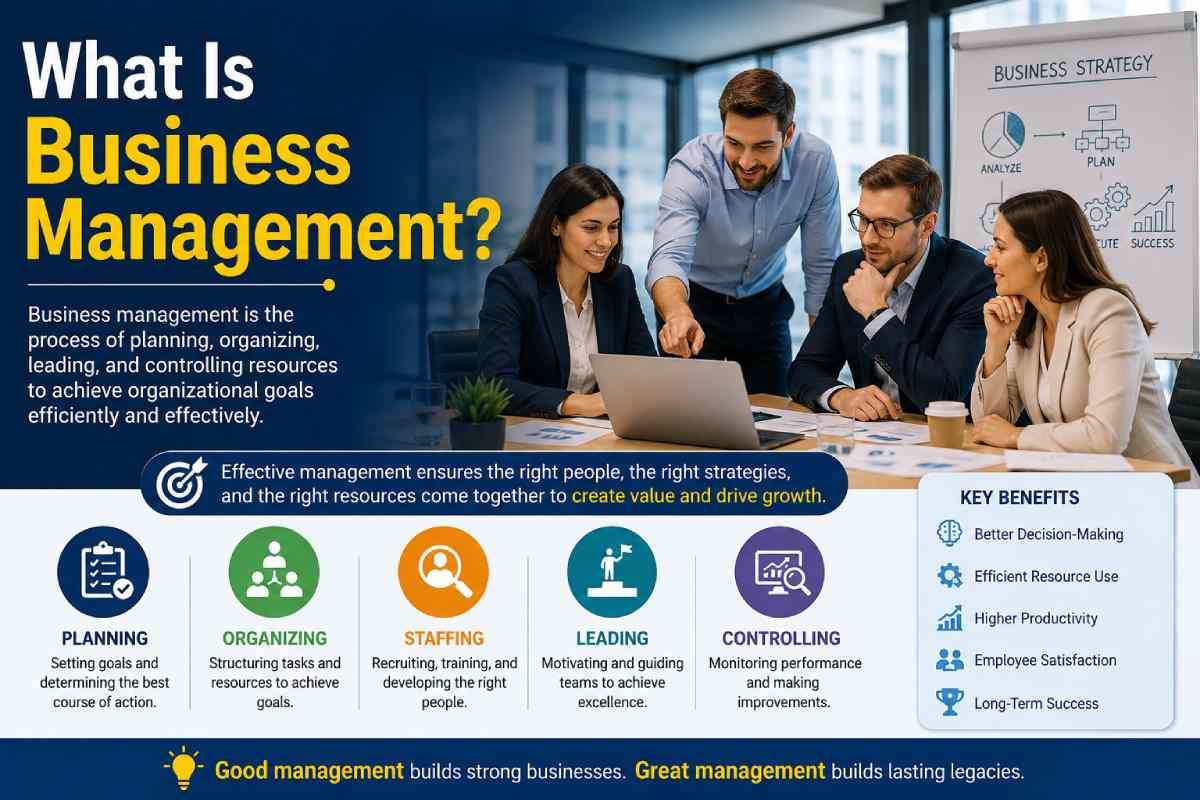
What Is Business Management? A Complete Guide to Principles and Functions

Management in the workplace is critical to success in any enterprise-large or small. For every entrepreneur, manager, student, and professional eager to lead an enterprise, establishing a sound foundation for business management and operations is imperative to success and profitability. The most successful entrepreneurs rely on business management principles for a firm, organized approach to building and sustaining a business in this dynamic landscape.
Business management requires leaders to think, plan, coordinate, and execute tasks strategically, taking ownership of objectives while steering a company through complex processes to achieve maximum output and profitability.
This resource delves into business management by providing you with a business management definition, business management functions, and why business management is crucial to organizational excellence and growth. You’ll uncover the basic principles of management and essential business administration concepts that business leaders and entrepreneurs should be acquainted with for optimized decision-making and enhanced productivity.
This Article is the part of Business Planning
Business Management Definition

Business management is about working with various aspects of a business-including people, financial aspects, technology, operations, and much more-in a way that will bring about a planned set of goals successfully and efficiently.
This process typically involves strategy setting, decision making, financial planning, staffing, leadership, controlling resources, and more. In its basic form, business management is just managing various parts of a business in order for them to operate together in producing an output for the organization in an economically sustainable manner.
Simple Business Management Definition
| Aspect | Explanation |
| Meaning | Managing business resources efficiently |
| Purpose | Achieve organizational goals |
| Focus | Planning, organizing, leading, and controlling |
| Scope | Finance, marketing, operations, HR, and strategy |
| Outcome | Business growth and long-term sustainability |
It is applicable in all kinds of organizations whether it be a manufacturing concern, a retail outfit, a health care institution, a school/university, a technology-based firm or a charitable body.
Business Management Basics

Business management basic understanding would guide people know how business succeeds. A business enterprise is actually dependent on management for daily coordination and strategic preparation.
Business management includes several essential responsibilities:
- Setting business objectives
- Developing business strategies
- Managing employees
- Allocating financial resources
- Monitoring organizational performance
- Solving operational problems
- Improving productivity
- Managing business risks
The successful managers combine long-range strategic planning with the operational necessity to run day-to-day. They will need to be agile enough to respond to shifts in their market.
Core Functions of Business Management
One of the most important topics when learning what business management is understanding its primary functions.
Functions of Business Management
| Function | Description | Example |
| Planning | Setting goals and creating strategies | Annual business plan |
| Organizing | Allocating resources and assigning responsibilities | Department structure |
| Staffing | Recruiting and developing employees | Hiring skilled professionals |
| Leading | Motivating and guiding teams | Team leadership |
| Controlling | Monitoring performance and making improvements | Budget tracking |
1. Planning
The initial, most vital management task is planning. The function involves determining objectives, fore-casting future conditions and devising plans for the activities needed.
Good planning helps businesses:
- Reduce uncertainty
- Prepare for market changes
- Allocate resources effectively
- Improve decision-making
Without planning, organizations often struggle with inefficiency and inconsistent performance.
2. Organizing
organizing involves how people, technology, financial assets, and physical resources are arrayed or arranged in an organized manner to facilitate achieving an objective.
This function includes:
- Defining job roles
- Creating departments
- Establishing reporting structures
- Allocating responsibilities
3. Staffing
Employees represent one of the largest resources any business may utilize to the advantage of its objectives. Employing means hiring staff to teach, assess and hold quality.
Effective staffing involves:
- Workforce planning
- Recruitment
- Employee training
- Performance evaluation
- Career development
Organizations that invest in employees often achieve higher productivity and lower turnover rates.
4. Leading
Leadership entails the art of influencing and persuading people in order to get their maximum contributions towards a particular objective.
Managers lead by:
- Communicating clearly
- Inspiring teamwork
- Resolving conflicts
- Building trust
- Encouraging innovation
5. Controlling
Planning involves developing business objectives while Controlling makes sure business activities will occur as planned and business actual results will coincide with business planned objectives.
Managers monitor:
- Financial performance
- Employee productivity
- Operational efficiency
- Customer satisfaction
- Quality standards
Importance of Business Management
There are countless ways a strong management is the catalyst for any successful business operation and it involves a much deeper scope than simply keeping tabs on employees.
Why Business Management Is Important
| Benefit | Business Impact |
| Better decision-making | Improves business performance |
| Efficient resource utilization | Reduces waste |
| Employee motivation | Higher productivity |
| Financial stability | Better profitability |
| Customer satisfaction | Stronger brand loyalty |
| Strategic growth | Long-term sustainability |
A structure is implemented by business management so organizations will cope well in facing competition, technology shifts, and economic challenges.
It also facilitates firms in capitalising on opportunities in a market, ensuring a great customer service, and remaining in control of daily activities.
Essential Management Principles
Every successful manager follows established management principles that guide organizational decision-making.
Key Management Principles
| Principle | Purpose |
| Division of Work | Improve specialization |
| Authority and Responsibility | Balance leadership with accountability |
| Discipline | Maintain organizational standards |
| Unity of Direction | Align everyone toward common goals |
| Equity | Treat employees fairly |
| Initiative | Encourage innovation |
| Team Spirit | Promote collaboration |
These principles continue to influence modern management practices across industries.
Explore our comprehensive guide to business management software to learn how modern solutions can simplify workflows and increase productivity.
Business Administration Concepts
Business Management deals with managing the activities of the organization whereas business administration includes overall running business aspects and making a profit out of the operations.
These concepts include:
- Financial management
- Marketing management
- Human resource management
- Operations management
- Supply chain management
- Strategic management
- Information management
- Business ethics
- Corporate governance
Business administration integrates these functional areas into one cohesive organizational strategy.
Skills Required for Effective Business Management
Business managers need both technical knowledge and interpersonal abilities.
Essential Management Skills
| Skill | Why It Matters |
| Leadership | Guides employees toward goals |
| Communication | Improves collaboration |
| Decision-making | Solves business challenges |
| Financial literacy | Controls budgets and investments |
| Strategic thinking | Supports long-term planning |
| Problem-solving | Handles operational issues |
| Time management | Increases productivity |
| Adaptability | Responds to changing markets |
Managers who continuously develop these skills are better equipped to lead successful organizations.
Challenges in Business Management
Even experienced managers face numerous challenges in today’s business environment.
Common challenges include:
- Rapid technological advancements
- Economic uncertainty
- Employee retention
- Cybersecurity risks
- Increasing competition
- Changing customer expectations
- Supply chain disruptions
- Regulatory compliance
Successful organizations overcome these challenges through innovation, strategic planning, and continuous improvement.
Modern Trends in Business Management
Business management continues to evolve with technology and globalization.
Current trends include:
| Trend | Business Benefit |
| Artificial Intelligence | Smarter decision-making |
| Remote work management | Greater workforce flexibility |
| Data analytics | Better business insights |
| Digital transformation | Increased efficiency |
| Sustainable business practices | Improved corporate reputation |
| Cloud computing | Better collaboration |
| Automation | Reduced operational costs |
Business Leaders who are prepared for these shifts in market conditions will ensure their companies thrive for years to come. Tips to Good Business Management When an organization succeeds on a consistent basis, a business management team that consistently executes good management practices is usually at the heart of that success. In a business that is performing at a high level, management should always have clear goals and provide effective communication and feedback regarding performance metrics, employee development and sound, fact-based decisions.
If businesses continue to reinforce the values of accountability and continuous improvement, they are much more likely to have a more productive organization that can successfully meet any new market challenges.
Managers who regularly review company financials, examine customer reviews, and regularly evaluate employee engagement in addition to their normal business duties will help organizations maintain high levels of productivity and sustain growth.
Conclusion
The basics of the business management definition Business management principles is a fundamental understanding that every individual with the intent to lead or to foster an expanding and successful business will need. Far more than just being able to lead or supervise staff; business management will look to plan, organize, staff, lead and control all parts of an entire business. Management functions of the business The functions of business management simply bring about efficiency within an organization; business management is therefore of great importance as it brings efficiency, profitability, employee fulfillment and also long-term endurance to an business.
By implementing some proven business management basic concepts as well as higher level business management fundamentals, a business can simply still sustain its position on the competitive marketplace.
Whether starting a business or if a currently established organization must have effective management strategies put in place; business management basics offer the basic organizational tools necessary for sustainable success.