

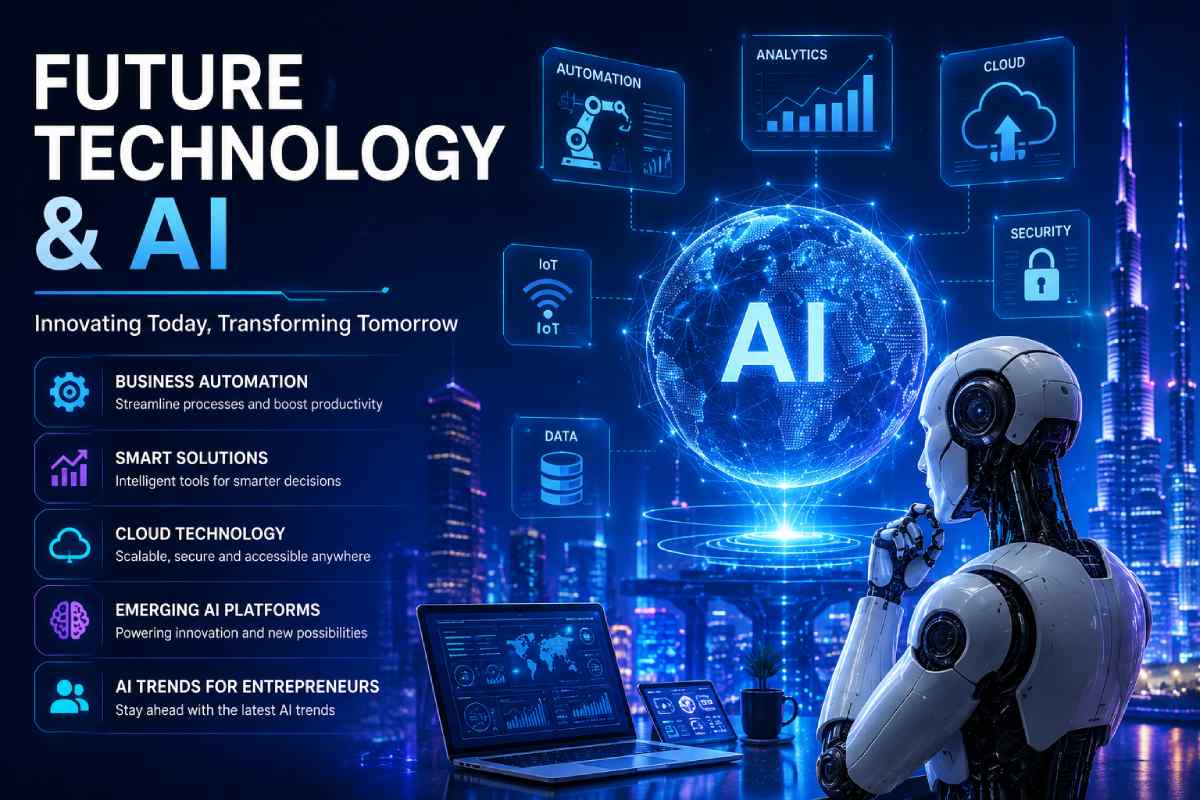
Future Technology & AI: Transforming the Future of Business

As you would expect from a technology at the heart of most of the trends in business that have emerged in the past decade, the impact that AI is having on the world of business is quite profound. We are finding it to be a tool that not only allows us to cut down the workload by automating the repetitive elements of business but also one that enables smarter data led decisions. The latest trends in the world of AI technologies are also providing opportunities for start-ups, as well as medium sized and large businesses and new opportunities to embrace such as the cloud, automated operations and Big Data Science. As you would expect from AI we are all ready seeing this enable businesses to not only reduce operational expenditure and increase productivity but also enable enhanced individual customer relations.
Smart company options include cloud business apps, new enterprise AI platforms, and AI automation are becoming a must for entrepreneurs and company executives looking ahead to the coming years. As entrepreneurs and company executives plan for the approaching decade, learning about the future of business automation, AI developments for business, smart business options, and advanced cloud services is critical.
This article is a part of Business Software Reviews
The Future of Business Automation
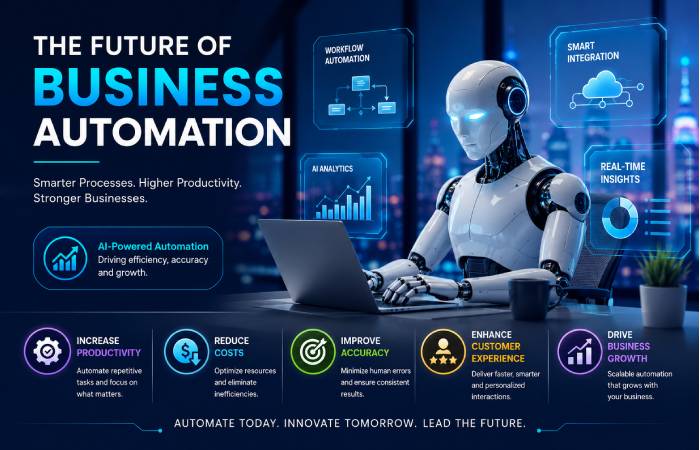
The landscape of business process automation is rapidly evolving and has moved beyond RPA or basic workflow automation to become intelligent. What we call as “intelligent process automation” now encompasses machine learning, AI and business rules to drive operational intelligence for various enterprises and facilitate significant business outcomes. Several analyses and studies suggest the overall market of business process automation has been changing and would continue to transform over years of time in years to come from the way we traditionally understand.
Key Benefits of Business Automation
|
Benefit |
Impact on Business |
|
Increased Productivity |
Reduces manual tasks and improves efficiency |
|
Cost Savings |
Lowers operational expenses |
|
Improved Accuracy |
Minimizes human errors |
|
Faster Decision-Making |
Uses real-time analytics |
|
Better User Experience |
Enables personalized interactions |
Some so many companies and products are directly incorporating AI into operations instead of thinking about AI as a tool. In businesses that can deeply incorporate AI into how they operate, they get better scaling and efficiency.
AI Trends for Entrepreneurs
Entrepreneurs AI innovation’s biggest supporters often are start-ups. You have access to business technology without major upfront infrastructure investments for marketing, customer service, sales forecasting, business analytics, and other functions.
Several emerging AI trends are expected to shape entrepreneurship in the coming years:
|
AI Trend |
Business Application |
|
Generative AI |
Content creation and customer engagement |
|
AI Agents |
Automated business operations |
|
Predictive Analytics |
Demand forecasting |
|
Conversational AI |
Customer support automation |
|
AI-Powered Decision Systems |
Strategic planning |
“We are moving away from an era of rigid, legacy software applications and building smart agents that can communicate with other applications and learn from their experiences to make decisions on the fly,” according to the report.AI adoption also is picking up speed at start-ups as well: AI will speed up innovation, open up new business models, and empower companies with smaller footprints to engage in business previously dominated by larger ones.
Smart Business Solutions in the AI Era
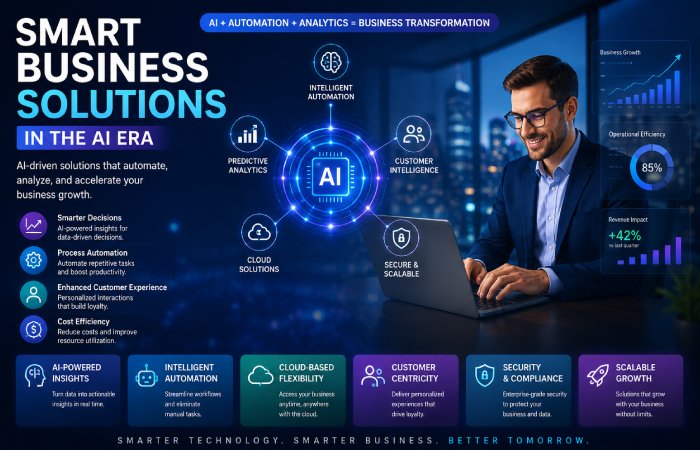
Smart business solutions integrating AI, automation, analytics and the cloud. The rise of efficiency Business Ecosystem Management A smart business solution blends the benefits of AI, automation, Analytics and the Cloud to develop extremely effective, efficient business ecosystems which help organizations to deliver excellence but with greater flexibility and scale.
Modern smart business systems commonly include:
- AI-powered customer relationship management (CRM)
- Automated workflow platforms
- Intelligent financial management systems
- Predictive inventory management
- AI-enhanced cybersecurity tools
Comparison of Traditional vs Smart Business Solutions
|
Feature |
Traditional Systems |
Smart AI Solutions |
|
Data Analysis |
Manual Reporting |
Real-Time Insights |
|
Customer Support |
Human Agents Only |
AI Chatbots + Humans |
|
Process Management |
Static Workflows |
Adaptive Automation |
|
Decision Making |
Historical Data |
Predictive Intelligence |
|
Scalability |
Limited |
Highly Scalable |
This transition is being increasingly driven by AI-enabled enterprise platforms. Modern business AI solutions that can seamlessly integrate with an assortment of business applications, parse structured and unstructured data, and automate end-to-end processes across departments.
If you’re assessing whether these tools are the right fit for your organization, reviewing an in-depth comparison guide can help you evaluate features, pricing considerations, and competitive advantages against alternative business platforms.
Cloud-Based Business Tools: The Foundation of Digital Transformation
Cloud computing has evolved into the cornerstone of modern enterprise technology, so many organizations around the globe are gravitating towards cloud technologies. One explanation is that cloud solutions offer security, flexibility, scalability, affordability and also make managing IT infrastructures so much easier and so much less costly.
Cloud platforms enable businesses to:
- Access applications from anywhere
- Scale resources on demand
- Improve collaboration among teams
- Integrate AI services seamlessly
- Strengthen disaster recovery capabilities
Popular Cloud-Based Business Functions
|
Business Function |
Cloud-Based Solution |
|
Collaboration |
Shared workspaces |
|
Data Storage |
Cloud databases |
|
Customer Management |
Cloud CRM |
|
Analytics |
Cloud BI platforms |
|
AI Development |
AI-as-a-Service |
The rise of AI will continue to fuel the cloud, with analysts expecting it to continue pushing cloud demand as cloud services offer the capacity and management expertise for sophisticated AI solutions. Furthermore, cloud computing is Democratizing advanced solutions in SME spaces.
Emerging AI Platforms and Their Business Impact
The focus of the next generation of AI platforms are intelligent agents, automation and the business of decision making, with Context. This is taking us further than Chabot’s into a business assistant, a virtual employee, a team assistant.
Characteristics of Emerging AI Platforms
|
Capability |
Description |
|
Autonomous Actions |
Performs tasks without constant supervision |
|
Context Awareness |
Understands business-specific information |
|
Multi-System Integration |
Connects with existing software |
|
Workflow Automation |
Executes end-to-end business processes |
|
Continuous Learning |
Improves performance over time |
Meanwhile, a recent survey reveals AI services are becoming more ecosystem-like, offering more functionality to assist not only marketing but sales, finance and operations by automating them through smart applications. As these tools mature, domain-specific AI-which is tailored to a specific industry or business line-is set to gain traction, with analysts expecting those platforms will offer more precise and business-impactful answers than.
Challenges Businesses Must Address
While the opportunities are significant, organizations must also prepare for the challenges associated with AI adoption.
|
Challenge |
Recommended Solution |
|
Data Privacy |
Implement strong governance |
|
AI Bias |
Regular model auditing |
|
Workforce Adaptation |
Employee training programs |
|
Security Risks |
Advanced cybersecurity measures |
|
Regulatory Compliance |
AI governance frameworks |
Experts emphasize that governance, transparency, and responsible AI implementation will become increasingly important as organizations integrate AI into critical business operations.
Conclusion
Technology and AI’s Role In Changing the Face of Business. What you should know? The Future of business automation is automated technology which analyses, learns and works on its own. Future of Business Automation AI Trends For Entrepreneurs highlights several opportunities for business expansion innovation.
Smart Business Solutions provides innovative technologies which enables businesses and Cloud-Based Business Tools supporting it to turn smarter and data – driven businessmodel and cloud technology that empowers them to manage business better in the digital era.
The new Emergence AI Platforms include intelligent automation, autonomous agent based automation as well as predictive intelligence that brings you the possibility to boost your workflow process. Business should adapt this strategy so that they have better opportunity to lead in the digital era.