

New Tax Regime in India: Tax Slabs, Deductions, Benefits & Exemptions

Last Updated: September 14, 2026
The New Tax Regime is now an integral part of the Indian income-tax system, wherein a taxpayer is liable to pay lower rate of taxes on multiple slabs of income in lieu of various deductions and exemptions. The New Tax Regime has come to be applicable under Section 115BAC of the Income Tax Act, 1961.
The new tax regime under Section 115BAC is the default tax regime for eligible taxpayers, although eligible taxpayers can opt for the old regime. For the latest official tax slabs and rules, refer to the Income Tax Department’s official guidance.
Beginning in A.Y 2024-25, the new tax regime was the default tax regime for certain individual tax payers, but eligible taxpayers are free to revert to the old regime subject to current rules.
The structure was further revised from AY 2026–27, with the highest 30% slab beginning above ₹24 lakh and a higher Section 87A rebate for eligible resident individuals.
This Article Belongs to Tax Tips
What is the New Tax Regime?
The new income tax regime is an alternative method of calculating income tax in India. Unlike the old regime, which offers numerous deductions and exemptions, the new regime generally provides lower slab rates but allows fewer tax deductions and exemptions.
The objective is to make new tax regime income tax calculations relatively straightforward while reducing the dependence on tax-saving investments merely for claiming deductions.
Under Section 115BAC, eligible taxpayers can be taxed according to the specified slab rates instead of the traditional old-regime slabs.
Key features of the New Tax Regime
- It is the default tax regime for eligible taxpayers.
- It has more income slabs than the old regime.
- The maximum slab rate is 30%.
- The 30% rate applies to income above ₹24 lakh under the current structure.
- Several deductions and exemptions available under the old regime are not available.
- The Section 87A rebate can substantially reduce tax for eligible resident individuals with income within the specified limit.
- Salaried taxpayers can claim the standard deduction of ₹75,000 under the new regime.
New Tax Regime Tax Slabs
Understanding the new tax regime tax slabs is essential before calculating your tax liability.
For AY 2026–27, the slabs applicable under the new regime are as follows:
| Taxable Income | Tax Rate |
| Up to ₹4 lakh | Nil |
| ₹4 lakh – ₹8 lakh | 5% |
| ₹8 lakh – ₹12 lakh | 10% |
| ₹12 lakh – ₹16 lakh | 15% |
| ₹16 lakh – ₹20 lakh | 20% |
| ₹20 lakh – ₹24 lakh | 25% |
| Above ₹24 lakh | 30% |
Tax rates under the new tax regime are as follows: These are progressive slabs, i.e., you pay a percentage of tax for each respective slab.
For example: your taxable income is Rs 16 lakh, but the whole Rs 16 lakh does not get taxed at 15%, as 10% is also a tax slab.
Example of tax calculation
Suppose an individual’s taxable income is ₹16 lakh.
| Income Portion | Rate | Tax |
| Up to ₹4 lakh | Nil | ₹0 |
| ₹4–8 lakh | 5% | ₹20,000 |
| ₹8–12 lakh | 10% | ₹40,000 |
| ₹12–16 lakh | 15% | ₹60,000 |
| Total | ₹1,20,000 |
The applicable health and education cess and any surcharge, where applicable, are considered separately.
New Tax Regime and Section 87A Rebate
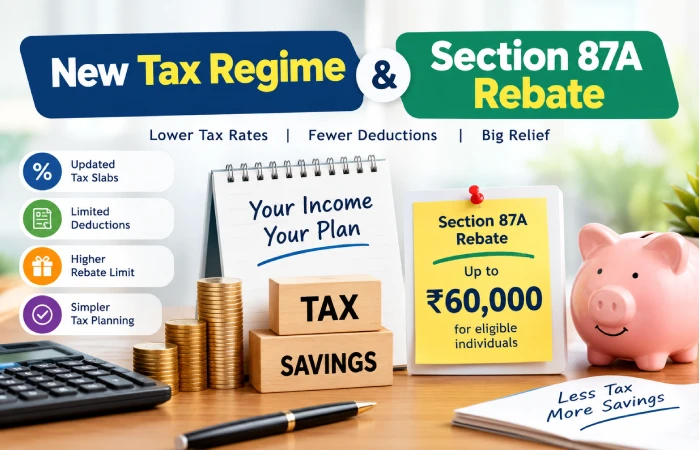
The most important new tax regime benefit for eligible resident individuals is the Section 87A rebate.
AY 2026-27 Rebate under Section 87A for the new regime increased to 60,000 for eligible taxpayers with total income up to 12 lakh.
So this provides relief to an eligible resident individual whose gross total income does not cross Rs 12 lakh after allowing the rebate, under the extensive conditions of the law.
What about salaried individuals?
The available standard deduction for salaried taxpayers under the new regime could also lead to a reduction in taxable salary income.
For instance, a salaried worker earning 12.75 lakh could potentially limit the taxable income using the permissible standard deduction of 75,000 to as low as 12 lakh. The Section 87A rebate if applicable and law.
This is one reason the new regime can be attractive to salaried taxpayers with moderate deductions.
New Tax Regime Deductions
One of the biggest differences between the two regimes concerns new tax regime deductions.
The new regime does not permit many of the popular deductions available under the old regime. However, certain deductions continue to be available.
Some important deductions or benefits that may be available under the new regime include:
1. Standard deduction for salary
Salaried person can claim the benefit of available standard deduction of Rs. 75,000 in case of new regime. This deduction is available without investing any money by the taxpayer and also is available for the taxpayers earning salaries.
2. Employer’s contribution to NPS
Deduction in relation to contribution by employer towards National Pension System under clause (2) of section 80CCD, subject to prescribed limit and conditions, by an employee.
This is particularly relevant for employees whose employers contribute to NPS.
3. Certain deductions for business income
Taxpayers in business or profession income category may avail certain deductions, being allowed under the new regime in the case of income and provisions of the Income Tax Act. Thus, a deduction is not lost under Section 115BAC.
Therefore, taxpayers should not assume that every deduction disappears under Section 115BAC.
New Tax Regime Exemptions
The new tax regime exemptions are more restricted compared with the old tax regime.
Common exemptions and deductions associated with the old regime, such as certain HRA and investment-related deductions, generally cannot be claimed under the new regime.
However, some specific exemptions or exclusions continue to apply depending on the nature of income.
For salaried employees, the treatment of allowances and benefits needs to be examined individually because not every salary component receives the same tax treatment.
Important distinction
The new regime does not mean that absolutely no deduction or exemption is available. Instead, the law restricts the deductions and exemptions that can be claimed compared with the old regime.
Therefore, taxpayers should evaluate their complete salary structure and investments before selecting a regime.
Popular Deductions Generally Not Available Under the New Regime
Taxpayers considering the new regime should understand what they may lose compared with the old system.
Some commonly used deductions/exemptions that are generally not available under the new regime include:
| Deduction/Exemption | New Regime |
| Section 80C investments | Generally not available |
| Section 80D medical insurance deduction | Generally not available |
| HRA exemption | Generally not available |
| Self-occupied home-loan interest deduction under Section 24(b) | Generally not available |
| Education loan interest under Section 80E | Generally not available |
| Certain other Chapter VI-A deductions | Generally not available |
The exact tax treatment depends on the nature of income and the specific provision involved.
New Tax Regime Benefits
There are several new tax regime benefits that can make this system attractive.
1. Lower tax rates across several slabs
The new regime spreads taxable income across more slabs and applies relatively lower rates to various income ranges.
2. Simpler tax planning
Taxpayers who do not have substantial investments eligible for deductions may find the new regime easier to understand.
3. Higher income threshold for the 30% slab
Under the current structure, the 30% slab begins above ₹24 lakh, compared with the lower threshold under the old regime.
4. Higher Section 87A rebate
The enhanced rebate can result in zero tax for eligible resident individuals whose total income falls within the prescribed threshold.
- Useful for taxpayers with fewer deductions
People who do not claim significant deductions for investments, insurance, housing or other eligible expenses may benefit from the new regime.
New Tax Regime vs Old Tax Regime
The most important decision for many taxpayers is whether to remain under the new regime or choose the old regime.
| Feature | New Tax Regime | Old Tax Regime |
| Default regime | Yes | No |
| Tax rates | Generally lower/more slabs | Higher rates at certain levels |
| Standard deduction for salary | Available | Available |
| Section 80C | Generally unavailable | Available |
| Section 80D | Generally unavailable | Available |
| HRA exemption | Generally unavailable | Available subject to conditions |
| Home-loan interest benefit | Restricted | More deductions available |
| Tax planning | Relatively simple | Requires more tax planning |
| Suitable for | People with fewer deductions | People with substantial eligible deductions |
The better option depends on individual circumstances rather than simply choosing the regime with the lowest headline tax rate.
Who Should Consider the New Tax Regime?
The new regime may be particularly suitable for:
Salaried employees with limited deductions
If you do not invest large amounts in tax-saving instruments and do not claim significant HRA or other exemptions, the new regime may provide a simpler calculation.
Young professionals
Individuals at the beginning of their careers may not yet have significant housing loans, insurance deductions or other tax-saving investments.
Taxpayers seeking simplicity
People who prefer straightforward tax calculation rather than maintaining records of numerous deductions may find the new system convenient.
Individuals with higher income
The revised slabs may provide advantages to some higher-income taxpayers, although the comparison should be made after considering all available deductions under the old regime.
Who May Prefer the Old Tax Regime?
The old regime can still be beneficial for taxpayers who have substantial eligible deductions.
For example, someone who has:
- Significant Section 80C investments
- Health insurance premiums eligible for Section 80D
- HRA exemption
- Eligible home-loan interest
- Education-loan interest
- Other qualifying deductions
may find that the deductions under the old regime offset its higher slab rates.
Therefore, a high-deduction taxpayer should calculate tax under both systems before making a decision.
How to Choose Between the Two Tax Regimes
A practical way to compare the regimes is to follow these steps:
- Calculate your gross total income: Include salary, interest, rental income, capital gains and other taxable income as applicable.
- Identify deductions and exemptions: Under the old regime, list all eligible deductions and exemptions you can claim.
- Calculate taxable income under both regimes: The new regime permits fewer deductions, so its taxable income may be higher even though the slab rates are lower.
- Calculate the final tax liability: Include applicable rebate, surcharge and health and education cess.
- Choose the regime that results in the lower legitimate tax liability: For many non-business taxpayers, the choice can generally be changed from year to year in the income-tax return, subject to the applicable rules.
Section 115BAC Explained
Section 115BAC is the key provision governing the new tax regime for eligible taxpayers.
The regime was initially introduced as an optional system. Thereafter, the regime evolved and the new regime became the default regime for eligible individual taxpayers and some other taxpayers starting the financial year 2024-25.
Ways to pay income tax Under Section 115BAC, taxpayers enjoy the benefit of the specified slab rates in return for relinquishing many deductions and exemptions of the old regime.
The section therefore creates a trade-off:
Lower rates + fewer deductions = simpler taxation
versus
Higher traditional rates + more deductions = greater tax-planning flexibility
Is the New Tax Regime Automatically Applicable?
Yes, for eligible taxpayers, the new regime is the default regime.
However, eligible taxpayers can generally choose the old regime subject to the applicable conditions and filing requirements.
For taxpayers having income from business or profession, the rules for exercising and withdrawing the option are more restrictive. The Income Tax Department states that eligible business/profession taxpayers opting out of the default regime use Form 10-IEA within the prescribed timeline.
Therefore, business taxpayers should pay particular attention to the applicable filing requirements.
New Tax Regime Income Tax: Important Things to Remember
When calculating new tax regime income tax, taxpayers should remember that the slab rate is only one part of the calculation.
Other factors can affect the final liability, including:
- Total taxable income
- Salary standard deduction
- Eligible deductions
- Section 87A rebate
- Special-rate income
- Capital gains
- Surcharge
- Health and education cess
- Nature and source of income
- Residential status
Certain types of income, such as specified capital gains, may be taxed under special provisions rather than simply applying the normal slab rates.
Therefore, taxpayers should not estimate their entire tax liability by applying the slab rate to their total income.
Example: New Tax Regime Calculation
Consider a salaried taxpayer with an annual salary of ₹15 lakh.
Assuming the applicable ₹75,000 standard deduction, taxable salary may be ₹14.25 lakh before considering other applicable adjustments.
The normal slab calculation would then broadly work as follows:
| Taxable Income Portion | Rate | Tax |
| ₹0–₹4 lakh | 0% | ₹0 |
| ₹4–₹8 lakh | 5% | ₹20,000 |
| ₹8–₹12 lakh | 10% | ₹40,000 |
| ₹12–₹14.25 lakh | 15% | ₹33,750 |
| Total tax before cess | ₹93,750 |
The final amount can vary depending on the taxpayer’s complete income profile, applicable rebate, special-rate income, surcharge and other provisions.
This example demonstrates why the new regime should be calculated progressively rather than applying a single percentage to total income.
Advantages and Disadvantages of the New Tax Regime
Advantages
- Lower rates across several income slabs
- More straightforward tax calculation
- Fewer investment-related tax-planning requirements
- Higher threshold for the 30% slab under the current structure
- Higher Section 87A rebate for eligible taxpayers
- Attractive for people with limited deductions
- Default regime for eligible taxpayers
Disadvantages
- Many popular deductions are unavailable
- HRA exemption is generally unavailable
- Section 80C benefits are generally unavailable
- Section 80D deduction is generally unavailable
- Taxpayers with substantial deductions may benefit more from the old regime
- Business/profession taxpayers face additional rules regarding switching regimes
Frequently Asked Questions
What is the New Tax Regime?
The New Tax Regime is an alternative income-tax system under Section 115BAC that provides revised tax slabs and generally lower rates while restricting many deductions and exemptions.
What is the new tax regime tax slab for ₹12 lakh income?
As per the Old normal slab rate, 0% rate on Income up to 4 lacs, 5% rate on Income from 4lacs to 8lacs and 10% rate on Income from 8lacs to 12lacs. Resident individual if eligible can avail section 87A rebate if conditions are met.
Is ₹12 lakh income tax-free under the new regime?
So, the rebate will be sufficient to wipe out the entire tax liability of an eligible resident individual in case the total income remains below the cap of 12 lakh as prescribed under the law. Rules in this regard shall apply. Salaried taxpayers may also claim the standard deduction.
Can I claim 80C in the new tax regime?
Generally, Section 80C deductions are not available under the new regime. However, certain specified deductions continue to be permitted.
Is HRA exempt under the new tax regime?
The HRA exemption available under the old regime is generally not available under the new regime.
Is the new tax regime mandatory?
The new regime is the default regime for eligible taxpayers, but eligible taxpayers can generally opt for the old regime subject to applicable conditions.
What is Section 115BAC?
Section 115BAC is the provision of the Income Tax Act that governs the concessional tax regime for eligible taxpayers.
Conclusion
The New Tax Regime has significantly changed the way individuals approach income-tax planning in India. Its wider slab structure, lower rates at several income levels and simplified approach can make it attractive to taxpayers who do not rely heavily on deductions and exemptions.
At the same time, taxpayers with substantial investments, insurance premiums, housing-related deductions or other eligible tax benefits should compare both regimes before making a decision.
The most important point is that there is no single best tax regime for everyone. Your salary, investments, deductions, exemptions, income sources and residential status all influence the final outcome.
For accurate tax planning, calculate your liability under both regimes using the applicable financial year’s rules and consider professional advice where your income includes business income, capital gains, multiple properties or other complex sources.