

New Tax Regime Deductions: Complete Guide to Allowed Deductions and Exemptions

Last Updated: September 14, 2026
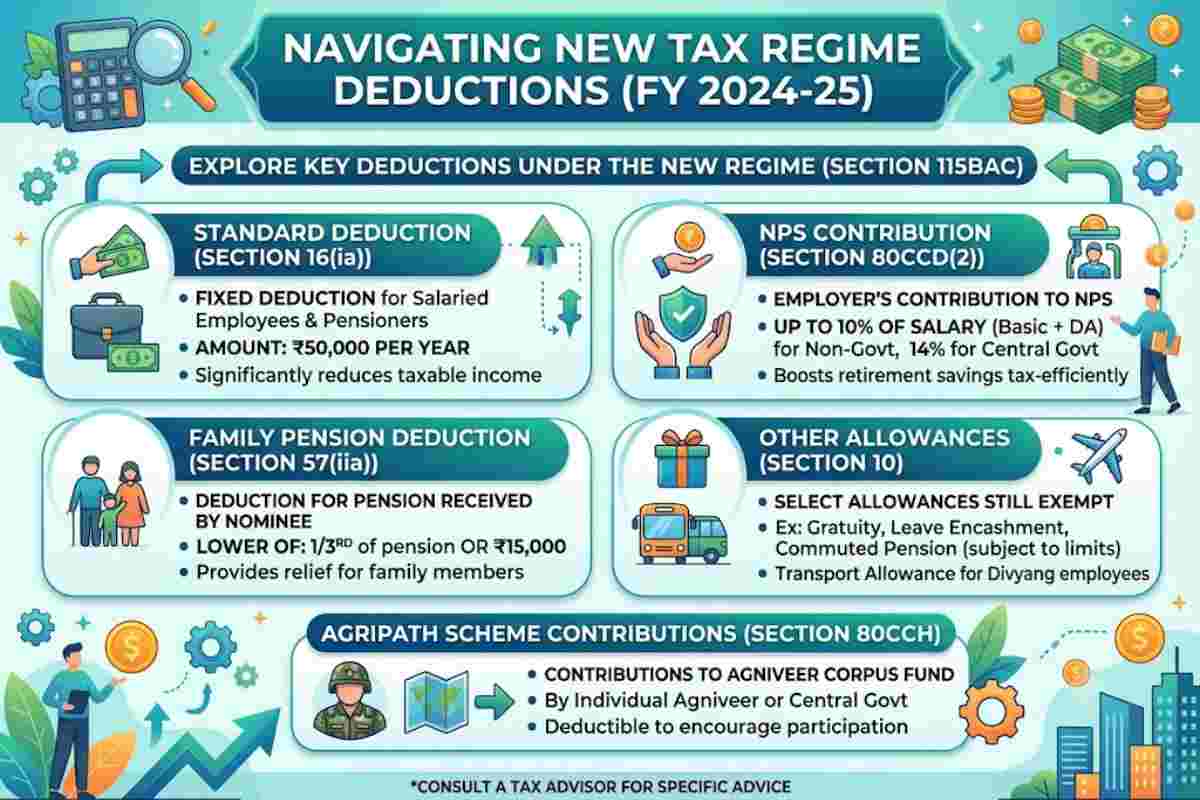
New Tax Regime Deductions As of now, the new tax regime deductions rules are generally aimed at giving the lowest tax rates by decreasing the number of deductions and exemptions one can claim. In the new regime, taxpayers can benefit from a few deductions as compared to the old regime where a taxpayer can avail of benefits like 80C, 80D, HRA and many more.
For FY 2025-26 (AY 2026-27), the conditions apply for claiming the new tax regime deduction Section 115BAC benefit which is standard deduction for a salaried individual and contribution by your employer to NPS and few more.
Deduction under 80C, 80D, HRA is only available in old regime as confirmed by the Income Tax Department. Thus, knowing these deductions allowed in the new tax regime before you decide which tax regime you should opt for.
This Article Belongs to Tax Tips
What Are New Tax Regime Deductions?
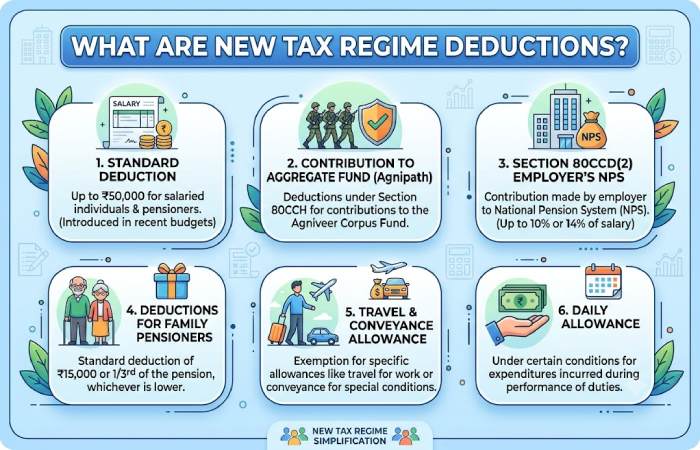
New Tax Regime Deductions are specific deductions and tax benefits that remain available even when a taxpayer chooses the concessional tax structure under Section 115BAC.
The new regime generally offers lower slab rates but removes many traditional deductions. According to the Income Tax Department, only specified deductions are available under the new tax regime. Therefore, taxpayers should not assume that every investment or insurance payment will reduce taxable income.
For example, 80C in new tax regime is not available. Similarly, 80D in new tax regime cannot generally be claimed for health insurance premiums.
However, some deductions continue to be permitted.
Key deductions available under the new regime
| Deduction / Benefit | Available under New Regime? | Key Point |
|---|---|---|
| Standard deduction | Yes | Up to ₹75,000 for eligible salaried taxpayers |
| Section 80C | No | Investments such as PPF, ELSS and life insurance generally cannot be claimed |
| Section 80D | No | Health insurance premium deduction is not available |
| Section 80CCD(2) | Yes | Eligible employer contribution to NPS |
| Section 80CCH | Yes | Eligible Agniveer Corpus Fund contribution |
| Section 57(iia) | Yes | Deduction from eligible family pension, subject to limit |
| Section 24(b) | Limited | Interest on housing loan may be considered for eligible let-out property income |
Is 80C Allowed in the New Tax Regime?
A common question is: Is 80C allowed in the new tax regime?
The answer is no for individual taxpayers opting for the new regime.
Under the old regime, Section 80C allows deductions for eligible investments and payments, with a combined limit of ₹1.5 lakh. Common examples include:
- Public Provident Fund (PPF)
- Employee Provident Fund (EPF)
- Equity Linked Savings Scheme (ELSS)
- Life insurance premiums
- National Savings Certificates
- Eligible tuition fees
- Principal repayment of a qualifying home loan
However, these payments do not generally qualify for a Section 80C deduction when the taxpayer opts for the new regime. The Income Tax Department lists Section 80C among the deductions available under the old regime rather than the new regime.
Therefore, taxpayers should not make an investment solely to obtain an 80C tax benefit in the new tax regime.
Is 80D Allowed in the New Tax Regime?
Another frequently searched question is whether 80D in new tax regime is available.
Generally, Section 80D is not available under the new tax regime.
Under the old regime, eligible taxpayers can claim deductions for health insurance premiums and certain preventive health check-ups. The available limits depend on factors such as the taxpayer’s age and the age of covered parents.
However, choosing the new tax regime means taxpayers generally cannot claim the Section 80D deduction for health insurance premiums.
This is an important difference for individuals who pay substantial health insurance premiums and previously relied on Section 80D to reduce taxable income.
Section 80CCH for Agniveers
Another deduction included in the new regime deduction list is Section 80CCH.
This provision relates to contributions made to the Agniveer Corpus Fund under the Agnipath Scheme.
Eligible contributions made by an individual enrolled in the Agnipath Scheme can qualify for deduction according to the applicable provisions. The Income Tax Department states that eligible amounts paid or deposited into the Agniveer Corpus Fund can receive deduction, subject to the relevant conditions.
Family Pension Deduction
A limited deduction, under Section 57(iia), is also available to family pensioners while availing the new regime.
As per the ITR validation rules issued by the Income Tax Department for AY 2026-27, up to one-third of the family pension, with a maximum limit of Rs. 25,000, will be deductible under the new regime.
This deduction should not be confused with the other deductions, like 80C and 80D, as it is available on family pension income.
Home Loan Interest Under the New Tax Regime
Home loan deductions require special attention.
The deduction under Section 24(b) for interest on borrowed capital is restricted under the new regime. For a self-occupied property, the familiar ₹2 lakh deduction available under the old regime cannot generally be claimed under the new regime.
For eligible let-out property, however, the rules can permit deduction of actual interest against income from house property, subject to the applicable provisions and restrictions. The Income Tax Department distinguishes these rules from the deductions available under the old regime.
Therefore, homeowners should calculate the tax impact carefully before choosing between the two regimes.
New Tax Regime Exemptions You Generally Cannot Claim
The new regime removes or restricts many popular exemptions and deductions. Depending on the taxpayer’s circumstances, commonly unavailable benefits include:
- Section 80C investment deduction
- Section 80D health insurance deduction
- Section 80CCD(1) deduction for an individual’s own eligible NPS contribution
- Section 80CCD(1B) additional ₹50,000 NPS deduction
- HRA exemption
- LTA/LTC exemption
- Most other investment-linked deductions available under the old regime
This means taxpayers should compare their total tax liability, rather than simply comparing individual tax rates.
New Tax Regime vs Old Regime: Deduction Comparison
| Tax Benefit | New Regime | Old Regime |
|---|---|---|
| Standard deduction | Yes, up to ₹75,000 | Yes |
| 80C | No | Yes, up to ₹1.5 lakh |
| 80D | No | Yes, subject to limits |
| Own NPS contribution under 80CCD(1) | Generally no | Yes |
| Additional NPS deduction under 80CCD(1B) | No | Yes |
| Employer NPS contribution under 80CCD(2) | Yes, subject to limits | Yes |
| Agniveer Corpus Fund under 80CCH | Yes, subject to conditions | Yes |
| HRA exemption | Generally no | Yes, if eligible |
| LTA exemption | Generally no | Yes, if eligible |
| Family pension deduction | Yes, subject to limit | Yes, subject to applicable rules |
Who Should Consider the New Tax Regime?
The new regime may be attractive for taxpayers who have relatively few eligible deductions and exemptions. It can also simplify tax planning because taxpayers do not need to make investments merely to claim deductions that are unavailable under the new regime.
On the other hand, taxpayers with substantial eligible deductions—such as 80C investments, 80D premiums, HRA and home-loan benefits—should compare both regimes before making a decision.
The right choice depends on salary, other income, eligible deductions, exemptions and the applicable tax rates.
Conclusion
New Tax Regime Deductions A host of commonly used allowances and deductions such as 80C in new tax regime and 80D in new tax regime are not available, but many focused benefits continue to be provided.
Section 80CCH benefits for eligible Agniveers and family pension deduction, employer NPS contributions under Section 80CCD(2), Rs 75,000 deduction to eligible salaried people, and others can still be claimed for a lower tax outgo if conditions are met.