

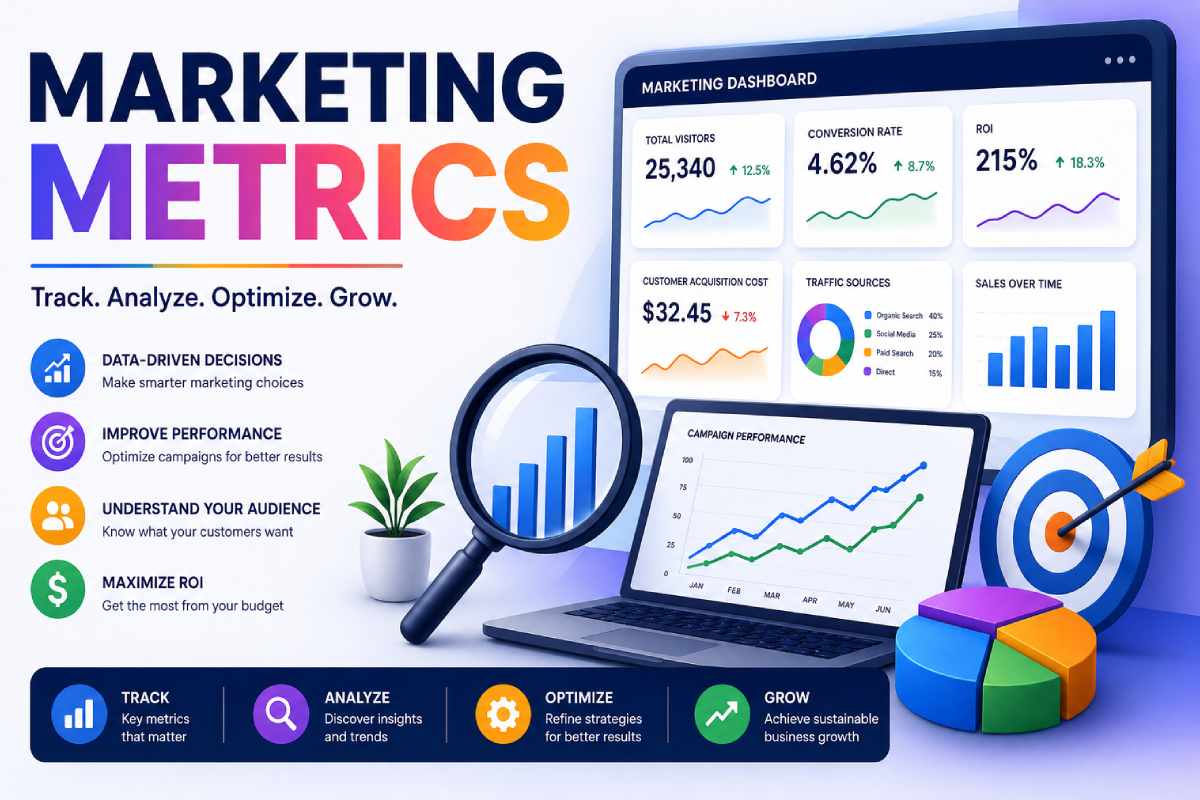
Marketing Metrics: A Complete Guide to Measuring Marketing Success

What are Marketing Metrics?
The marketing metric is the metric used by a business to measure the efficiency and success of its marketing campaigns. Marketers are constantly monitoring their marketing metrics to track which marketing strategies and tactics are working effectively and which ones need to be refined. In today’s environment, using the right marketing KPI whether its email marketing, social media, SEO or paid advertising, is essential to ensure that your marketing spend actually delivers value.
Marketers are leveraging data, not assumptions, to measure campaign performance, and improve how they connect and convert with customers.
By gaining a working knowledge of the basics of marketing analytics, the business in every sector can observe customer actions, demonstrate marketing investment results, and refine its approach as the real-time success data dictates.
Businesses that understand customer needs, market segmentation, value propositions, and promotional strategies can interpret metrics more effectively and make smarter decisions. If you’re new to these principles, explore our guide to core marketing concepts to build a stronger foundation before analyzing your KPIs.
This Article is the part of Marketing Sales
Why Marketing Metrics Matter

The marketing equivalent of driving without a dashboard “The problem is the sheer lack of data around, or at least the analysis and insight from, these metrics to give businesses clarity on whether they are actually creating leads, sales, and lasting relationships.”
Key benefits include:
- Making informed business decisions
- Improving campaign performance
- Optimizing marketing budgets
- Understanding customer behavior
- Increasing return on investment
- Identifying high-performing marketing channels
A firm which routinely checks its marketing information usually runs more effective campaigns, because they can swiftly eliminate those which aren’t performing.
Insights gathered from surveys, competitor analysis, and audience behavior help marketers understand why campaigns perform the way they do. Learn how market research supports better decision-making and improves the accuracy of your marketing performance analysis.
Essential Marketing Metrics Every Business Should Track
The table below covers the most common marketing metrics used throughout various industries.
|
Marketing Metric |
Purpose |
Why It Matters |
|
Website Traffic |
Measures visitors to your website |
Indicates audience interest |
|
Conversion Rate |
Tracks visitors completing desired actions |
Shows campaign effectiveness |
|
Customer Acquisition Cost (CAC) |
Calculates cost of acquiring a customer |
Helps control marketing expenses |
|
Customer Lifetime Value (CLV) |
Estimates long-term customer revenue |
Measures long-term profitability |
|
Click-Through Rate (CTR) |
Percentage of users clicking advertisements |
Evaluates ad relevance |
|
Return on Investment (ROI) |
Measures marketing profitability |
Determines campaign success |
|
Bounce Rate |
Percentage leaving without interaction |
Indicates user experience quality |
|
Lead Conversion Rate |
Tracks leads becoming customers |
Measures sales funnel performance |
Marketing KPIs vs Marketing Metrics
Several marketers use the terms loosely and are unaware of the different roles that each term plays.
|
Marketing Metrics |
Marketing KPIs |
|
Measure overall performance |
Measure progress toward specific business goals |
|
Can include dozens of data points |
Focus only on the most critical indicators |
|
Used for analysis |
Used for strategic decision-making |
|
Help identify trends |
Help evaluate business success |
In simple terms, all KPIs are metrics, but not all metrics are KPIs.
Businesses should also monitor indicators such as brand awareness, customer loyalty, and brand perception to evaluate long-term success. Developing a recognizable brand begins with understanding the branding fundamentals that influence customer trust and business growth.
ROI in Marketing
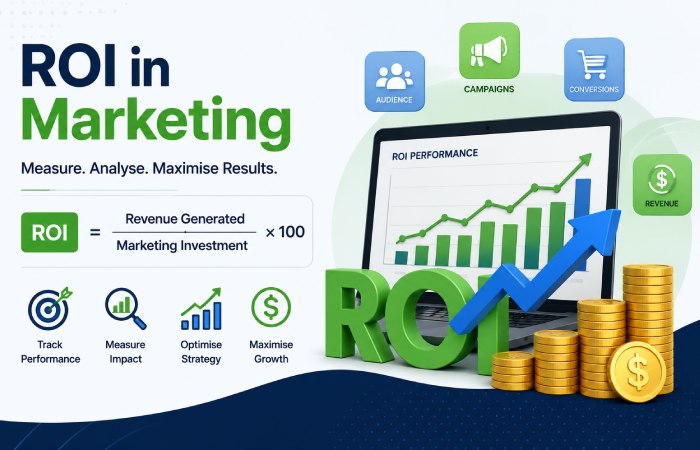
One of the most crucial marketing performance metrics, your marketing return on investment, measures the total return on your investment.
ROI Formula
ROI = (Revenue – Marketing Cost) ÷ Marketing Cost × 100
Example
|
Marketing Spend |
Revenue Generated |
ROI |
|
£5,000 |
£15,000 |
200% |
|
£10,000 |
£30,000 |
200% |
|
£8,000 |
£12,000 |
50% |
Positive ROI is an indicator that marketing efforts are working and profitable. Negative ROI (or a return on investment that is not as strong as it could be) indicates where attention should be given to improve performance. ROI measurement enables marketers to funnel their budget into those marketing initiatives that deliver the most in return.
Understanding Conversion Rate Metrics
The conversion rate is one of the key conversion rate indicators that we look at. It is used for the calculation of visitor percentages, for example those performing desired action(s):
- Purchasing a product
- Signing up for a newsletter
- Downloading an eBook
- Requesting a quote
- Filling out a contact form
Conversion Rate Formula
Conversion Rate = (Conversions ÷ Total Visitors) × 100
Higher conversion rates usually indicate:
- Better website design
- Effective messaging
- Strong calls-to-action
- Relevant targeting
- Improved customer experience
By tracking and monitoring their conversion rate, marketers are able to find areas for improvement during the entire process in which customers interact with them.
Customer Acquisition Cost (CAC)
Customer acquisition cost measures how much a business spends to gain a new customer.
CAC Formula
Customer Acquisition Cost = Total Marketing & Sales Costs ÷ Number of New Customers
For example:
|
Total Marketing Cost |
New Customers |
CAC |
|
£10,000 |
200 |
£50 |
|
£25,000 |
500 |
£50 |
|
£15,000 |
150 |
£100 |
A lower CAC generally indicates more efficient marketing.
But the truth of CAC is it should be used in conjunction with customer lifetime value (CLV). As long as your customers spend much more with you then you spend getting them to buy from you, it’s worth spending money to bring them aboard.
Marketing Analytics Basics
Companies can learn how to convert data to insights by understanding marketing analytics basics. Marketing analytics is comprised of data sourced from a wide variety of marketing channels that the data is then analyzed in order to identify performance.
Common sources include:
|
Data Source |
Information Provided |
|
Google Analytics |
Website traffic and user behavior |
|
Google Search Console |
Organic search performance |
|
Email Marketing Platforms |
Open and click rates |
|
CRM Systems |
Lead management and customer journeys |
|
Social Media Analytics |
Engagement and audience growth |
|
Advertising Platforms |
Campaign performance and conversions |
Using multiple data sources provides a complete picture of marketing effectiveness.
Choosing the Right Marketing Performance Metrics
Not every business needs to monitor every available metric.
Instead, select marketing performance metrics that align with your business objectives.
|
Business Goal |
Recommended Metric |
|
Increase Sales |
Conversion Rate, Revenue |
|
Improve Brand Awareness |
Reach, Impressions |
|
Generate Leads |
Cost per Lead |
|
Increase Website Traffic |
Organic Sessions |
|
Improve Customer Retention |
Customer Lifetime Value |
|
Maximize Profitability |
ROI in Marketing |
The goal specific approach of setting KPIs would further enable to streamline your reports and thus enhance the decision making abilities.
Best Practices for Measuring Marketing Success
Successful marketers follow consistent measurement practices.
|
Best Practice |
Benefit |
|
Define SMART marketing goals |
Clear performance target |
|
Track KPIs regularly |
Early issue detection |
|
Compare historical data |
Identify trends |
|
Test campaign variations |
Improve conversions |
|
Automate reporting |
Save time |
|
Optimize based on insights |
Increase campaign efficiency |
Conclusion
Using marketing analytics is a vital skill for any business, and in today’s marketplace, no matter your size and sector. Whether it be by keeping tabs on meaningful marketing KPIs, analyzing your marketing performance, calculating ROI, understanding your conversion rate metrics, or analyzing customer acquisition cost, your organisation can understand how you could implement changes and reap the rewards. By using a good level of marketing analytics, you will gain better insights into your business – no more guesswork.