

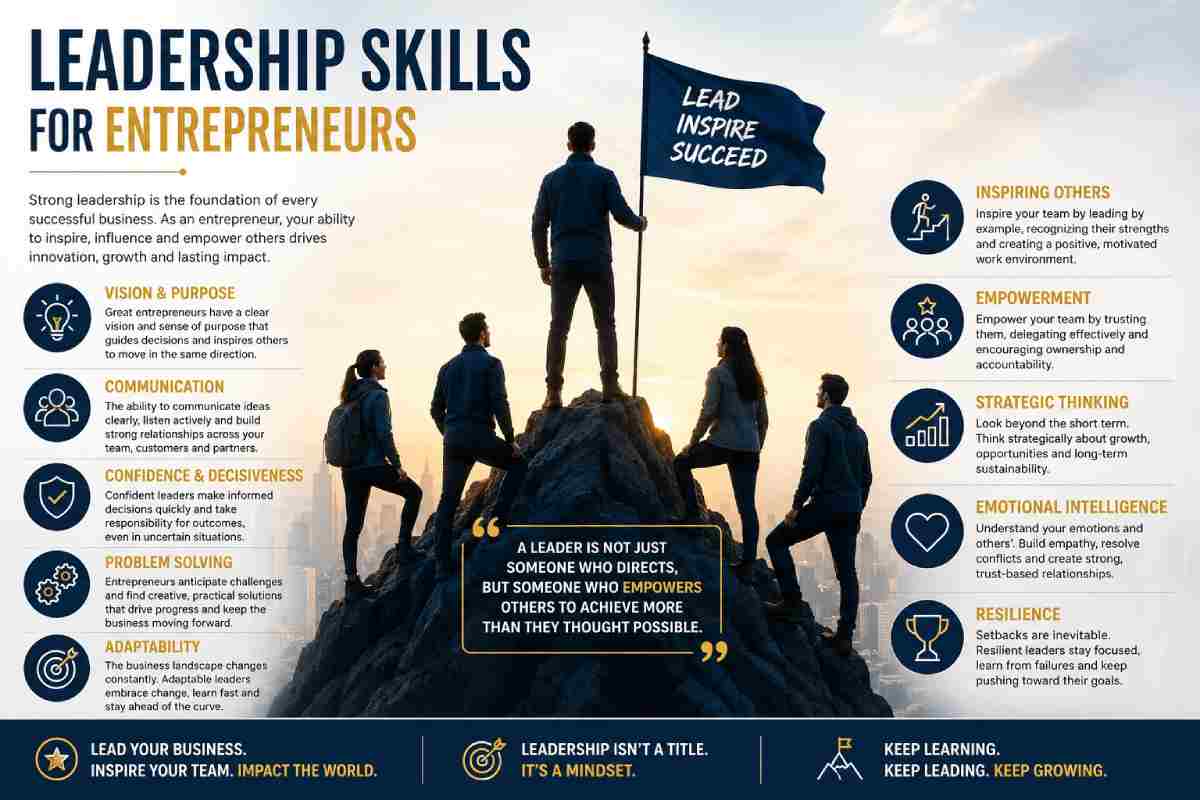
Leadership Skills for Entrepreneurs: A Complete Guide Building Successful Businesses

Beyond a brilliant idea and a catchy product launch, there’s one skill that helps entrepreneurial minds achieve lasting growth how they lead people. Developing leadership skills for entrepreneurs – guiding and inspiring their teams to drive the business forward – means fostering motivation, make critical decisions, and respond swiftly to market shifts.
As any entrepreneur knows, whether scaling a company from a single product, growing a startup or establishing a small business, cultivating a collaborative workplace, enhancing output and enjoying business longevity starts with leadership skills, an array of practices to get better, and entrepreneur leadership case studies.
This Article is the part of Business Planning
What Are Leadership Skills for Entrepreneurs?
The leadership skills in entrepreneurship relate to inspiring, influencing and coaching an organisation toward a specific objective while taking business decisions into account. The main difference between managers and entrepreneurs is that entrepreneurs lead companies at times of instability, a need that demands innovative capacity and high resilience.
Entrepreneurship, leadership skills are a combination of ideas and actions; With this, entrepreneurs can present a clear idea and provide solutions to every situation while promoting an innovative work culture within the team.
Strong leadership is essential for guiding teams, making strategic decisions, and ensuring long-term success, especially when managing a growing company. Understanding the fundamentals of small business management can help entrepreneurs improve efficiency, strengthen operations, and build sustainable growth.
Leadership vs. Management
| Leadership | Management |
| Creates vision | Executes plans |
| Inspires people | Supervises employees |
| Encourages innovation | Maintains processes |
| Focuses on long-term growth | Focuses on daily operations |
| Builds trust | Ensures compliance |
While leadership is the ability to inspire while Management is the ability to get work done there is not one skill to succeed as an entrepreneur beyond both those skills and the one described below.
Great leaders don’t just inspire people—they also optimize workflows and improve organizational performance. business operations management enables entrepreneurs to streamline daily processes, reduce inefficiencies, and achieve better business outcomes.
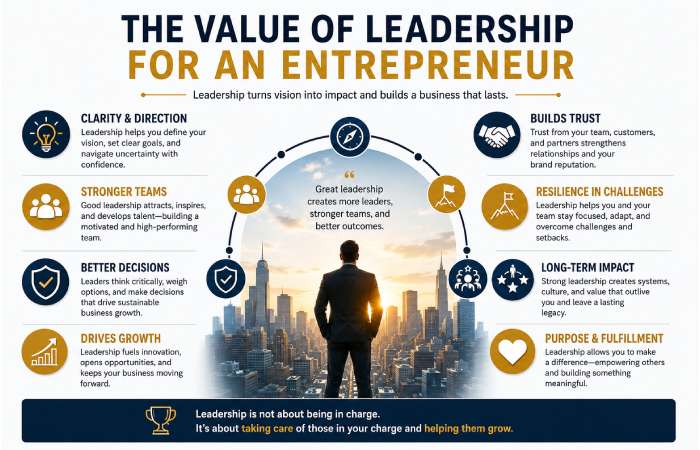
The Value of Leadership for an Entrepreneur
Across the globe businesses face many of the same challenges in navigating around saturation of markets and economical unpredictability with advancements in technologies.
Some key benefits include:
- Better employee engagement
- Higher productivity
- Improved decision-making
- Stronger company culture
- Faster innovation
- Better customer satisfaction
Essential Leadership Skills for Entrepreneurs
Founders have to adapt. Improve on the strategic, relationship, and technical competencies they currently possess.
1. Vision and Strategic Thinking
Successful entrepreneurs not only know where they’re taking their business but also, most importantly, they articulate that to the employees.
A compelling vision:
- Aligns employees
- Attracts investors
- Encourages innovation
- Creates long-term focus
2. Communication Skills
Some of the skills most important for a leader to know include communication.
Entrepreneurs communicate with:
- Employees
- Investors
- Customers
- Suppliers
- Business partners
Better understanding increases trust and departments can work more effectively as a result. Misunderstanding will become less frequent.
3. Decision-Making
Entrepreneurs make dozens of decisions every day.
Strong leaders:
- Analyze available information
- Consider risks
- Evaluate alternatives
- Make timely decisions
- Accept responsibility for outcomes
4. Emotional Intelligence
This allows the entrepreneur to be able to feel and understand not only their own emotions, but also those of others
It includes:
- Self-awareness
- Self-control
- Empathy
- Relationship management
- Motivation
5. Adaptability
Markets change day by day. There’s always something new being added to a new device or product, or the taste of consumers change. The number of new competitors added on to a market on a daily basis is quite enormous.
Entrepreneurs who adapt quickly can:
- Identify new opportunities
- Reduce business risks
- Improve customer experience
Entrepreneurial Leadership in Modern Business

The combination of innovation with leadership results in entrepreneurial leadership. This means going beyond management of existing business processes. It means searching for new ventures or chances and to foster creativity throughout the company.
Characteristics include:
| Entrepreneurial Leadership Trait | Business Impact |
| Innovation | Creates competitive advantage |
| Risk management | Supports sustainable growth |
| Vision | Aligns organizational goals |
| Adaptability | Responds to market changes |
| Collaboration | Improves teamwork |
Modern leadership also involves embracing technology to increase productivity and collaboration. Investing in the right business management software allows leaders to automate routine tasks, manage projects effectively, and make data-driven decisions.
Team Management Skills Every Entrepreneur Needs
Nobody can take the business even if they have awesome business idea unless and until they are capable enough to implement. Building a team and manage it smartly is one such skill set that the entrepreneurial people possess to achieve productive employees and workplace.
Important management practices include:
Delegation
We, entrepreneurs, love to delegate work. Through this, our team members pick up some skills, and we, the leaders are free to take time for more strategic, high-impact tasks.
Conflict Resolution
In the workplace, arguments may arise naturally. It’s a manager’s role to swiftly manage these by communication clearly and providing just and even decisions.
Motivation
Employees are generally more energetic and productive when their input toward business objectives is recognized and valued.
Motivation can include:
- Recognition
- Professional development
- Career growth
- Flexible work environments
- Clear performance expectations
Leadership Qualities of an Entrepreneur
There are a few traits found in almost all successful entrepreneurs that tend to evoke faith from both employees and investors.
Leadership Qualities of an Entrepreneur
| Leadership Quality | Why It Matters |
| Integrity | Builds trust |
| Confidence | Encourages team commitment |
| Accountability | Creates responsibility |
| Creativity | Solves business problems |
| Resilience | Helps overcome setbacks |
| Patience | Supports long-term growth |
| Curiosity | Drives continuous learning |
| Optimism | Inspires teams during challenges |
Qualities that will help an entrepreneur to lead often are acquired by experience, constant training and also through introspection.
Business Leadership Skills That Drive Growth
Growing businesses require more than technical expertise.
Important business leadership skills include:
| Skill | Business Benefit |
| Strategic planning | Long-term success |
| Financial awareness | Better budgeting |
| Negotiation | Stronger partnerships |
| Time management | Increased productivity |
| Innovation management | Competitive advantage |
| Customer focus | Improved loyalty |
| Problem-solving | Faster issue resolution |
Entrepreneur Leadership Examples
The best business executives can be the greatest teachers to business entrepreneurs.
- Steve Jobs
The visionary leader, Jobs inspired innovation through obsessive focus on product design and the experience it created.
Leadership lesson: Build products that solve meaningful problems.
- Sara Blakely
This is Sara Blakely-a woman who combined grit with resourcefulness, and with a true eye for the customer, was able to triumph through rejection and build an empire.
Leadership lesson: Persistence often matters more than perfection.
- Elon Musk
With a reputation for making the impossible happen with the right team and ideas, this vision-leader works across many different disciplines to change how things are done.
How Entrepreneurs Can Improve Leadership Skills
Leadership doesn’t happen during one point of time during your life. Leadership is a life learning experience.
Consider these practical strategies:
| Improvement Strategy | Expected Outcome |
| Read leadership books | Broader perspectives |
| Attend workshops | New management techniques |
| Seek mentors | Practical guidance |
| Request employee feedback | Better self-awareness |
| Practice delegation | Stronger teams |
| Develop communication | Improved collaboration |
| Learn continuously | Better decision-making |
Common Leadership Mistakes Entrepreneurs Should Avoid
Many of us will fail at our ventures and never realize it was due to our own leadership.
Some common examples include:
- Micromanaging employees
- Avoiding difficult conversations
- Failing to delegate
- Ignoring employee feedback
- Resisting change
- Making emotional decisions
- Neglecting company culture
Building a Leadership Culture
Leadership should not exist only at the top of an organization.
Entrepreneurs can create leadership throughout the company by:
- Encouraging employee ownership
- Supporting professional development
- Rewarding innovation
- Promoting open communication
- Recognizing achievements
- Empowering decision-making
Conclusion
Growing entrepreneurial leadership is among the most worthwhile things an individual could invest in their business. Excellent entrepreneurial leadership is more than managing daily activities and is more about establishing an inspiring vision, fostering belief and empowering your employees.
And also make decisions to get it achieve lasting expansion, an entrepreneur needs to build the business to acquire entrepreneurial traits, have the ability to improve staff management expertise as well as be successful entrepreneurial leadership skills that can give enduring growth. The successful entrepreneur leadership may be developed. It must gain the help of a well-known entrepreneurial leadership illustration in order to gain lasting success.