

Comparison: Online Business vs Offline Business LLC vs Sole Proprietorship and More

Introduction
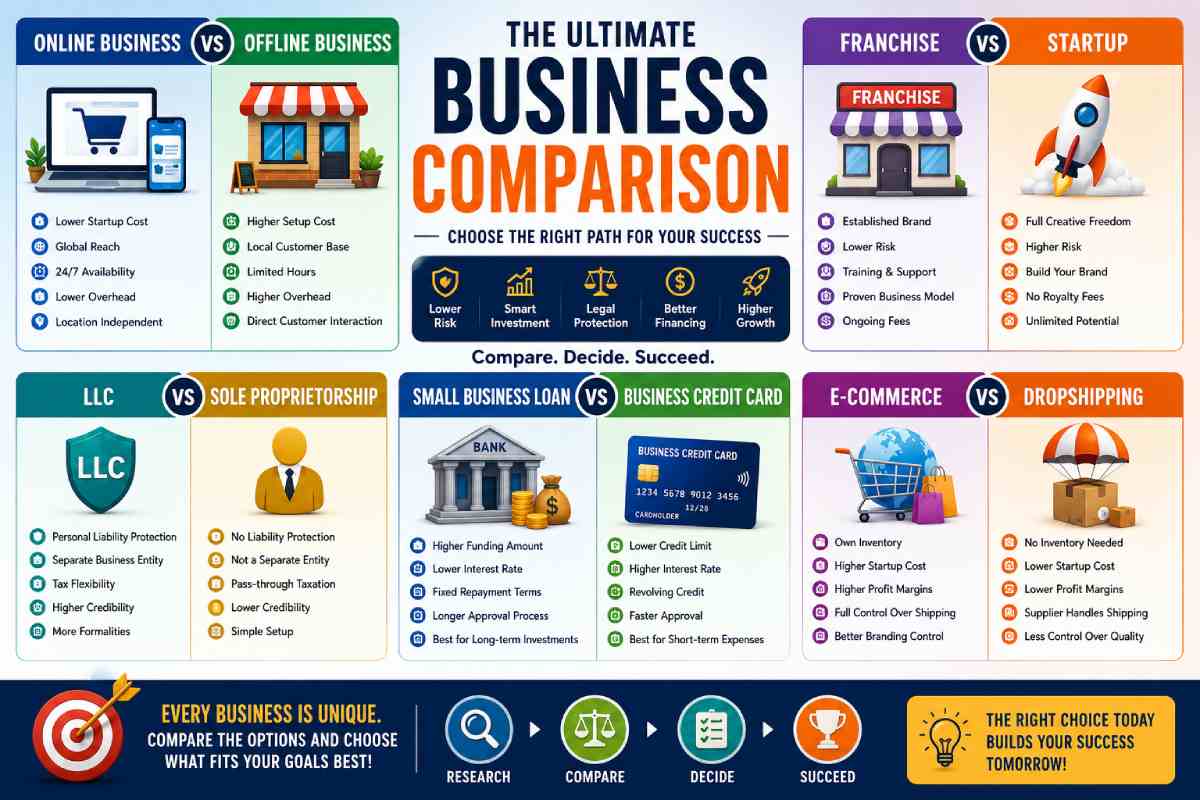
Business Owners Struggle With Several Decisions Deciding to start an online business versus an offline business, setting up a franchise instead of a startup, selecting a legal business structure, and finding a funding method are just some of the choices business owners face that, based on business decisions and analyses, have large implications to their success and failures. These comparisons are highly popular and regularly requested.
A Business Comparison Guide: Comparing These Five Common Decisions for entrepreneurs to get help in their entrepreneur journeys. These comparisons include: Compare These 5 Comparisons entrepreneurs will definitely want.
This Article is a part for Startups
Online Business vs Offline Business
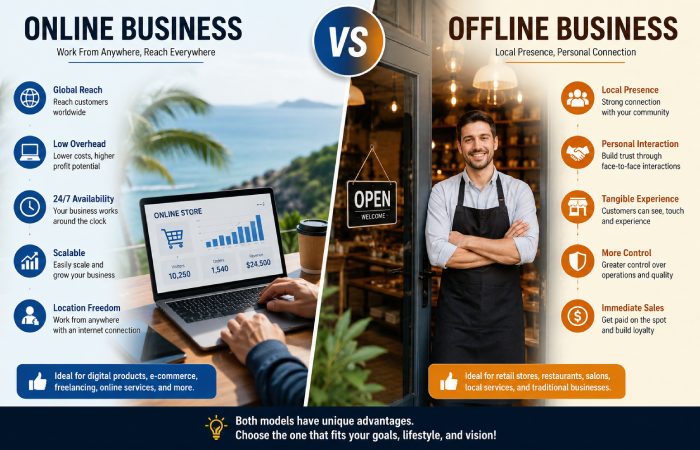
This is due to advancements in technology, changing ways of how companies do their business today. Being an offline, there is direct face-to-face relation between the businessman and the customer, and more established ties to the local market. In terms of being an online, there is great flexibility for online businessman as they tend to be less costly than a typical business offline.
| Feature | Online Business | Offline Business |
| Startup Cost | Generally lower | Usually higher |
| Customer Reach | Global audience | Local or regional audience |
| Operating Hours | 24/7 availability | Limited by business hours |
| Overhead Costs | Lower | Higher |
| Personal Interaction | Limited | Direct customer engagement |
| Scalability | Faster scaling potential | Slower expansion process |
Online businesses appeal to entrepreneurs who want to sell globally without incurring the overhead of a brick-and-mortar establishment. Digital marketing firms, software firms, and e-commerce businesses are great examples of companies that are remote while serving diverse geographic locations.
Businesses that rely on interpersonal service relationships, such as restaurants, brick-and-mortar retail operations, health clinics, and service industries benefit greatly from the value these personal touches bring customers. For some business owners, a combination of online and offline presence, which we’ll call online/offline business hybrid operations, can give them the benefits of both in the same company.
Franchise vs Startup
Should you create your company or buy an established business franchising? It is a frequently asked question entrepreneurs are faced.
| Factor | Franchise | Startup |
| Brand Recognition | Established brand | Build from scratch |
| Initial Risk | Lower | Higher |
| Creative Freedom | Limited | Full control |
| Training & Support | Extensive support | Self-managed |
| Startup Costs | Often higher | Flexible |
| Profit Potential | Shared with franchisor | Fully retained |
A franchise provides access to an established business model, recognized branding, and operational support. This reduces uncertainty and can accelerate profitability. However, franchise owners must follow company guidelines and often pay ongoing royalty fees.
Startups offer greater flexibility and innovation opportunities. Entrepreneurs can create unique products, build their own brand, and adapt quickly to market trends. Although startups involve higher risk, they also provide unlimited growth potential and complete ownership of profits.
Entrepreneurs seeking stability often prefer franchises, while those motivated by innovation and independence typically choose startups.
Access to good financial services is an incredibly vital component to any start-ups growth & success. Getting a solid foundation established with business bank account services will enable you to maintain a healthy cash flow to facilitate your overall growth and will also position your business perfectly to access business loans and merchant services in the future. Read to find out more about how Banking for Businesses can benefit your Company’s Financial Well-Being.
LLC vs Sole Proprietorship
Selecting the right business structure is essential for legal protection, taxation, and long-term growth.
| Feature | LLC | Sole Proprietorship |
| Legal Protection | Personal liability protection | No separation of assets |
| Setup Complexity | Moderate | Simple |
| Tax Flexibility | Multiple options | Pass-through taxation |
| Credibility | Higher | Moderate |
| Administrative Requirements | More formalities | Minimal paperwork |
| Growth Potential | Strong | Limited |
A Sole Proprietorship The easiest kind of structure to set up is asole proprietorship . They are fantastic for solo-preneurs, freelancing work, and any small business without many employees. A sole proprietorship offers 100% control to the business owner and fewer headaches.
Limited Liability Company (LLC) An LLC creates a distinction between personal assets and the business’s liabilities.
This shields the owner from creditors in the event a business fails. Many customers, creditors, and lenders consider an LLC a more credible business entity. If your entrepreneurial ambitions are substantial, you plan on having employees, or intend to seek outside investment funding for a high growth organization, an LLC could be a better choice, even with the added complications and maintenance involved.
Different industries offer unique advantages, investment requirements, and growth prospects, making it easier for entrepreneurs to choose a sector that matches their goals. Read our guide to business categories for a detailed overview.
Small Business Loan vs Business Credit Card
Access to capital plays a crucial role in business growth. Two common funding options are small business loans and business credit cards.
| Factor | Small Business Loan | Business Credit Card |
| Loan Amount | Larger funding amounts | Lower credit limits |
| Interest Rate | Typically lower | Usually higher |
| Repayment Term | Fixed schedule | Revolving credit |
| Approval Process | More detailed | Faster approval |
| Best Use | Major investments | Daily expenses |
| Credit Building | Yes | Yes |
Long term investments: Loans work well for larger investments to buy equipment, expand your workplace or pay for more employees to support business growth, have low, predictable payments and interest rates.
Business credit cards can manage everyday operating costs and even travel and expenses; most are for short terms to cover cash flow problems, sudden expenses, equipment or operating costs and include cash back or rewards programs. Combining both methods of obtaining capital: Most growing businesses need financing of both types.
E-commerce vs Dropshipping
The growth of online retail has introduced multiple business models, with e-commerce and dropshipping becoming two of the most popular options.
| Feature | E-commerce | Dropshipping |
| Inventory Ownership | Yes | No |
| Startup Investment | Higher | Lower |
| Profit Margins | Higher | Lower |
| Shipping Control | Full control | Supplier-controlled |
| Product Customization | Greater flexibility | Limited |
| Risk Level | Moderate | Lower |
These traditional business model companies invest in and warehouse inventory prior to selling it to customers. These businesses enjoy strong oversight of product quality, shipping, branding, and customer experience. Dropshipped businesses also don’t hold onto stock prior to selling them. When order are made to the seller, suppliers shipping item directly to buyers, which may drastically increase the initial capital and economic risk of the company.
It usually offers a comparatively lower benefit margin and much lower control of the product and shipping timelines.
An internet marketer wishing to create brand recognition might prefer an old age e-commerce business model. However an absolute beginner is normally a much greater candidate for drop ship business model to start making a fortune online.
Learning key principles of planning, leadership, and risk management can significantly improve your chances of success. Explore our guide to entrepreneurship and business success to build a strong foundation for your venture.
Which Business Model Is Right for You?
The ideal choice depends on your goals, experience level, available capital, and risk tolerance.
| Business Goal | Recommended Option |
| Low Startup Cost | Online Business or Dropshipping |
| Established Brand Support | Franchise |
| Full Creative Freedom | Startup |
| Legal Asset Protection | LLC |
| Large Expansion Funding | Small Business Loan |
| Flexible Expense Management | Business Credit Card |
| Strong Brand Building | E-commerce |
Entrepreneur should weigh their own goals-both short-term as well as long-term-before they choose. An ideal model for another entrepreneurs may be far from a model that is good for their situation.
Exploring different concepts can help identify the right path for sustainable success. Learn more about profitable business idea to find opportunities with strong earning potential.
Conclusion
Every great business comes into being on the heels of strong, first-principles decisions. When considering such choices as online business vs offline business, franchise vs startup, LLC vs sole proprietorship, business credit card vs small business loan, and dropshipping vs e-commerce, you need to weigh the upsides and downsides. Fortunately, today’s entrepreneurial options provide numerous advantages; and the business owner who is wise to assess factors such as costs, potential gains, growth scope and the effort needed for day-to-day tasks can make a winning selection.