


Startup Planning: A Complete Guide to Launching a Successful Business

One of the most fulfilling endeavors an entrepreneur can experience is building a successful business from the ground up. Yet most entrepreneurship fail not by accident, but from the absence of thoughtful startup planning that guides entrepreneurs in turning concepts into money-making businesses. The key, as it often is in any aspect of business, starts at the very first decision – how to begin a business – through business planning, estimating startup costs, selecting a business structure, and business registration.
Research and the U.S. Small Business Administration (SBA) indicates that firms established through organized planning, even small online retailers, consultants and tech companies will have higher rates of survival through the early stages of business compared to the average un-planned enterprise.
Each sector gives businesses differing benefits in terms of their need to invest, potential to grow and many other factors, so entrepreneurs can select one that fits with what they are trying to achieve. Our guide to business categories will provide an in-depth understanding.
This Article is a part for Startups
What is Startup Planning?
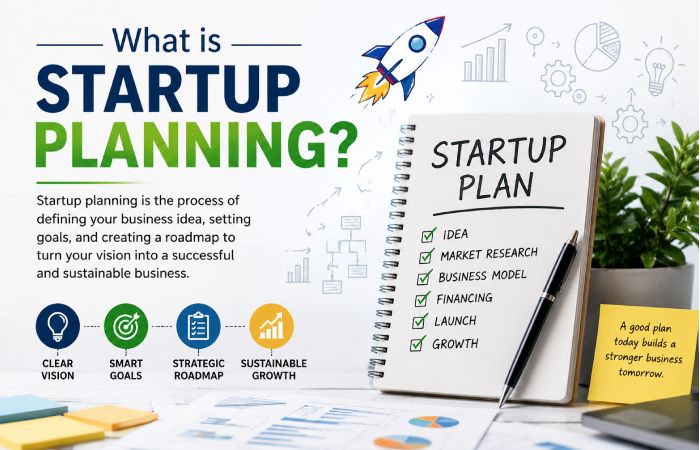
Startup planning involves putting in place all the necessary components of a business prior to its launch. This process encompasses the analysis of the target market, establishing the objectives of the business, developing a business model, calculating the required funding as well as putting into practice the business’s operations.
The planning of a business will considerably reduce the amount of uncertainty surrounding its operation and will enable entrepreneurs to make more rational decisions. Instead of being forced to tackle situations as they arise entrepreneurs will be in a position to preempt potential problems.
Key Elements of Startup Planning
| Startup Planning Component | Purpose |
| Market Research | Understand customers and competitors |
| Business Plan | Create a roadmap for growth |
| Financial Planning | Estimate costs and revenues |
| Legal Structure | Define ownership and liability |
| Business Registration | Ensure legal compliance |
| Marketing Strategy | Attract customers |
| Operations Plan | Manage daily activities |
How to Start a Business Successfully
One of the most frequent inquiries aspiring entrepreneurs make is the procedure required to launch a business. While each business is individually developed, most of the startups achieve their success by implementing a procedure in a specific sequence. The initial step includes defining a feasible business idea. This idea should target a specific problem or need within the market. Furthermore, the viability of the idea is established by examining whether the target customers are prepared to pay for it or not, through extensive market research.
The research process includes analyzing competitors, identifying the target customers and the relevant industries. Once the idea is proven, the entrepreneurs can identify their value proposition, which clearly defines what differentiates them from the competition. After the value proposition is specified, entrepreneurs should proceed to establish finances and business goals, and also set up operational procedures.
Steps to Start a Business
| Step | Description |
| 1 | Identify a business opportunity |
| 2 | Conduct market research |
| 3 | Develop a business plan |
| 4 | Estimate startup costs |
| 5 | Choose a business structure |
| 6 | Register the business |
| 7 | Open business bank accounts |
| 8 | Create a marketing strategy |
| 9 | Launch operations |
| 10 | Monitor and improve performance |
Business Plan Guide for New Entrepreneurs
A sound business plan guide is the foundation for the success of any start up. Investors, lenders and business partners all may be subject to seeing a business plan prior to an investment.
A business plan sets forth your company’s mission statement, vision, and goals; products or services offered; target market; competitive advantages; financial projections; and expansion strategy.
As stated by SCORE Mentors, entrepreneurs who write business plans are twice as likely to receive funding and accomplish growth objectives.
Essential Sections of a Business Plan
| Section | Purpose |
| Executive Summary | Overview of the business |
| Company Description | Business mission and goals |
| Market Analysis | Industry and competitor research |
| Products and Services | Description of offerings |
| Marketing Plan | Customer acquisition strategy |
| Operations Plan | Daily business activities |
| Financial Plan | Revenue forecasts and budgets |
| Funding Request | Capital requirements |
A business plan should remain flexible. As market conditions change, entrepreneurs should update projections and strategies regularly.
Startup Costs Explained
One of the biggest issues when planning a startup is understanding expenses. One of the main reasons why new businesses fail is undercapitalization (i.e., founders do not realize the amount of capital needed to survive while revenue is still erratic).
In layman’s terms, what a startup expense is relates to listing down every item that is going to cost something before consistent revenue is generated. Startup costs will vary greatly depending on the sector, place and even business model. A website consultation firm, for example, may cost less than a brick and mortar shop.
Common Startup Expenses
| Expense Category | Examples |
| Business Registration | Licenses and permits |
| Equipment | Computers, machinery |
| Office Space | Rent and utilities |
| Marketing | Advertising and branding |
| Inventory | Products and materials |
| Website Development | Domain and hosting |
| Insurance | Business coverage |
| Employee Costs | Salaries and benefits |
Sample Startup Budget
| Expense Item | Estimated Cost (USD) |
| Business Registration | $100 – $500 |
| Website Setup | $200 – $2,000 |
| Marketing Launch | $500 – $5,000 |
| Equipment | $1,000 – $10,000 |
| Insurance | $300 – $2,000 |
| Initial Inventory | $1,000 – $20,000 |
| Working Capital | $2,000 – $50,000 |
Entrepreneurs should always maintain a financial cushion to handle unexpected expenses during the first year of operation.
Choosing a Business Structure
The next important planning decision for a start-up business relates to the structure that the business will operate as. This is an important decision as the business structure impacts many areas, including taxation, liability limitation, managerial ease, and fundraising possibilities. Business structure choice will vary depending on the goals of the business, how it will be owned, and the willingness of the owner/ owners to take on risks.
Comparison of Business Structures
| Structure | Advantages | Disadvantages |
| Sole Proprietorship | Simple setup, low cost | Unlimited personal liability |
| Partnership | Shared responsibilities | Shared liabilities |
| LLC | Liability protection, flexibility | Additional paperwork |
| Corporation | Easier fundraising | More regulations |
| S Corporation | Tax advantages | Eligibility restrictions |
Entrepreneurs should consult legal and tax professionals before finalizing a structure. Resources from the Internal Revenue Service (IRS) and U.S. Small Business Administration provide valuable guidance.
Compare start up cost, profit, scalability and market demand before comparing the different types of business opportunities. Learn more by looking at the top businesses to comparison the different models of business you have at your disposal to the ones where business success is probable.
Registering a New Business
After selecting a structure, the next step is registering a new business. Registration establishes the company as a legal entity and ensures compliance with government regulations.
Requirements vary by country, state, and industry. However, most businesses must complete several standard procedures.
Business Registration Checklist
| Task | Purpose |
| Register Business Name | Protect brand identity |
| Obtain Tax Identification Number | Tax reporting |
| Apply for Licenses | Industry compliance |
| Open Business Bank Account | Separate finances |
| Register for Taxes | Legal operation |
| Purchase Insurance | Risk management |
Proper registration helps build credibility with customers, vendors, and investors while preventing legal complications in the future.
Access to good financial services is an incredibly vital component to any start-ups growth & success. Getting a solid foundation established with business bank account services will enable you to maintain a healthy cash flow to facilitate your overall growth and will also position your business perfectly to access business loans and merchant services in the future. Read to find out more about how Banking for Businesses can benefit your Company’s Financial Well-Being.
Common Startup Planning Mistakes
So many entrepreneurs fall foul of mistakes, early in the life of their venture, which they could avoid. Being aware of these problems early on can greatly increase the chances of success. The biggest problem, many find, is skipping market research. The founders fail to ask what the customer needs, and produce a product no one will buy. The problem also occurs when founders under-estimate their startup costs, which results in cash flow problems very early on in the business. Some also fail to market their business at all, relying on the assumption that customers will find them. These businesses must make constant efforts to gain visibility. Lastly, many entrepreneurs do not plan out a proper business plan, which hinders them with decisions, and doesn’t attract investors.
Tips for Effective Startup Planning
Discipline, research and flexibility are essential for successful startup planning. Focus on validating the business idea before committing major resources and build reasonable projections to control expenses and present to lenders.
Develop a mentor base, research your industry, connect with business groups and find mentors. Leverage business information provided by SCORE and the SBA Learning Center. Use available tools for accounting, customer management, project planning and digital marketing.
Conclusion
The basis of any successful launch of a business lies in effective startup planning. Through acquiring the knowledge of how to start a business, navigating the right business plan guide, knowing how to explain startup costs, understanding how to select a business structure, and correctly registering a business, founders are better prepared to mitigate risk and build a profitable business for the future. While each startup is unique, diligent planning remains the highest determinant of longevity of a business. Building time in for smart planning today will contribute to a business that flourishes, and grows to be profitable for years.