

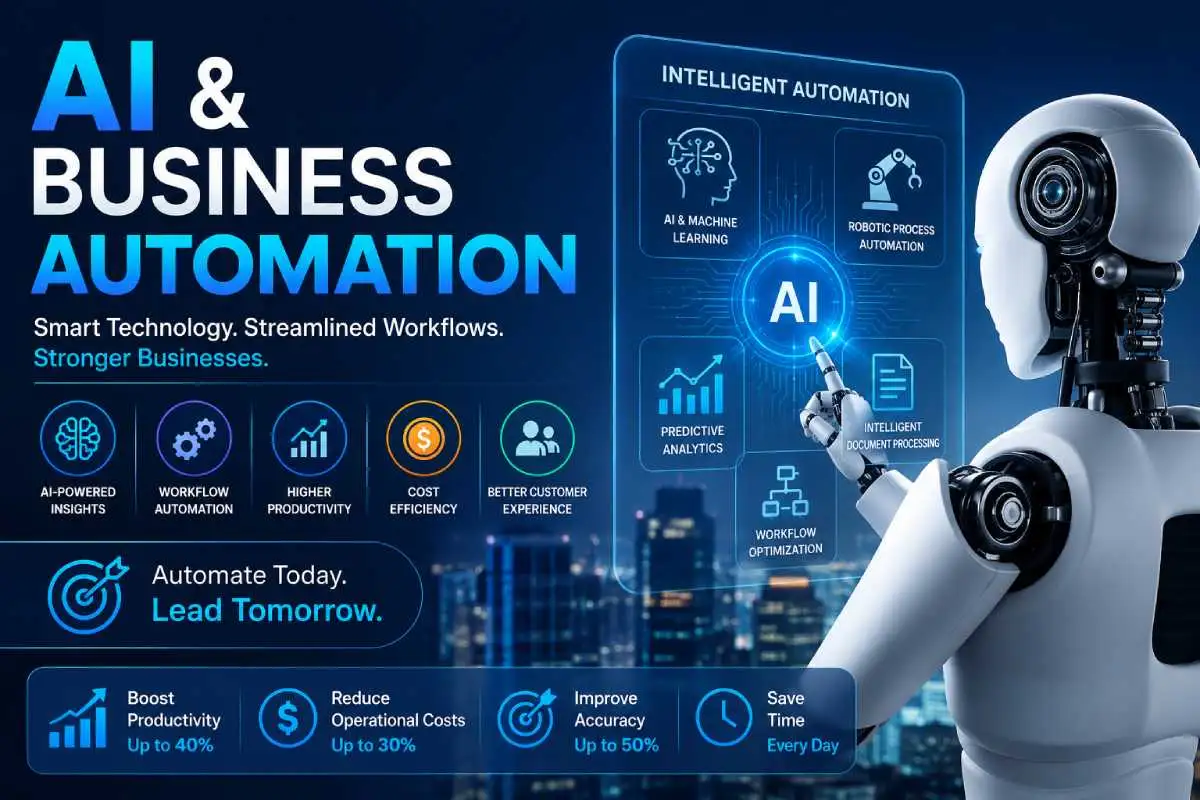
AI & Business Automation: Transforming Modern Organizations Through Intelligent Technology

Artificial Intelligence (AI) and Business Automation have become an indispensable part of doing business in the present day economy. All organizations big and small is leveraging the potential of AI powered business applications in order to automate mundane processes, optimize operational cost and increase productivity and enhancing customer interaction. From automating clerical work, to developing intelligent solutions for decision making and enabling predictive analyses, AI has already become a key part of organizations.
With all industries undergoing a phase of rapid change and evolution, companies implementing AI and automation gain an edge through faster operations, optimal utilization of resources and increased innovation. Be it customer service, marketing, finance, HR or the supply chain, AI powered automation solutions are enabling businesses to work intelligently.
If you are new to the platform, understanding the ecosystem basics can help you learn how its AI-powered products, business solutions, and digital tools work together within a unified ecosystem.
This article is a part of Business Software Reviews
What is AI & Business Automation?

AI & Business Automation is the application of Artificial Intelligence in automated business operations with the purpose of improving the levels of productivity, decision-making and efficiency. Unlike traditional automation which works through standard rules, automation of a business operation powered by AI technology does not merely optimize a process; it has the capability of learning, adapting and continually improving an organization’s overall operation.
Businesses use AI automation to:
- Process large volumes of data
- Automate repetitive tasks
- Improve customer interactions
- Predict market trends
- Optimize resource management
- Enhance operational efficiency
Many businesses have also become more reliant on Intelligent Automation for their administrative processes, allowing employees to focus on business critical initiatives.
This can serve as a good opportunity for your company to assess which of the available business process automation solutions may be best suited to meet your needs when a comparison of the tools.
Key Components of AI Business Automation
| Component | Purpose | Business Impact |
| Machine Learning | Learns from data patterns | Improves predictions and decisions |
| Natural Language Processing (NLP) | Understands human language | Enhances chatbots and customer support |
| Robotic Process Automation (RPA) | Automates repetitive tasks | Reduces manual labor |
| Predictive Analytics | Forecasts future outcomes | Supports strategic planning |
| Computer Vision | Analyzes visual data | Improves quality control and security |
| Intelligent Document Processing | Extracts information from documents | Speeds up administrative work |
Why Businesses Are Investing in AI Automation
Today, modern organizations are being pressed from both sides; demanding greater output for less spending. AI automation serves to satisfy both demands by enhancing efficiency throughout organizations.
Digital transformation initiatives are making an ever increasing demand on the need for intelligent machines capable of managing and executing routine tasks with less human input. Businesses deploying AI are witnessing faster reaction times, greater accuracy in operations and ultimately customer happiness. AI processes can be run around the clock without addition labor costs.
The platform’s business tools are designed to operate within the broader ONPASSIVE Ecosystem, enabling organizations to streamline operations and improve collaboration across multiple functions.
Business Automation Benefits
Beyond simply lowering expenses, AI automation offers additional benefits to organizations, such as Increased agility, superior user experience, and improved data-driven decision making
Major Benefits of AI Automation
| Benefit | Description |
| Increased Productivity | Employees focus on strategic tasks instead of repetitive work |
| Cost Reduction | Lower operational and labor costs |
| Improved Accuracy | Less errors made by humans |
| Faster Decision-Making | Quick responses can be enabled by analysis of data in real-time. |
| Better Customer Experience | Faster support and personalized interactions |
| Scalability | Processes can expand without proportional staffing increases |
Many companies that utilize automation will experience quantifiable gains in productivity as well as increase in employee morale.
AI Tools for Businesses
A growing number of AI-powered platforms help organizations automate workflows, manage data, and enhance productivity.
Popular AI Tools for Businesses
| AI Tool Category | Business Application |
| AI Chatbots | Customer service and support |
| Virtual Assistants | Scheduling and administrative tasks |
| Predictive Analytics Platforms | Forecasting sales and trends |
| AI Marketing Tools | Content creation and campaign optimization |
| CRM Automation Systems | Customer relationship management |
| HR Automation Software | Recruitment and employee onboarding |
| Financial AI Solutions | Budgeting, fraud detection, and forecasting |
Companies like Microsoft AI Solutions, Google Cloud AI and Amazon Web Services AI services are some of the major technology suppliers that provide enterprise grade AI solutions that support automation for various industries.
AI Productivity Platforms
AI productivity tools the new office standard AI Productivity Tools are becoming as essential a piece of office equipment as a pen or an email server. The ability for you and your teams to work using the cutting-edge artificial intelligence within each task on the go is more critical than ever before.
AI productivity platforms typically provide:
- Automated scheduling
- Smart task management
- Meeting summarization
- Workflow optimization
- Document generation
- Data analysis
If you take away the weight of these types of administrative work, you get people who are allowed to focus on creativity, interaction with the customer, and high level strategic objectives. Many businesses would see more effective use of time and collaboration between departments if adopting this type of AI productivity tool.
Workflow Automation Solutions
Solutions to automate workflow are designed to increase the ease with which business process can be implemented by reducing manual and redundant tasks. These solutions create a system for connecting various applications, system and sources so that information is easily transferred from one point to another.
Common Workflow Automation Use Cases
| Department | Workflow Automation Example |
| Marketing | Automated email campaigns |
| Sales | Lead qualification and follow-up |
| Finance | Invoice processing and approvals |
| HR | Employee onboarding workflows |
| Customer Service | Ticket routing and response automation |
| Supply Chain | Inventory monitoring and procurement |
| IT Operations | Incident management and system monitoring |
Workflow automation eliminates bottlenecks and ensures consistent and error free operation across the organization. With increasing business, workflow automation is being perceived as more of a necessity to be productive without increasing manpower resource by much.
AI Applications Across Industries
AI automation is transforming virtually every sector of the economy.
Industry-Specific Applications
| Industry | AI Automation Application |
| Healthcare | Patient scheduling and diagnostics |
| Banking | Fraud detection and risk assessment |
| Retail | Personalized recommendations |
| Manufacturing | Predictive maintenance |
| Education | Adaptive learning systems |
| Logistics | Route optimization |
| Real Estate | Property valuation and customer engagement |
These applications demonstrate how AI can improve operational performance while delivering better outcomes for customers and stakeholders.
Challenges of AI Business Automation
While AI automation offers significant benefits, organizations must address several implementation challenges.
Some common concerns include:
- Data privacy and security
- Integration with legacy systems
- Employee training requirements
- Initial implementation costs
- Ethical AI considerations
- Regulatory compliance
Successful organizations typically develop comprehensive AI strategies that include governance frameworks, workforce training programs, and clear performance metrics.
By addressing these challenges proactively, businesses can maximize the return on their automation investments.
Future of AI in Business
The future for AI in business looks remarkably bright. Machine learning, generative AI, predictive analytics, and autonomous systems, among others, will continue to shape business processes. Leading figures believe that we can expect even more complex decision-making capabilities and automated knowledge work, coupled with the ability to generate instant strategic advice.
Emerging AI Trends
| Trend | Expected Impact |
| Generative AI | Automated content and software creation |
| Hyper automation | Automate your business processes fully from start to finish |
| AI-Powered Decision Intelligence | Smarter business strategies |
| Autonomous Operations | Reduced human intervention |
| Intelligent Customer Experiences | Highly personalized interactions |
| AI Cybersecurity Solutions | Advanced threat detection |
According to research by World Economic Forum AI Insights, “AI will continue to be an engine for innovation, economic transformation and productivity growth globally across industries. Companies that invest in AI capabilities now will be better equipped to capitalize on future market opportunities and threats.”
The platform is designed to provide AI-powered tools and business solutions that can help entrepreneurs streamline operations, improve productivity, and scale their ventures more efficiently. To explore this aspect in greater detail, read our guide on and entrepreneurship.
Conclusion
AI & Business Automation are revolutionizing the way companies function, compete and grow. Companies can improve their efficiency, cost structure and customer experience through using AI tools for business, applying workflow automation systems and adopting a leading productivity platform.
The advantages of business automation go far beyond operational efficiency; it allows organizations to become more agile, innovative and data driven. With continuous advancements in AI technology, the future of AI in business will hold even greater opportunities in the realms of intelligent decision-making, operational autonomy and sustainability.
Organizations that integrate AI-powered automation now are likely to have greater prospects of navigating the digital economy of tomorrow and gaining a decisive edge in the tech-centric world.