

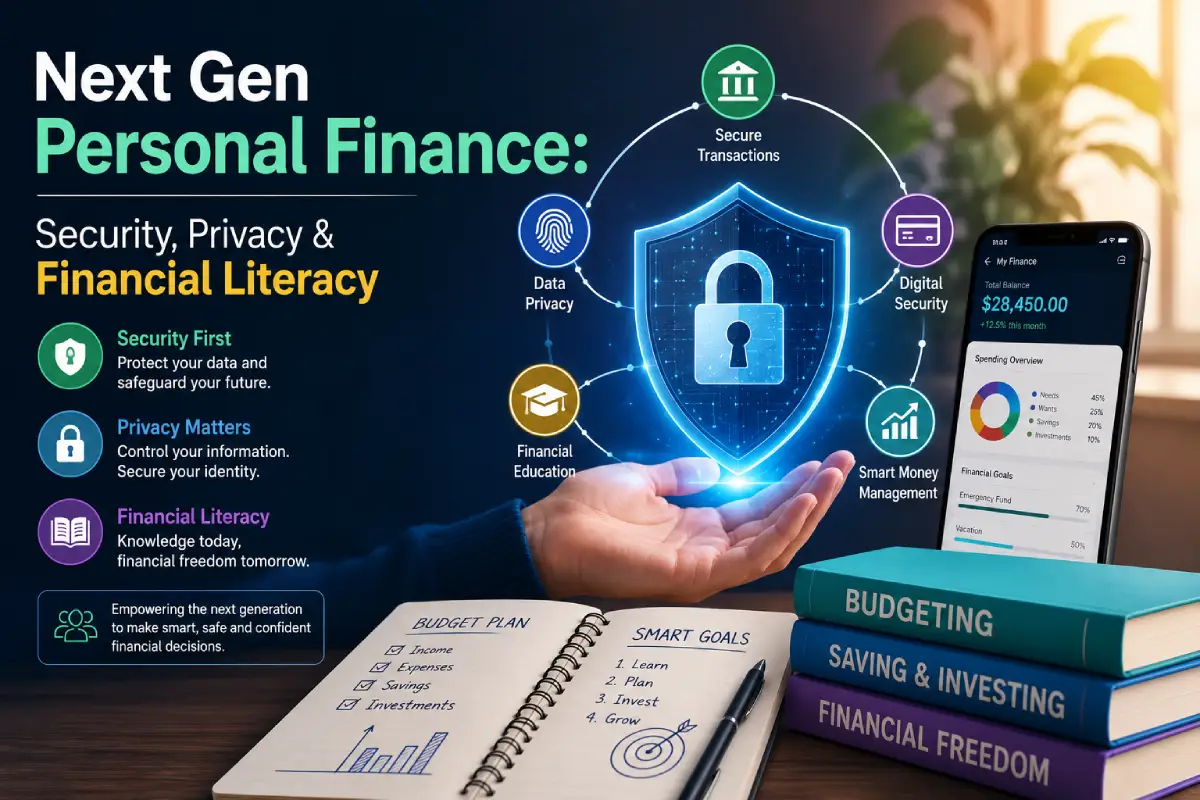
Next Gen Personal Finance: Security, Privacy & Financial Literacy

Digital banking, investment platforms, budgeting applications and AI-driven financial services, all play significant role on changing the way people manage their money today, and they come along with certain responsibilities in addition to convenience. Security of personal finance apps, privacy of financial applications, data security of financial information and financial literacy, among others, need to be well-known.
Next-gen personal finance is much more than simply saving or investing better. It’s about understanding how and where financial apps are using your data, being aware of its associated risks, and then being armed with what you need to make intelligent choices.
This Article Belongs to personal Finance
Why Security Matters in Next Gen Personal Finance
Recent financial applications enable the integration of bank accounts, credit cards, portfolios, investment and payment services into a single platform. Although this development is designed for convenience, sensitive financial data may be stored and/or transmitted online.
Robust fintech security guards you from unauthorized access, phishing scams, identity theft, malicious software, and data leaks. Be fully aware of the financial application’s security mechanisms before divulging any data in them and only provide the required information.
| Security Feature | Why It Matters |
| Two-factor authentication | Adds an additional login protection layer |
| Encryption | Helps protect data during storage and transmission |
| Biometric login | Uses fingerprints or facial recognition for access |
| Login alerts | Notifies users about suspicious account activity |
| Secure connections | Reduces risks when accessing financial information |
Personal Finance App Security: What Users Should Check
Personal Financial app security should be considered before linking any bank account to an app. An official and professional looking application doesn’t necessarily guarantee security.
Be aware of the security measures, clearly defined privacy policies, frequent software updates and explicit disclosure of how financial information is handled. Download apps from trusted sources and check the developer details prior to entering any sensitive information.
Always remember to never share a OTP, PIN, or password as well as an authentication code with anyone. Proper and trusted financial institutions will not and would not require you to share sensitive information via an unsolicited call, text or email.
Understanding Financial App Privacy
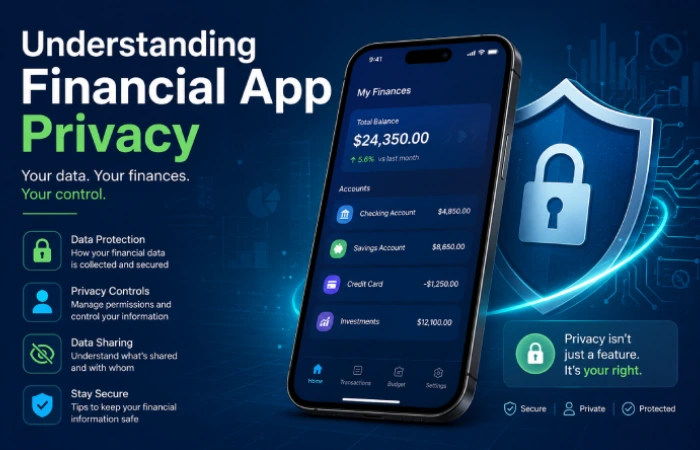
Privacy aspects on a financial app are also essential. As for a financial application, the data collected may be transaction logs, device identifiers and numbers, account information, geographical locations, or data on user behavior.
Review a privacy policy when installing any application before accepting the application terms, this clearly state the amount of information that will be collected, why it will be collected for and the possibility it will be shared with other users.
Users must check applications permissions regularly, revoke any access no longer needed.
Financial Data Security Best Practices
For financial data security, we must rely on fundamental digital protection practices. Strong and original passwords should be used on financial accounts, with multi-factor authentication activated whenever possible.
Strong financial data security requires understanding both cybersecurity and privacy risks. The National Institute of Standards and Technology (NIST) provides cybersecurity and privacy guidance covering areas such as identity management, risk management, cryptography, and emerging technologies.
Do not check these types of sensitive accounts over unsecured public Wi-Fi networks. Also, make sure all your devices such as the mobile phone and laptop, browser, and financial applications are kept up to date as security patches fix vulnerabilities.
Similarly, keep close watch of bank and investment accounts. Unexplained transactions, the sooner you notice it, the less the harm done.
AI Finance Risks in the Next Generation
More finance functions like budgeting, making suggestions, detecting money laundering and automatic investments are handled by artificial intelligence. While the financial management process has become much easier due to AI, they do not come without AI finance risks.
Inaccurate or outdated information-or a lack of information upon which recommendations are generated, or assumptions that don’t accord with reality-can lead to AI recommendations not being best for an individual. Automation has error potential.
Consumers must use advice given by an AI in this space as a reference, not a fact. Any significant financial decisions relating to investment, borrowing, protection or savings, for example, should be thoroughly considered.
| AI Finance Benefit | Potential Risk |
| Automated budgeting | Incorrect categorization |
| Personalized insights | Incomplete personal information |
| Fraud detection | False alerts |
| Investment assistance | Model limitations or unsuitable recommendations |
| Automated financial tasks | Overreliance on technology |
Choosing Safe Money Management Apps
When looking for secure money management apps, there’s more than just star ratings and download numbers involved. Look into the company’s background and history, security measures, privacy policies, customer service, and transparency.
A reliable app needs a clear service description and transparent information regarding costs, data consumption and security. Steer clear of apps which insist on immediate payments or asks for overly sensitive details.
Financial Literacy Is Your First Line of Defense
A replacement for financial literacy cannot be technology. Users require sufficient knowledge in budgeting, saving, debt, investing, interest, fees, tax rates and risk.
Furthermore financial literacy empowers people to detect frauds and avoid exaggerated promises. For example, suggestions that it will be possible to invest at above market rate guaranteed need to be looked with a pinch of salt.
The combination of financial knowledge and secure technology creates a stronger foundation for long-term money management.
A Simple Next Gen Finance Safety Checklist
Before using a digital financial service, ask:
- Is the company legitimate and clearly identified?
- Does the app use strong authentication and encryption?
- Have I reviewed its privacy policy?
- Does it request more personal information than necessary?
- Are notifications enabled for important transactions?
- Am I using a unique password and multi-factor authentication?
- Do I understand the fees and financial risks?
- Am I relying too heavily on automated or AI-generated recommendations?
Final Thoughts
Next Gen Personal Finance: Security, Privacy & Financial Literacy. So where do we meet technology & financial responsibility, digital money management provides user-friendly tools for budgeting, saving, investing & managing, while keeping in mind security & privacy:
Effective security, responsible data policies, and judicious use of AI along with enhanced financial literacy will equip consumers to make more sound choices. The most secure approach can be summed up by four key actions: utilize reputable fintech tools, manage your credentials, be aware of your data utilization, and ensure automation never takes precedence over your personal judgment.