


New Tax Regime Benefits: Advantages, Disadvantages and Pros & Cons

Last Updated: September 15, 2026
The New Tax Regime Benefits have made the newer income-tax system an attractive option for many taxpayers in India. The regime focuses on lower tax rates across income slabs while offering fewer deductions and exemptions compared with the old tax regime.
For the salaried employees, professionals and the rest of individual taxpayers: The decision to stick with old or opt for the new regime will also be determined by the level of your income, investments, investments, deductions and admissions to total income. How is the new tax regime advantageous for you?
This Article Belongs to Tax Tips
What Is the New Tax Regime?
The new tax regime provides taxpayers with revised income-tax slabs and relatively lower tax rates at different income levels. In exchange for these rates, taxpayers generally give up many deductions and exemptions available under the old regime.
The government has gradually increased the attractiveness of the new regime by providing additional relief to eligible taxpayers.
According to the, Income Tax Department the new tax regime is the default regime for eligible individual taxpayers, although eligible taxpayers can opt for the old regime.
Benefits of New Tax Regime
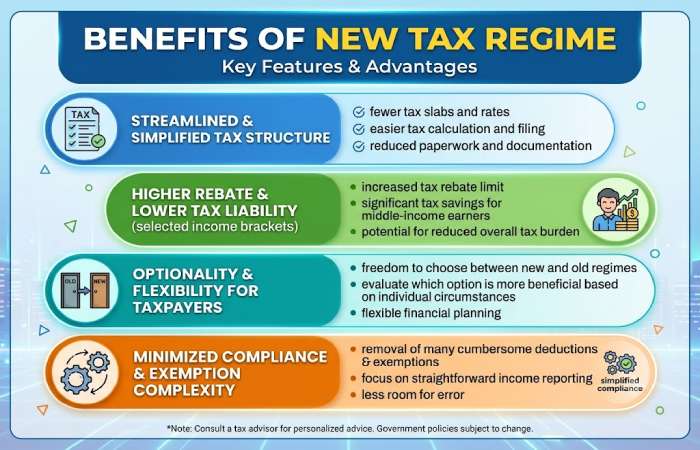
Here are some of the major new tax regime advantages taxpayers should consider:
1. Lower Tax Rates Across Slabs
One of the biggest advantages is the availability of different tax slabs with lower rates at various income levels compared with the traditional system.
This can reduce the overall tax burden for taxpayers who do not claim substantial deductions.
2. Simpler Tax Calculation
The new system is comparatively straightforward because taxpayers do not need to calculate numerous deductions and exemptions.
This makes tax planning easier, particularly for individuals who have limited investments or deductions.
3. Useful for Taxpayers With Fewer Investments
People who do not invest heavily in tax-saving instruments may benefit from the new regime. Instead of making investments primarily to reduce taxable income, they can focus on their actual financial goals.
4. Standard Deduction for Salaried Taxpayers
Eligible salaried individuals can claim the applicable standard deduction under the new regime. This provides an additional reduction in taxable salary income without requiring investment documentation.
5. Less Documentation
Since the new regime eliminates or restricts many traditional deductions, taxpayers may have fewer investment proofs and exemption calculations to manage.
6. Potentially Better for Middle-Income Earners
Depending on salary, deductions and applicable tax relief, the new regime can be particularly beneficial for taxpayers who do not have significant claims under sections traditionally used for tax planning.
New Tax Regime Advantages vs Disadvantages
While there are several advantages, taxpayers should also understand the limitations before switching.
| New Tax Regime Advantages | New Tax Regime Disadvantages |
|---|---|
| Simplified tax structure | Fewer deductions and exemptions |
| Lower tax rates across applicable slabs | Limited tax-saving opportunities |
| Less documentation | May not suit taxpayers with large deductions |
| Standard deduction available to eligible salaried taxpayers | Home-loan and other deductions may have restrictions |
| Useful for taxpayers with fewer investments | Old regime may be better for some high-deduction taxpayers |
New Tax Regime Disadvantages
The new tax regime disadvantages mainly relate to the reduced availability of deductions and exemptions.
Limited Tax Deductions
Taxpayers cannot generally claim many of the popular deductions available under the old regime. This can reduce the attractiveness of the new system for people who make substantial tax-saving investments.
Fewer Exemptions
Several salary-related exemptions that were commonly used under the old system may not be available under the new regime, subject to applicable rules.
Not Always the Cheapest Option
A lower headline tax rate does not automatically mean lower tax for everyone. Someone with substantial eligible deductions may find the old regime more beneficial.
Pros and Cons of New Tax Regime
The pros and cons of the new tax regime can be summarised as follows:
Pros
- Simpler tax calculation
- Lower slab rates under the applicable structure
- Fewer documents and investment proofs
- Suitable for taxpayers with limited deductions
- Standard deduction available to eligible salaried taxpayers
Cons
- Several deductions are unavailable
- Fewer exemptions compared with the old regime
- Taxpayers with significant investments may lose some tax benefits
- Requires comparison with the old regime before making a decision
New Tax Regime: Good or Bad?
Whether the new tax regime is good or bad depends on an individual’s financial circumstances. It is not automatically better or worse for every taxpayer.
For example, an employee who does not claim significant deductions may prefer the simplicity of the new regime. On the other hand, someone with substantial eligible deductions and exemptions should compare both regimes carefully.
The best choice should therefore be based on total taxable income and applicable deductions, rather than simply comparing tax rates.
Is New Tax Regime Better?
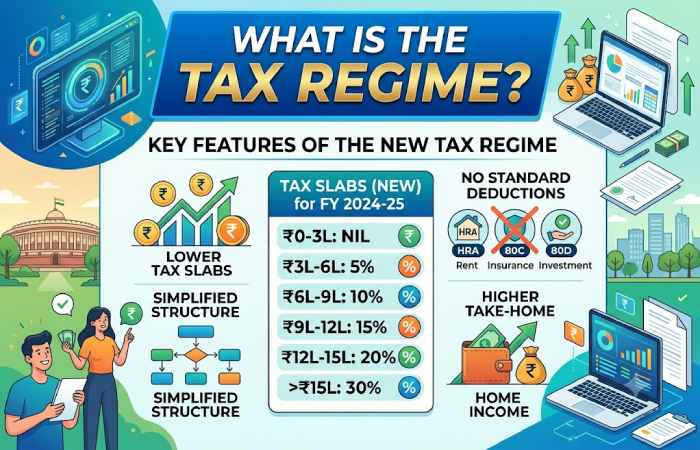
Is the new tax regime better? For many taxpayers, it can be, particularly when they have fewer deductions and want a simpler tax structure. However, taxpayers with substantial eligible deductions should calculate their liability under both systems.
| Factor | New Tax Regime | Old Tax Regime |
|---|---|---|
| Tax structure | Simplified | More deduction-oriented |
| Deductions | Limited | More available |
| Documentation | Generally lower | Generally higher |
| Suitable for | Fewer deductions | Significant eligible deductions |
| Tax planning | Relatively simple | More investment-focused |
Final Thoughts
The New Tax Regime Benefits include simpler tax calculations, lower applicable slab rates and reduced dependence on tax-saving investments. However, the system also has disadvantages because many deductions and exemptions available under the old regime are restricted or unavailable.
Therefore, the new tax regime advantages should always be considered alongside its disadvantages. Before choosing a regime, taxpayers should calculate their tax liability under both options based on their actual salary, income, investments and eligible deductions.