

EdFinancial Loan Forgiveness: Complete Guide to PSLF, IDR Forgiveness, SAVE Plan, and Federal Forgiveness Programs

Loan borrowers are likely to look up EdFinancial loan forgiveness in pursuit of information concerning their eligibility to cancel or get affordable payments on loans tied up in their federal loan payments. When borrowers research “EdFinancial,” it is because EdFinancial is technically loan servicing. So although you won’t directly remove your federal loans and be debt-free of it with EdFinancial, it will do more than manage repayment and applications for federal borrower- forgiveness programs from the United States Department of education.
In this write-up you are given more details about: Public Service Loan Forgiveness (PSLF), IDR forgiveness, SAVE Plan, discharge of loans, forgiveness status, and other student loan forgiveness options in the federal government sector.
This Article is the part of Financial-Planning
What is EdFinancial Loan Forgiveness?
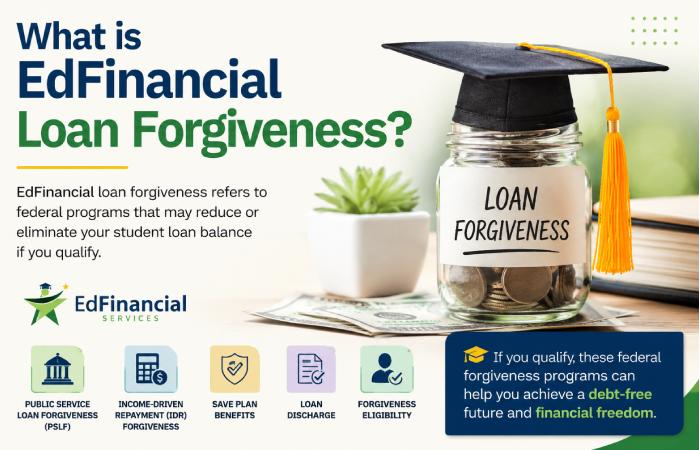
EdFinancial loan forgiveness is federal student loan forgiveness from federal programs that is being processed by your loan servicer, EdFinancial. You would be dealing with your bill, paying off loans, and application forms, but EdFinancial can’t be the one granting the approval nor deny nor does process the approval, that part come from a governing federal agency.
Depending on who your employer is, which loan you paid off or working towards to pay off, and which repayment plan your on, one may get lucky and become eligible to one or even two federal forgiveness programs to write off those loans with.
Overview of EdFinancial Loan Forgiveness Programs
| Program | Who Qualifies | Main Benefit |
| Public Service Loan Forgiveness (PSLF) | Government and nonprofit employees | Forgiveness after qualifying payments |
| IDR Forgiveness | Borrowers on income-driven repayment plans | Remaining balance forgiven after repayment term |
| SAVE Plan | Eligible federal loan borrowers | Lower monthly payments and IDR benefits |
| Teacher Loan Forgiveness | Eligible teachers | Partial loan forgiveness |
| Total and Permanent Disability (TPD) Discharge | Disabled borrowers | Complete loan discharge |
Public Service Loan Forgiveness (PSLF)
The PSLF program is one of the most popular on the federal level and will cover you if you work full time for government non-profit employers. Once you have made 120 successful monthly payments, in an eligible plan, with on of the employers, your entire direct loan balance can be eliminated.
PSLF Requirements
- Work full-time for an eligible employer.
- Have qualifying federal Direct Loans.
- Make 120 qualifying monthly payments.
- Submit employer certification regularly.
- Continue working for a qualifying employer until forgiveness is approved.
If your EdFinancial loan was acquired from one of the loan originators, that servicer of record would track your payment history. Whether or not those payments qualify for PSLF is determine by the Dept. Of Education.
IDR Forgiveness
An additional choice is IDR forgiveness-which may seem similar to other forgiveness and payment reduction programs, but it’s separate and distinct. There are income-driven repayment (IDR) options for almost all types of federal loans. With an IDR plan, your monthly payments will be calculated based on your income and number of dependents-rather than the entire sum owed. After you make payments on an IDR plan for a set amount of time (usually 20 or 25 years), the remaining, eligible balance might then be forgiven.
Benefits of IDR Forgiveness
- Affordable monthly payments
- Protection during lower-income periods
- Remaining balance forgiven after required repayment period
- Available for many federal student loan borrowers
SAVE Plan and Loan Forgiveness
SAVE stands for “Saving on a Valuable Education Plan. This plan offers an income-driven repayment on any loan type to make monthly payments affordable for many.
The plan can help borrowers by:
- Lowering required monthly payments
- Preventing unpaid interest from growing under applicable program rules
- Providing access to long-term IDR forgiveness
- Supporting borrowers with lower incomes
EdFinancial-serviced loans may be eligible to apply for the SAVE plan, according to requirements set by the Department of Education.
Loan Discharge Options
Instead, your loan obligation is completely erased based on your circumstances when considering loan discharge opposed to those which offer various terms and years to repay it.
Common discharge options include:
- Total and Permanent Disability (TPD)
- School Closure Discharge
- False Certification Discharge
- Borrower Defense to Repayment
- Death Discharge
Each discharge program has separate documentation and eligibility requirements.
Loan Forgiveness vs. Loan Discharge
| Feature | Loan Forgiveness | Loan Discharge |
| Requires repayment history | Yes (usually) | Usually No |
| Employment requirement | Sometimes | No |
| Disability eligible | No | Yes |
| School closure eligible | No | Yes |
| Managed by Department of Education | Yes | Yes |
Forgiveness Eligibility
Your forgiveness eligibility depends on several factors.
These include:
- Loan type
- Employer
- Repayment plan
- Payment history
- Income
- Federal program requirements
Eligible federal loan generally means you’re taking out a loan in the Direct Loan Program or you had loans in either the Federal Family Education Loan or Perkins Programs and consolidating those before you qualify for a program. Know what kind of loans you have; check that carefully to find the best federal programs for you.
Federal Forgiveness Programs Available
The U.S. Department of Education offers several federal forgiveness programs beyond PSLF.
These include:
- Public Service Loan Forgiveness (PSLF)
- Income-Driven Repayment (IDR) Forgiveness
- Teacher Loan Forgiveness
- Total and Permanent Disability Discharge
- Borrower Defense Loan Discharge
- Closed School Loan Discharge
Each program has unique requirements, deadlines, and documentation.
Which Program Is Right for You?
| Borrower Situation | Recommended Program |
| Government employee | PSLF |
| Nonprofit employee | PSLF |
| Low income | SAVE Plan + IDR Forgiveness |
| Long repayment history | IDR Forgiveness |
| Permanent disability | TPD Loan Discharge |
| School closed | Closed School Discharge |
How to Apply Through EdFinancial
If your federal student loans are service by EdFinancial, the application process generally includes:
- Log in to your EdFinancial account.
- Review your federal loan information.
- Select the appropriate repayment plan if needed.
- Complete the required forgiveness or discharge application through the Department of Education.
- Submit supporting documents.
- Continue making required payments until your application is approve, unless instructed otherwise.
Tips to Maximize Your Chances of Approval
To improve your chances of receiving federal loan forgiveness:
- Keep employment certifications updated for PSLF.
- Make payments on time.
- Stay enrolled in an eligible repayment plan.
- Update your income annually for IDR plans.
- Save copies of all loan documents and correspondence.
- Monitor your loan status through your servicer.
Conclusion
In fact, the more you understand about loan forgiveness options with EdFinancial you’ll be able to select a more favorable approach. Not only must eligible borrowers take steps in accordance with the repayment guidelines, it is also imperative to understand whether PSLF or IDR forgiveness, the SAVE Plan, or a loan discharge are more viable options.