

Bad Credit Business Loans: Options, Eligibility, Costs & How to Qualify

Business loans with bad credit is one of the main difficulties of applying for business finance with bad credit, is that most traditional lenders place a high emphasis on your credit report. As a result, some entrepreneurs have no access to business finance if their credit history isn’t perfect.
Though that might sound discouraging, it does not mean that finance options for entrepreneurs are in vain. Depending on the type of lender, sources of business income, time in business, assets or collateral, and other factors, entrepreneurs have a list of options to choose from.
This article will cover what bad credit business loans are, how they work, the requirements to qualify, the types of financing available, the costs involved, and steps to improve your chance of approval.
This Article Belongs to Business Loans
What are Bad Credit Business Loans?
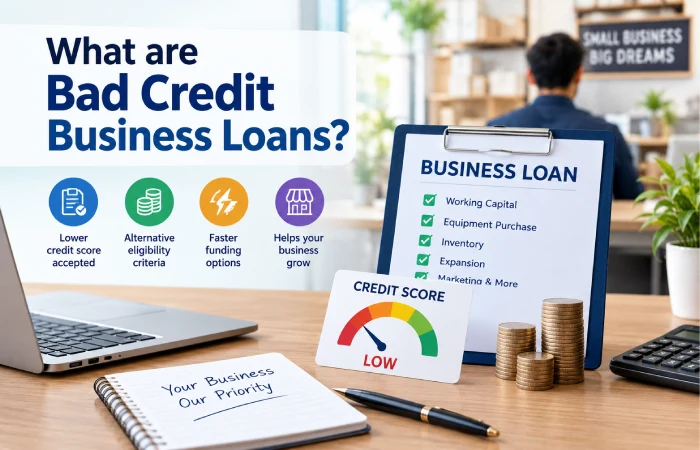
Bad credit business loans are types of funding meant for entrepreneurs with poor or limited personal or business credit. Bad credit business loans might come from alternative, online, or finance companies.
Where traditional business loans typically focus on the borrowers’ personal credit and financial history, some lenders might focus on the business’s revenue, cash flow, bank statements, collateral, and financial strength.
Lenders define “bad credit” differently. A credit score that is considered “bad” by one lender may not be considered bad by another, and vice versa.
Key Features of Bad Credit Business Loans
| Feature | What It May Mean |
| Lower credit requirements | Some lenders accept applicants with weaker credit profiles |
| Higher borrowing costs | Interest rates or fees may be higher because of increased perceived risk |
| Alternative eligibility criteria | Revenue, cash flow, collateral, or business history may be considered |
| Smaller loan amounts | Some lenders may limit the amount available |
| Faster funding | Online lenders may offer quicker application and funding processes |
| Shorter repayment periods | Certain products may require repayment over a relatively short period |
Before taking the financing, be sure to carefully examine the annual percentage rate (APR), fees, repayment terms, collateral requirements, and any other conditions.
How Do Business Loans for Bad Credit Work?
Bad credit business loans can be similar to other business loans; lenders may consider a number of factors with a business with poor credit.
A typical process involves:
- Application: The business owner submits an application and financial information.
- Credit assessment: The lender reviews personal and/or business credit history.
- Business evaluation: Revenue, cash flow, time in business, and outstanding debts may be assessed.
- Financing offer: If approved, the lender provides the proposed amount, rate, fees, and repayment terms.
- Agreement: The borrower reviews and signs the financing agreement.
- Funding: Funds are deposited into the business bank account according to the lender’s process.
- Repayment: Payments are made according to the agreed schedule.
Some financing products may not technically be structured as traditional term loans. For example, a business line of credit or merchant cash advance may have a different pricing and repayment structure.
Small Business Loans for Bad Credit
Small business loans for bad credit can be used for a variety of business expenses, depending on the financing product and lender.
Common uses include:
- Purchasing inventory
- Buying equipment
- Managing working capital
- Paying business expenses
- Expanding operations
- Marketing and advertising
- Renovating business premises
- Managing seasonal cash-flow gaps
- Hiring employees
- Purchasing business assets
However, not every lender allows every use. Borrowers should confirm that the intended purpose is permitted before accepting financing.
Types of Bad Credit Business Financing
Business owners with poor credit may encounter several financing options.
1. Secured Business Loans
A secured loan is one where you put up collateral, which may include equipment, property, vehicles, or other qualifying business assets.
Because the loan is secured by the asset that is financed, some lenders might be willing to relax their credit requirements.
Nonetheless, the borrower stands to forfeit the object offered as collateral if the financing contract specifies that the lender can repossess the asset upon default.
2. Business Lines of Credit
The business line of credit gives a fixed credit limit that can be borrowed upon in whole or in part. It may be useful in helping to meet the company’s short-term working-capital requirements.
3. Equipment Financing
Equipment finance is for the specific purpose of purchasing business equipment. Depending on the type of equipment finance being used, the equipment may be used as security.
Where you require equipment, machinery, vehicles, computers, or other assets for your business, this could be used in lieu of an unsecured business loan.
4. Invoice Financing
If your company offers products or services on credit, some of your customers likely still owe you money for sales made in the past. Invoice financing gives creditworthy businesses the chance to get money by pledging their unpaid bills.
The lender will look at the invoices and the customers’ credit position rather than the business owner’s personal credit.
5. Merchant Cash Advances
A merchant cash advance provides an upfront amount in exchange for a portion of future business sales or receivables.
This product can have a different cost structure from a traditional loan. Business owners should understand the factor rate, effective borrowing cost, repayment mechanism, and potential impact on cash flow before accepting one.
6. Business Credit Cards
A business credit card can provide a revolving source of financing for eligible expenses. Approval may depend partly on the owner’s personal credit profile, especially for small businesses.
Interest rates can be relatively high, particularly when balances are carried from month to month.
Business Loans With Low Credit Score: What Lenders Consider
A low credit score is only one factor that may influence a financing decision.
Lenders may also examine:
| Factor | Why It Matters |
| Business revenue | Indicates the company’s ability to generate cash |
| Cash flow | Helps assess whether repayments can be supported |
| Time in business | Shows operating history |
| Debt obligations | Indicates existing financial commitments |
| Bank statements | May provide evidence of actual business activity |
| Collateral | Can reduce lender exposure in secured financing |
| Industry | Some industries may have different risk characteristics |
| Business plan | Particularly relevant for newer businesses |
| Owner’s credit history | Often important for small businesses |
| Existing relationship | Banking or financing history may be considered |
Because requirements differ significantly, business owners should compare lenders rather than assuming that one lender’s rejection applies to every financing option.
Startup Business Loans for Bad Credit
Obtaining startup business loans for bad credit can be more difficult because new businesses often lack established revenue and operating history.
A startup may strengthen its application by providing:
- A detailed business plan
- Realistic financial projections
- Evidence of industry experience
- Personal and business bank statements where applicable
- Details of expected revenue
- Information about available assets or collateral
- A clear explanation of how the financing will be used
- Evidence of personal investment in the business
Some startup financing may rely heavily on the owner’s personal creditworthiness, while other programs may emphasize collateral, business assets, or alternative eligibility factors.
Entrepreneurs should also distinguish between financing needed to launch a business and financing needed by an established business experiencing temporary cash-flow problems.
How to Improve Your Chances of Getting Business Funding With Bad Credit
Bad credit can make borrowing more expensive or restrictive, but there are steps that may improve an application.
1. Check Your Credit Reports
Review personal and business credit reports for errors or outdated information. If inaccurate information is found, follow the appropriate dispute process with the relevant credit-reporting agency.
2. Demonstrate Strong Business Revenue
If the business generates consistent revenue, provide appropriate documentation such as bank statements, financial statements, or tax records.
Consistent cash flow can help demonstrate repayment capacity.
3. Reduce Existing Debt
High levels of existing debt may make additional financing more difficult. Paying down certain obligations, when financially feasible, may improve the overall debt position.
4. Consider Collateral
If appropriate assets are available, secured financing may provide another avenue to explore.
However, collateral creates additional risk because the pledged asset may be subject to recovery if the borrower defaults under the agreement.
5. Prepare a Strong Business Plan
A well-prepared business plan can help explain:
- How the business generates revenue
- Why financing is needed
- How the funds will be used
- Expected revenue growth
- Operating expenses
- Repayment capacity
This is particularly important for startups and young businesses.
6. Compare Multiple Offers
Do not focus only on the advertised interest rate. Compare the complete cost of financing, including fees and repayment requirements.
Costs Associated With Bad Credit Business Loans
The cost of financing can vary considerably depending on the lender, loan type, credit profile, business finances, loan amount, repayment period, and other factors.
Potential costs include:
- Interest
- Origination fees
- Application fees
- Processing fees
- Late-payment charges
- Prepayment charges, where applicable
- Annual fees for certain credit facilities
- Factor rates for certain alternative financing products
Example of Borrowing Cost
Suppose a business borrows $20,000 and the total repayment obligation under the financing agreement is $24,000.
The financing cost would be:
$24,000 − $20,000 = $4,000
This simple example does not represent an interest-rate calculation and does not account for timing or additional fees. It simply demonstrates why borrowers should look at the total repayment amount rather than focusing on the amount received.
Bad Credit Business Loans vs. Traditional Business Loans
| Factor | Bad Credit Financing | Traditional Business Financing |
| Credit requirements | May be more flexible | Often stricter |
| Interest/cost | May be higher | May be lower for qualified borrowers |
| Documentation | Varies by lender | Often extensive |
| Funding speed | May be faster with online providers | Can take longer |
| Collateral | May be required or optional | Depends on product |
| Loan amount | May be limited | Can be higher for qualified businesses |
| Repayment terms | May be shorter | Can be longer depending on product |
These are general differences, not universal rules. Individual lenders can have substantially different requirements.
Pros and Cons of Bad Credit Business Financing
Potential Advantages
- Financing may be available despite a weak credit history.
- Some lenders consider factors beyond credit scores.
- Alternative financing can provide access to working capital.
- Secured financing may offer additional options for businesses with valuable assets.
- Some online financing applications can completed relatively quickly.
Potential Disadvantages
- Borrowing costs may be higher.
- Loan amounts may be smaller.
- Repayment periods may be shorter.
- Collateral may be required.
- Some financing products can place significant pressure on business cash flow.
- Default can negatively affect credit and potentially result in loss of pledged assets.
How Much Can You Borrow With Bad Credit?
There is no universal loan amount for borrowers with bad credit. The amount may depend on:
- Credit history
- Business revenue
- Cash flow
- Business age
- Existing debt
- Collateral
- Financing type
- Lender policies
- Repayment capacity
A business generating consistent revenue may have access to different financing options than a newly established company with no operating history.
Rather than borrowing the maximum amount available, businesses should consider how much they can realistically repay without compromising essential operating expenses.
Alternatives to Bad Credit Business Loans
A traditional loan is not the only way to obtain business funding.
Depending on circumstances, businesses may consider:
- Business credit cards
- Equipment financing
- Invoice financing
- Business lines of credit
- Supplier or vendor credit
- Crowdfunding
- Equity investment
- Personal savings
- Government-backed financing programs, where eligible
- Financing from business partners or investors
Each option has different eligibility criteria, costs, risks, and ownership implications.
Business owners exploring financing options can also review the U.S. Small Business Administration’s official loan resources to understand available small-business loan programs and eligibility requirements.
How to Avoid Predatory Business Financing
Businesses with poor credit can be more vulnerable to expensive financing offers.
Be cautious when a provider:
- Guarantees approval without reviewing any information
- Does not clearly disclose costs
- Pressures you to sign immediately
- Requests unusual upfront payments
- Avoids providing written terms
- Uses unclear repayment calculations
- Makes unrealistic claims about improving credit
- Does not clearly identify the legal entity providing the financing
Always read the complete agreement and verify the lender or financing provider before sharing sensitive financial information.
Can Bad Credit Business Loans Help Rebuild Credit?
Some financing programs are reported to commercial or consumer credit bureaus; others are not. If the lender reports your payments, you might be able to build a positive credit score as you make payments, provided your payments are on time every time. If you’re late or skip a payment, that can harm your credit score.
Before taking financing specifically to rebuild credit, confirm whether the lender reports account activity and to which credit bureaus.
Final Thoughts
Bad credit business loans can be a viable source of funding for business owners that may not qualify for traditional funding. These can be in the form of secured business loans, lines of credit, bad credit business equipment financing, bad credit invoice financing or any other form of bad credit business financing.
If you are searching for business loans for bad credit, small business loans for bad credit, business loans with low credit score, or startup business loans for bad credit, make sure to compare the total cost, repayment structure, qualifications, and risks.
A low credit score does not necessarily eliminate every financing option, but businesses should borrow responsibly and choose financing that fits their actual cash-flow capacity.