

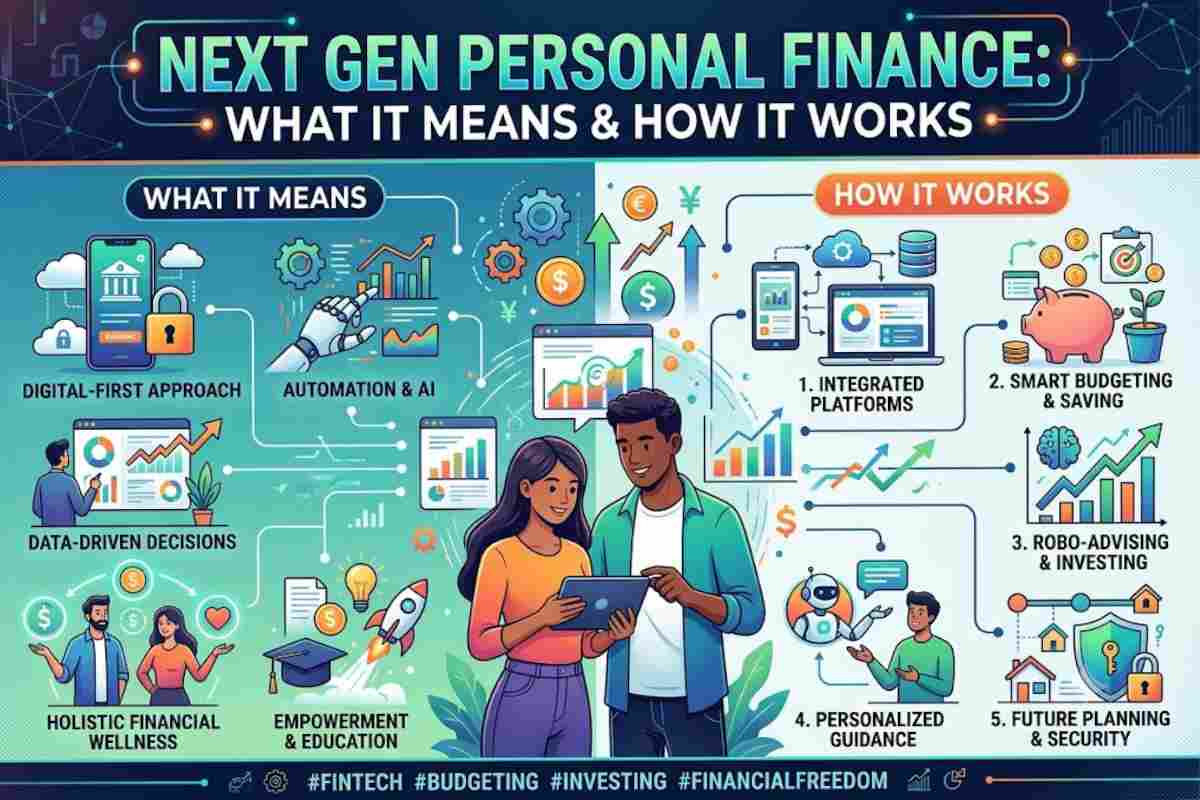
Next Gen Personal Finance: What It Means & How It Works

Managing our money has completely transformed in recent years and this is due to smartphone usage, artificial intelligence, automation, financial technologies and more. In the days when we are glued to a screen, the dependence on spreadsheets, bank statements, and the financial advisor is diminishing because people can now see what they’re spending each month, save up for certain goals and track where their money is being spent with very sophisticated methods available right at our finger tips, that can help process this data much quicker than normal.
It’s a concept referred to by some as next gen personal finance-the next stage of personal finance management by having a blend of a combination of financial services alongside technology, data analysis, automation, and personalized assistance.
This Article Belongs to personal Finance
What Is Next Gen Personal Finance?

The next generation of personal finance focuses more on where your money should go, not where it has been. Most personal finance products are data providers but increasingly, personal finance has become advice based and focused on planning the best course of action next.
Examples include a financial digital product that tags transactions and predicts required cash flows, tracks frequent spending or alerts if budget limits have been reached.
According to the Consumer Financial Protection Bureau, ‘new financial products may make use of electronic financial records in the context of budgeting, savings, bill payment, tax preparation, and loan applications’.
How Does Next Gen Personal Finance Work?

The basic process combines financial data with software that analyses and presents useful information to the user.
| Step | What happens |
|---|---|
| 1. Connect accounts | Users may connect bank, credit, investment, or other financial accounts. |
| 2. Collect data | Transactions and balances are organised in one digital interface. |
| 3. Analyse information | Software categorises spending and identifies financial patterns. |
| 4. Generate insights | The platform can provide budgets, alerts, forecasts, or recommendations. |
| 5. Automate actions | Users may automate transfers, savings, payments, or other recurring activities. |
| 6. Monitor progress | Dashboards help users track financial goals over time. |
Some services rely on consumer-authorised access to financial records held by other providers. This can allow multiple accounts to be analysed together rather than requiring users to manage each account separately.
Key Features of Digital Personal Finance
The digital personal finance system also incorporates various components for simplifying managing one’s daily financial lives.
Automated Budgeting
Budgeting apps of today can auto categorize transaction expenses into the necessary budgets such as groceries, housing, transportation, entertainment and subscriptions which would eliminate the manual process.
Automated Savings
Some options let you create rules to make transfers or savings automatic. These features help you save money consistently since they do not rely on your memory.
Financial Dashboards
Through one display, rather than reviewing multiple accounts individually, users will be able to view balances, spending trends, amounts owed and overall goals.
AI and Personalised Insights
Artificial intelligence is becoming an important part of personal finance technology. AI-powered systems can analyse large amounts of financial information and potentially provide personalised explanations or recommendations.
However, AI-generated financial guidance should not automatically be treated as professional financial advice. The CFPB has also highlighted limitations and risks associated with automated financial chatbots, including technical limitations and difficulties handling complex situations.
Fintech Personal Finance vs Traditional Money Management
The difference between traditional and fintech personal finance is primarily the way technology is used to deliver financial services.
| Traditional approach | Next-generation approach |
|---|---|
| Spreadsheets | Automated dashboards |
| Manual transaction tracking | Automatic categorisation |
| Periodic financial reviews | Real-time or frequent monitoring |
| Manual savings transfers | Automated saving rules |
| General financial information | Personalised digital insights |
| Multiple financial interfaces | Integrated financial views |
The goal isn’t necessarily to eliminate traditional financial practices. Instead, technology can make them faster, more accessible, and easier to maintain.
Benefits of the Future of Personal Finance
The future of personal finance is likely to become increasingly automated and personalised. Several potential benefits stand out:
- Convenience: Financial information can be accessible through mobile devices.
- Better visibility: Multiple accounts may be brought together for easier monitoring.
- Automation: Recurring financial tasks can require less manual effort.
- Personalisation: Data-driven tools can tailor insights to individual circumstances.
- Faster decisions: Users can receive alerts and financial information when they need it.
The CFPB provides financial education resources covering budgeting, saving, debt, credit, bills, and financial products, showing that technology works best when combined with sound financial knowledge.
Risks to Consider
Next gen personal finance also introduces important risks. Connecting financial accounts can involve sharing sensitive financial information with third-party providers. Users should understand what data they are granting access to and review privacy and security practices carefully.
There is also a risk of relying too heavily on automated recommendations. Digital tools may make mistakes, use incomplete information, or present recommendations influenced by commercial relationships. The CFPB has warned that digital comparison tools can potentially steer consumers toward products based on compensation received by the operator.
The Future of Modern Money Management
These advancements reflect an increasingly proactive and advisory stance being adopted by modern financial tools. It’s shifting from the concept of passively reporting on our spending habits to more intelligently assisting individuals with planning for their future spending needs, developing habits, and making sound choices based on available financial information.
We can look at it this way; we’re starting to see an approach where technology acts more like our money adviser, and less like a replacement for it. Integrating these technology advances with good old budgeting and financial sense can provide significant value to many customers.