

Index Funds & ETF Mutual Fund Categories

Investors seeking to diversify market exposure with a passive investment style will often turn to index funds and exchange-traded funds (ETFs). Rather than trying to beat a market index by buying and selling securities more frequently, index funds and ETFs typically seek to mirror the performance of a market index.
With the knowledge of the index mutual funds list, types of index funds, and the difference between ETFs and Mutual Funds, investors can select an index fund based on their investment objective, risk appetite, and investment duration.
This Article Belongs to Mutual Funds
What Are Index Funds?
An index fund is a type of mutual fund where the fund is configured to perform similar to some index. For example, an index fund could attempt to replicate the Nifty 50 or the Sensex or the Nifty Next 50 or any other broad or specific index.
Since the fund tracks an index as opposed to the fund managers trying to beat the market through active management, these funds tend to be passively managed and may have potentially lower management fees than actively managed funds.
Index Mutual Funds List
The following table provides examples of common index fund categories available in the Indian market:
| Index Fund Category | Example Index | General Focus |
|---|---|---|
| Large-cap index funds | Nifty 50 | Leading large companies |
| Broad-market index funds | Nifty 500 | Large, mid and small companies |
| Next 50 index funds | Nifty Next 50 | Companies after Nifty 50 |
| Sensex index funds | BSE Sensex | 30 major companies |
| Mid-cap index funds | Nifty Midcap 150 | Mid-sized companies |
| Small-cap index funds | Nifty Smallcap indices | Smaller companies |
| Sectoral index funds | Nifty Bank, IT etc. | Specific sectors |
| International index funds | Global indices | Overseas markets |
The exact availability of funds can vary between fund houses, and investors should review the fund’s tracking index, expense ratio, tracking difference and other costs before investing.
Major Index Fund Categories
Different index fund categories provide exposure to different segments of the market.
1. Broad-Market Index Funds
These funds track broad indices containing companies across different market capitalisations. They can provide diversified exposure to a large section of the equity market.
2. Large-Cap Index Funds
These funds typically track indices containing established large companies. They may be considered by investors seeking exposure to India’s leading listed businesses.
3. Mid-Cap and Small-Cap Index Funds
Mid-cap and small-cap index funds track indices representing smaller companies. Their returns can fluctuate significantly because smaller companies may experience greater price volatility.
4. Sectoral and Thematic Index Funds
These funds follow a particular sector or theme, such as banking, information technology or infrastructure. Since their exposure is concentrated, they can carry higher concentration risk than broad-market index funds.
5. International Index Funds
These funds provide exposure to companies or markets outside India by tracking international indices. Currency movements and international market conditions can affect their returns.
What Are Passive Mutual Funds?
Passive mutual funds follow a predefined market index or benchmark instead of attempting to select securities to outperform it. Index mutual funds are one of the most common examples.
The fund manager’s primary responsibility is generally to maintain the portfolio so that its performance remains reasonably close to the underlying index. However, returns may differ slightly because of expenses, transaction costs, cash holdings and tracking differences.
ETF vs Mutual Fund
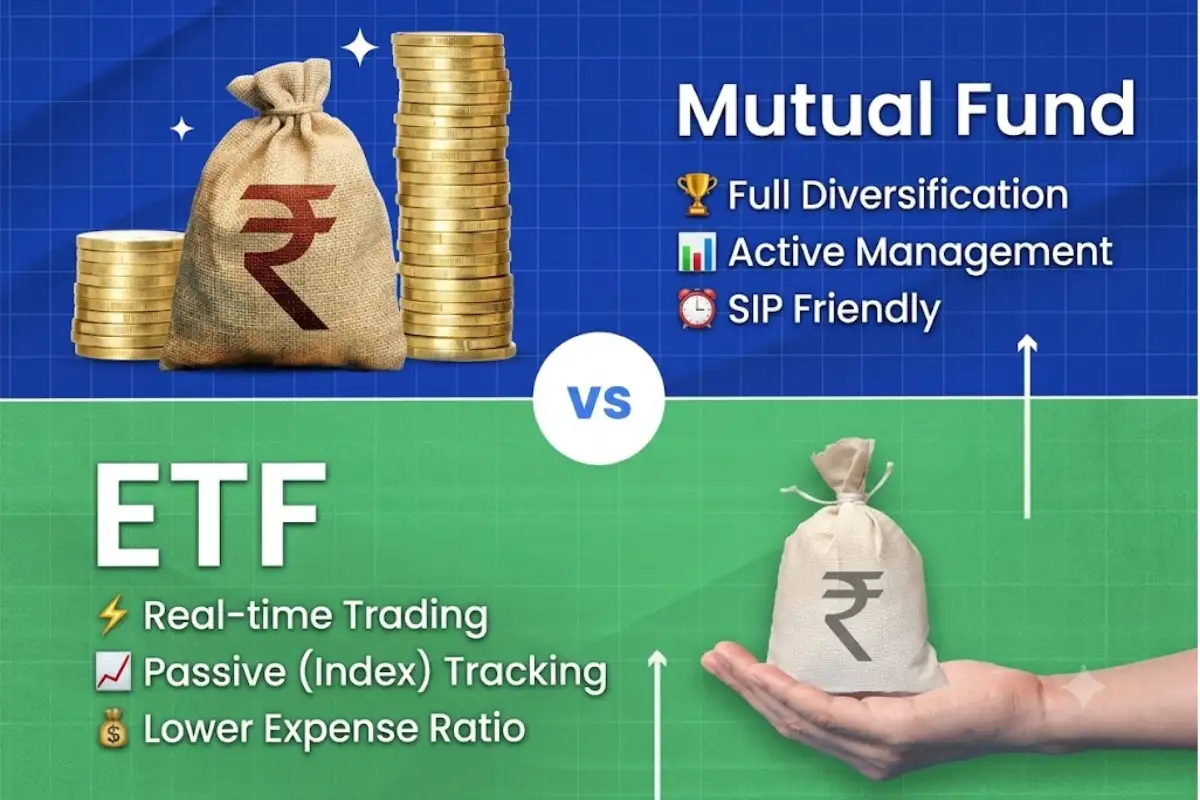
An ETF is also generally designed to track an index or other underlying asset, but it trades on a stock exchange during market hours. Traditional mutual funds are purchased or redeemed through the fund house or applicable investment platforms at the applicable net asset value (NAV).
| Feature | Index Mutual Fund | ETF |
|---|---|---|
| Trading | Bought/redeemed at applicable NAV | Traded on stock exchange |
| Pricing | NAV-based | Market price during trading hours |
| Demat account | Generally not required | Generally required |
| Investment method | SIP and lump sum possible | Bought like a share |
| Passive strategy | Usually | Usually |
| Liquidity | Depends on fund processing | Depends on exchange liquidity |
| Costs | Expense ratio and other applicable costs | Expense ratio plus brokerage/spread where applicable |
The ETF vs mutual fund decision depends on factors such as investment method, trading preference, liquidity, costs and whether the investor already uses a demat account.
Benefits and Risks of Index Funds
Index funds can offer diversification, transparency and a relatively simple investment approach. Since the portfolio follows a predefined index, investors can also understand the fund’s broad investment strategy more easily.
However, index funds are not risk-free. Equity index funds are affected by market movements and can lose value during market declines. Sectoral and smaller-company indices may carry additional concentration or volatility risks. Tracking differences and fund expenses can also cause returns to differ from the underlying index.
How to Choose an Index Fund
Before investing, consider:
- Underlying index: Understand which companies or securities the fund tracks.
- Expense ratio: Compare ongoing fund expenses.
- Tracking difference: Check how closely the fund has followed its benchmark.
- Fund size and liquidity: Larger funds may offer greater operational scale, while ETF investors should also consider trading liquidity.
- Investment horizon: Match the fund with your financial objective and time horizon.
- Risk level: Consider market-cap, sector and geographical concentration.
Conclusion
Index Funds and ETFs are passively managed funds that can give investors diversified exposure to the market. The index mutual fund categories list covering broad-market, large-cap, mid-cap, small-cap, sector and international index funds. By getting familiar with the categories of index funds and comparing the differences in ETF vs mutual fund, one can then decide which fund to choose.
Investors should review the scheme documents, benchmark, costs, tracking performance and associated risks before making an investment decision.