

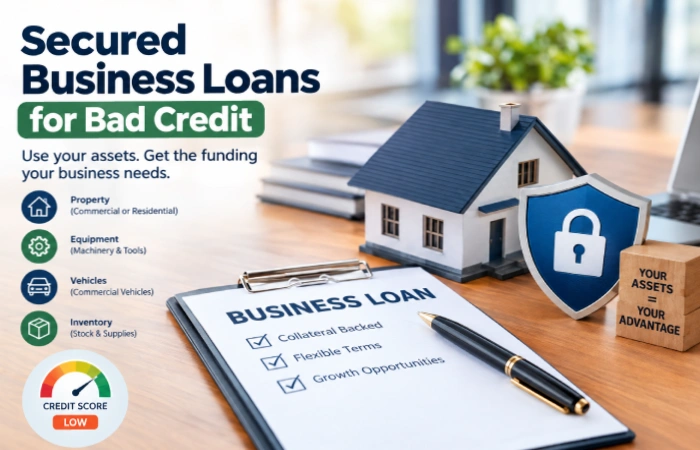
Secured Business Loans for Bad Credit

Business funding options can be a challenge with a poor credit history. Conventional loan providers might see negative credit as a greater risk, and they might limit the amount you’re eligible for, or apply higher interest rates or stricter approval standards. But secured business loans for bad credit can be an option to consider.
Secured loans provide the lender with the assurance of an asset pledged against the borrowed funds. This could lead to easier access to financing for some companies with less than perfect credit histories.
This Article Belongs to Business Loans
What are Secured Business Loans for Bad Credit?

Business loans for bad credit that are secured by assets such as property, equipment, vehicles, inventory, or other qualifying assets are called secured business loans. A legal claim is held by the lender against the collateral until the debt is satisfied.
Since the lender owns an asset as collateral, credit score might only be part of the full evaluation. Still, approval is not always a given, and each lender might have varying standards for collateral, income, operational history, and ability to pay.
How Does a Secured Business Loan Work?
A secured business loan generally follows these steps:
- The business applies for financing and provides financial and business information.
- The lender evaluates the borrower’s credit profile, income, repayment capacity, and business performance.
- An eligible asset is offered as collateral.
- The lender may assess the value and ownership of the asset.
- If approved, the loan is disbursed according to the agreed terms.
- The borrower makes scheduled repayments until the outstanding balance is cleared.
If the borrower defaults, the lender may have the right to take possession of and sell the pledged asset, depending on the loan agreement and applicable laws.
Types of Collateral Used for Business Loans
Different lenders accept different types of assets. Common examples include:
| Collateral Type | Possible Business Use |
| Commercial property | Working capital, expansion, or major investments |
| Residential property | Business financing, subject to lender policies |
| Equipment and machinery | Purchasing or upgrading business equipment |
| Commercial vehicles | Transportation and logistics businesses |
| Inventory | Short-term working capital |
| Fixed deposits | Smaller secured borrowing requirements |
The value and liquidity of the asset can influence the amount a lender is willing to provide.
Collateral Business Loan vs. Unsecured Business Loan
A collateral business loan differs from an unsecured loan mainly because an asset backs the borrowing.
| Feature | Secured Business Loan | Unsecured Business Loan |
| Collateral | Usually required | Generally not required |
| Credit history | Considered | Often strongly considered |
| Interest rate | May be lower in some cases | May be higher |
| Loan amount | May be higher depending on collateral | Often limited by eligibility |
| Risk to borrower | Collateral can be at risk | No specific collateral pledged |
| Approval factors | Asset + finances + credit profile | Credit + finances + business profile |
Actual terms vary by lender and borrower.
Asset-Backed Business Loan for Poor Credit
An asset-backed business loan can be considered when a business owner has valuable assets but a weaker credit history. Instead of relying entirely on the credit score, the lender may also consider the asset’s value, business cash flow, existing obligations, and repayment capacity.
For instance, you, as a business owner who owns commercial real estate, might be able to use that as collateral to receive financing. Still, traditional lenders typically undertake a financial and credit evaluation before approving the loan.
Secured Small Business Financing: Eligibility
Eligibility requirements differ between lenders, but applicants may commonly need to provide. “Business owners can also review the U.S. Small Business Administration’s official business loan guidance for additional information about business financing and loan requirements.”
- Business registration and ownership details
- Bank statements
- Income or financial statements
- Identity and address documents
- Details of existing loans
- Documents proving ownership of the proposed collateral
For businesses with bad credit, demonstrating stable cash flow and a realistic repayment plan can be particularly important.
Benefits and Risks
Potential Benefits
A secured form of finance might allow borrowing of larger sums, longer terms or more attractive prices than some unsecured alternatives. It can be another source of finance for customers who do not meet the criteria for certain unsecured products.
Important Risks
The value of the collateral is the largest factor. Collateral-backed business loan- If you don’t make your repayments as you agreed in your loan terms, then the asset you put up as collateral may be lost.
Consequently, before accepting an offer, the borrower needs to assess the total cost of borrowing, the fees, the repayment schedule, the collateral requirements and the repercussions of default.
How to Improve Your Chances of Approval
Business owners with poor credit can consider strengthening their application by:
- Showing consistent cash flow: Recent bank statements can demonstrate the business’s ability to generate income.
- Choosing suitable collateral: A clearly owned and readily valued asset can simplify the lender’s assessment.
- Reducing existing debt: Lower outstanding obligations may improve repayment capacity.
- Preparing accurate documents: Complete financial and business records can help avoid unnecessary delays.
- Borrowing responsibly: Requesting an amount that matches the business’s repayment capacity may make the application more sustainable.
Final Thoughts
Secured business loans for bad credit are a possible solution for those businesses that cannot qualify for unsecured finance. Using a suitable asset as collateral can give those with a less than perfect credit file access to the required funds.
Collateral does not mean the borrower doesn’t need to worry about a lender’s evaluation of his or her creditworthiness or ability to repay. Shop around for a collateral business loan and compare the interest rate, fees, repayment schedule, collateral type, and collateral Default. (Most importantly), ensure that the anticipated benefits of the business justify the debt and risk associated with the collateral asset.