

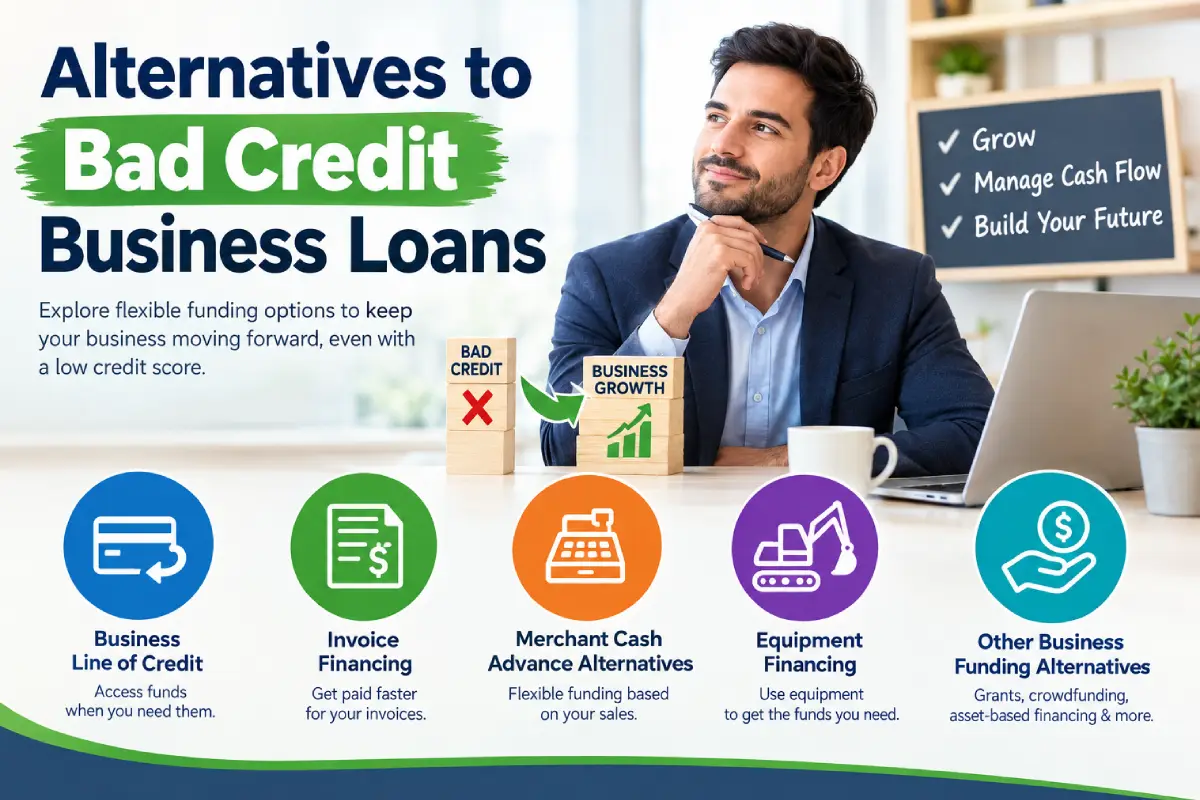
Alternatives to Bad Credit Business Loans

A poor business credit score can make a traditional loan difficult to qualify for, as lenders often require collateral, charge increased interest, or place tighter requirements on applicants. But that doesn’t mean there are no other options to help your business grow.
There are a number of business funding options that can permit companies to maintain cash flow, acquire inventory, cover short-term expenditure needs, or fund growth. For instance, resources like invoice financing, business credit lines, purchasing equipment, and also merchant-based funding can help everyone.
Understanding your options to business loans can allow business owners to compare fees, repayment terms, minimum requirements, and risks of various financing options.
This Article Belongs to Business Loans
What are Alternatives to Bad Credit Business Loans?
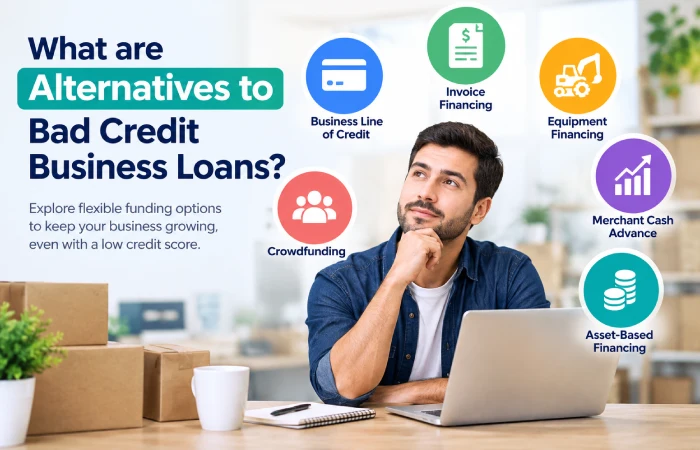
Business Loan Alternatives For Bad Credit Business Loans are financing options that might be obtainable if a business cannot get a traditional loan with a bad credit score or little credit history.
The use of other factors like outstanding invoices, business income, the value of equipment, or daily sales to make lending decisions is possible in addition to the borrower’s overall creditworthiness.
| Financing Option | Main Qualification Factor | Typical Use |
| Business line of credit | Revenue and cash flow | Working capital |
| Invoice financing | Outstanding invoices | Cash-flow management |
| Equipment financing | Equipment value | Purchasing equipment |
| Merchant cash advance | Business sales | Short-term expenses |
| Asset-based financing | Business assets | Larger funding needs |
| Crowdfunding | Business/project appeal | Startup or growth funding |
1. Business Line of Credit for Bad Credit
A line of credit is a loan that gives a company the ability to draw money up to a set limit and, in most cases, pay interest on the money drawn.
It is possible that alternative lenders will offer you a business line of credit bad credit – the question is, on what terms? If your business generates consistent revenue, you may have more options even if your credit score is not up to par.
For example, a business could have a $20,000 credit limit but use only $5,000. Depending on the agreement, repayments replenish the available credit.
Advantages
- Flexible access to working capital
- Interest may apply only to the amount used
- Can help manage short-term cash-flow gaps
Considerations
Interest rates and fees can be higher for borrowers with weaker credit. Some lenders may also require minimum revenue, a personal guarantee, or additional security.
2. Invoice Financing for Bad Credit
Invoice finance bad credit solutions enable companies to raise money using the value of their invoices as security. Instead of waiting between 30-90 days for their customers to pay for goods or services, a provider may lend a part of the invoice value.
For instance, if a business has an outstanding total of $50,000 in eligible unpaid invoices, a provider could pay out a portion of the funds up front and hold the rest, minus fees, until the invoices are paid.
This option can be particularly relevant for businesses that have reliable customers but experience delayed payments.
3. Equipment Financing
Equipment financing can help businesses purchase machinery, vehicles, technology, or other business equipment without using a traditional unsecured business loan.
The equipment itself may serve as collateral, which can reduce the lender’s risk. However, approval requirements, interest rates, down payments, and repayment terms vary by lender.
| Factor | Equipment Financing |
| Primary purpose | Purchase business equipment |
| Security | Often the equipment itself |
| Useful for | Machinery, vehicles, technology |
| Credit requirements | Vary by lender |
| Main risk | Equipment may be repossessed if payments are not made |
4. Merchant Cash Advance
A merchant cash advance (MCA) provides an upfront amount in exchange for a portion of future business sales. Repayment may be structured around daily or weekly sales rather than a traditional fixed monthly loan payment.
An MCA can be accessible to businesses with weaker credit when they have consistent sales. However, business owners should carefully examine the total repayment amount and effective cost before accepting an offer.
If you are researching merchant cash advance alternatives, options such as invoice financing, a business line of credit, equipment financing, or revenue-based financing may provide different repayment structures.
5. Asset-Based Financing
Asset-based financing is another form of funding that is based on the assets of the business. Under this method, the assets that may qualify are as varied as inventory, equipment, accounts receivable or others, depending on the lender and the structure.
Since the financing is attached to the business assets, the lender could pay less attention to credit score than in certain unsecured types of financing.
However, businesses should understand the consequences of default because pledged assets may be subject to repossession or liquidation under the financing agreement.
6. Crowdfunding and Business Funding Alternatives
Crowdfunding is an option if the company is selling a product, service, or idea that can get mass support from thousands of people.
Businesses exploring alternatives to business loans can also review the funding options and resources provided by the U.S. Small Business Administration
Businesses may get the funding via the reward, investment, or other model depending on the platform. Some regulations and requirements apply on other countries.
Other business funding alternatives can include:
- Supplier or vendor financing
- Business grants where available
- Equity investment
- Friends and family funding
These options have different costs, obligations, and eligibility requirements, so they should be evaluated separately from debt financing.
Comparing Alternatives to Business Loans
The right financing structure depends on why the business needs money, how quickly it needs funding, and how it expects to repay it.
| Alternative | Credit Flexibility | Repayment Structure | Best Suited For |
| Line of credit | Moderate | Revolving | Short-term working capital |
| Invoice financing | Often more flexible | Linked to invoices | Businesses awaiting payments |
| Equipment financing | Moderate | Fixed payments | Equipment purchases |
| MCA | Often flexible | Percentage of sales | Businesses with steady card sales |
| Asset-based financing | Asset dependent | Varies | Businesses with valuable assets |
| Crowdfunding | Different evaluation model | Depends on structure | New products and projects |
How to Choose an Alternative to a Bad Credit Business Loan
Before accepting financing, compare the total cost, not just the amount you receive. Check interest rates or factor rates, origination fees, repayment frequency, collateral requirements, personal guarantees, and early repayment conditions.
Businesses should also consider whether the expected cash flow can comfortably support repayments. A financing option that solves an immediate cash shortage but creates larger future cash-flow problems may increase financial pressure.
Final Thoughts
There are other business financing options for bad credit companies besides traditional business loans. Business lines of credit, invoice financing, equipment financing, asset based financing, merchant cash advances, and crowdfunding are all bad credit financing options.
Different options have different eligibility criteria, costs, repayment terms and risks involved. Business owners can make a comparison and read the loan agreement carefully before making any commitment. The most appropriate option depends on the cash flow of your business, reasons to access the loan, asset quality and repayment ability.