

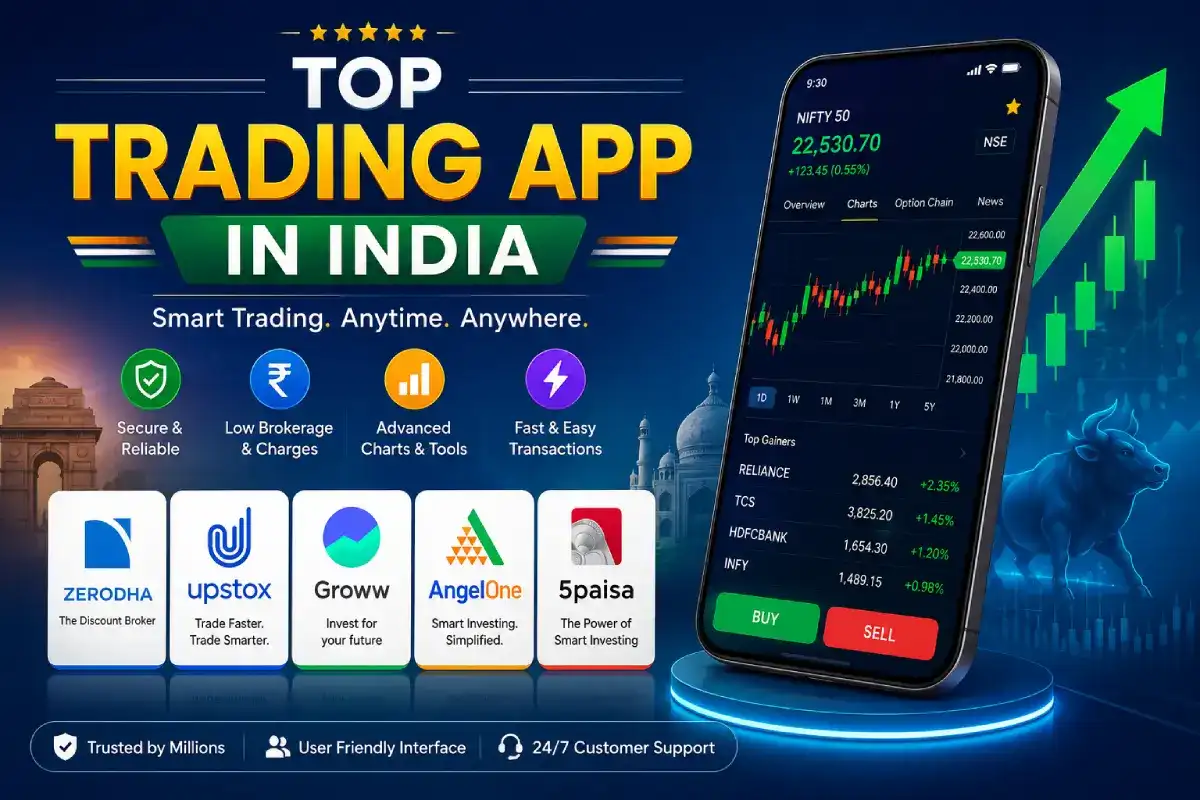
Top Trading App in India: Best Trading Apps for Beginners and Investors

The top trading app in India is something of the most essential choices to make right now for a person intending to trade shares or deal with the Indian stock market actively. There are so many online brokers in India that offer good mobile applications, as well as web platforms packed with the advantage of low brokerage and extensive trading capabilities, that it has all become an investors’ market.
However, the lowest brokerage can still not be the “trading app” in India, so the good trading app is not the one giving you low brokerage, but with good facilities of rates in reasonable, reliable system, security, and information, placing order with simplicity.
This feature may be most important to beginners, whereas Active traders may put this factor aftercharts, order types, or execution features; while those in for the long term might be more interested in the portfolio, mutual funds, research features, and IPO features.
This comparison will assist potential investors in choosing among the widely used platforms available. Platforms like Zerodha, Groww, Upstox, Angel One, etc have been selected. However, do note that the costs are volatile in nature and investors need to be aware of the charges stipulated by their selected broker, prior to account opening.
This Article Belongs to Investment App Reviews
What is a Trading App?
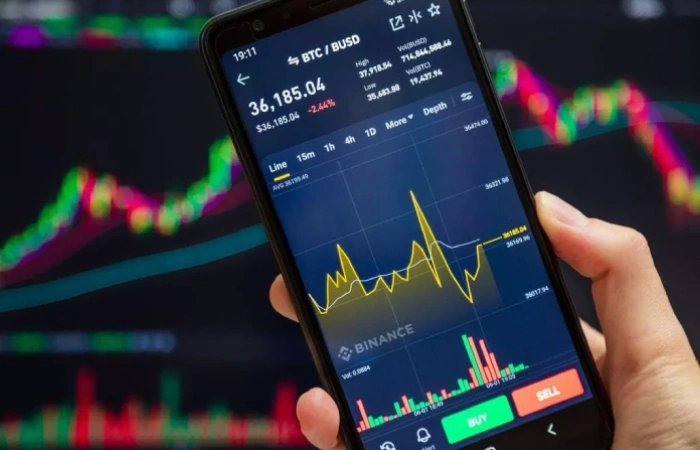
A trading app is online software offering through the stockbroker to customer to have trading and investment access to financial markets by smartphones or web interface. Users are able to do some purchase & sales for shares, mutual funds, apply IPOs or futures transactions on the platform based on service offered by brokers.
Ultimately, the app is just the technology enabling customers and the broker to communicate with each other. For that reason, the decision about what app to use shouldn’t just be based on the user interface. Broker’s regulatory requirements, costs, security protocols, customer service and image are no less important.
In India, to check whether your stock broker is registered under SEBI, you can view it under intermediary under website of SEBI. According to SEBI “Stock Broker is an intermediary, registered with SEBI and investors can check the registration with SEBI through respective websites and respective Stock Exchange”.
Top Trading Apps in India
India has numerous available trading platforms, among them four are quite prominent – namely Zerodha, Groww, Upstox and Angel One. Each of them have a diverse pricing system, application and design interface and range of tools for trading.
| Trading App | Particularly Suitable For | Equity Delivery Brokerage* | Intraday Brokerage* | F&O Brokerage* |
| Zerodha | Investors and active traders | ₹0 | ₹20 or 0.03%, whichever lower | ₹20/order for options |
| Groww | Beginners and investors | ₹20 or 0.1%, whichever lower | ₹20 or 0.1%, whichever lower | ₹20/order |
| Upstox | Traders and investors | ₹20/order | ₹20 or 0.1%, whichever lower | ₹20/order |
| Angel One | Investors and active users | ₹20 or 0.1%, whichever lower | ₹20 or 0.1%, whichever lower | ₹20/order |
Brokerage figures are based on the brokers’ published pricing pages accessed for this article. Taxes, exchange charges, STT, GST, stamp duty, DP charges and other applicable costs can be additional.
1. Zerodha

Zerodha is one of India’s best-known discount brokers and its Kite platform is widely used by both investors and active traders. The platform focuses heavily on providing a streamlined trading experience without making the interface unnecessarily complicated.
One of Zerodha’s major attractions for long-term equity investors is its zero brokerage on equity delivery. Its current pricing page also lists intraday brokerage at ₹20 or 0.03% per executed order, whichever is lower, and a flat ₹20 per executed order for options.
The platform also provides charting and market-monitoring features that can be useful to users who want to go beyond basic buy-and-sell transactions. Investors can use its ecosystem for equities, mutual funds and derivatives.
For beginners, Zerodha can take some time to learn because the platform offers more functionality than a very basic investment application. However, that can become an advantage as an investor gains experience.
Best suited for: Long-term investors, active traders and users who want a mature trading platform.
2. Groww
Groww has become particularly popular among new investors because of its relatively straightforward user experience. The platform brings several investment products into one application, making it convenient for people who want to manage different investments from a single account.
Groww’s current pricing page lists equity brokerage at ₹20 or 0.1% per executed order, whichever is lower, with a minimum brokerage provision. Its F&O pricing lists ₹20 per executed order. Additional statutory and regulatory charges can apply.
The platform’s simple presentation can make it attractive to people who are opening their first investment account. At the same time, investors should not confuse simplicity with reduced risk. Purchases of stocks remain subject to market risk. Users should do their own research prior to purchasing.
Which is why GROWW can be a solid bet for anyone looking for best trading apps for beginners India, especially if ease of use is your priority.
Best suited for: Beginners, long-term investors and users who prefer a simple interface.
3. Upstox
Upstox is a well-established online trading platform which allows you to invest in equities, derivatives etc. Its platform is designed to accommodate both investors and more active market participants.
As per its current pricing structure, Upstox charges Rs.20 for each equity delivery order placed and executed while the same for intraday equity trading is Rs 20 per order or 0.1% whichever is lower and equity option is charged at a flat Rs. 20 per order execution.
Upstox also publishes its statutory charges separately, which is useful because investors can see that the actual cost of a trade involves more than brokerage alone.
The platform may appeal to users who want a combination of investing functionality and active trading features without moving between different applications.
Best suited for: Investors and active traders looking for a broad digital trading platform.
4. Angel One
Angel One is another established name in India’s retail investment market. Its application provides access to stocks, derivatives and other financial products, along with market information and trading-related tools.
Angel One currently states that equity delivery and intraday brokerage is ₹20 or 0.1% per executed order, whichever is lower, subject to a minimum brokerage of ₹5. For futures and options, it lists ₹20 per executed order.
Investors should also understand the difference between brokerage and account-related charges. Angel One states that AMC conditions apply after the first year, depending on the account category.
This makes Angel One worth considering for users who want a feature-rich platform but are also willing to compare the complete fee structure before making a decision.
Best suited for: Investors who want multiple investment products and trading features in one platform.
Best Stock Trading App in India: Comparison
There is no single platform that is automatically the best stock trading app in India for every investor. Your choice should depend on how you plan to use the application.
| Requirement | Zerodha | Groww | Upstox | Angel One |
| Beginner-friendly | Good | Excellent | Good | Good |
| Long-term investing | Excellent | Excellent | Good | Good |
| Active trading | Excellent | Good | Excellent | Excellent |
| Charting | Strong | Good | Strong | Strong |
| Mutual funds | Yes | Yes | Yes | Yes |
| IPO investing | Yes | Yes | Yes | Yes |
| F&O | Yes | Yes | Yes | Yes |
| Low delivery brokerage | Strong | Moderate | Moderate | Moderate |
| Simple interface | Good | Excellent | Good | Good |
The table should be viewed as a general comparison rather than a universal ranking. Features, charges and platform functionality can change over time.
Best Trading App for Beginners in India
To an aspiring trader who is looking to open their first trading account, India’s best trading app for beginners wouldn’t be the lowest-priced platform. Instead, a beginner must look for an application, which explains the fundamental concepts effectively.
On one hand, Groww’s simple interface can appeal to beginners and on the other hand, Zerodha may appeal to the people who are willing to learn step by step and then move to advanced trading tools. Otherwise, Upstox and Angel one too are decent choices that can be made by beginners who wish to trade more trading products.
The most important point is that a beginner should not select an application simply because it makes trading look easy. Even the stock market is not “risk-free”. A simplified interface would make it simpler to put an order through, but it does nothing to make losing your money impossible.
Before making your first trade, understand market orders, limit orders, stop-loss orders, delivery investing and the difference between investing and intraday trading.
Low Brokerage Trading App in India
A lot of traders look for a cheap brokerage trading app in India while anticipating heavy use. Brokerage cost is an effective factor to consider if active trading will happen frequently, but can’t be the solely parameter to compare among brokers.
Zerodha, for example, currently advertises ₹0 brokerage on equity delivery, while Groww, Upstox and Angel One use different brokerage structures depending on the type of transaction.
However, STT, exchange transaction charges, GST, SEBI charges, Stamp Duty and DP charges can also become part of the total transaction amount. Zerodha specifically notes that STT and other statutory costs can sometimes be considerably larger than the brokerage itself.
So for comparing a cheap trading platform, investigate the full costs as well as the headline brokerage.
Safest Trading App in India
The phrase safest trading app in India should be approached carefully. No trading application can guarantee that an investor will never experience technical problems, fraud attempts or investment losses.
One of the most important checks is whether the broker is properly registered with SEBI. SEBI’s official database provides registration information for stock brokers and other intermediaries. According to the database available with SEBI, as of September 6, 2006, there were thousands of registered stock brokers in various segments of the stock market.
Before opening a trading account, investors should verify whether the broker is registered with SEBI. You can check the broker’s registration details through the official SEBI Registered Stock Brokers database.
Even while downloading apps it is recommended that you download them through official app stores only and not through links that may be received through unknown emails, social-media sites or messaging applications. Please do not share your password, PIN, OTP with anyone.
The security ought to include the behavior of the investor as well. Even though a heavily regulated broker will not be able to safeguard the account in case the investor gives away the login details or approves a fake transfer at free will.
Best App for Stock Market Trading: What Should You Compare?
The best app for stock market trading depends heavily on your trading style.
A long-term investor may care more about delivery brokerage, portfolio tracking and mutual fund access. An intraday trader may care more about charts, order execution and platform stability. Someone trading derivatives needs to understand brokerage, margins and the additional risks associated with leveraged products.
The following comparisons can help investors identify what matters most.
| Investor Type | Important Features |
| Beginner | Simple interface, education, transparent charges |
| Long-term investor | Low delivery costs, portfolio tools, mutual funds |
| Intraday trader | Charts, fast order placement, order types |
| F&O trader | Brokerage, margin information, risk-management tools |
| Occasional investor | Easy account management and low maintenance costs |
There is no need to choose an application simply because it has the largest number of features. If you are a long-term investor who buys shares a few times a year, an extremely complicated trading interface may provide little additional value.
Understanding Trading App Charges
Trading costs can be confusing because several charges may appear on the same contract note.
| Charge | What It Generally Represents |
| Brokerage | Fee charged by the broker |
| STT | Securities Transaction Tax |
| GST | Goods and Services Tax on applicable services and charges |
| Exchange transaction charges | Fees associated with exchange transactions |
| SEBI charges | Regulatory charges |
| Stamp duty | Applicable government charge |
| DP charges | Depository-related charges, particularly relevant to certain delivery transactions |
| AMC | Account maintenance charge, where applicable |
For example, Groww publishes separate information for brokerage, STT, stamp duty, exchange transaction charges, SEBI turnover charges and DP charges. Upstox similarly separates brokerage from statutory and exchange-related charges.
This is why the phrase “zero brokerage” should not automatically be interpreted as “zero cost.”
Trading App vs Demat Account
A trading account and a demat account serve different purposes.
The trading account is used to enter transactions into the market, while the demat account is used to store securities electronically. With the advent of one onboard through many brokers offering services such as these two, the difference between the two is often not really obvious to beginner investors.
When you purchase shares for delivery, the securities are ultimately held electronically in the demat account. When you sell them, the securities are transferred from the demat account according to the applicable settlement process.
Understanding this distinction makes it easier to understand why brokerage and DP charges can appear separately on a transaction.
How to Choose the Top Trading App in India
Instead of asking which application is universally number one, investors should ask which platform best matches their own requirements.
Start by deciding whether you are primarily a long-term investor, intraday trader or derivatives trader. Then compare the charges applicable to that specific activity.
For example, an investor focused on long-term equity may find delivery brokerage particularly important. Someone who makes numerous intraday trades should examine the per-order brokerage and other trading costs. A derivatives trader should pay closer attention to F&O brokerage, transaction costs and risk-management features.
Technology reliability is also important. A trading application should provide a stable experience during market hours, because an inability to access an account or place an order at the right time can be frustrating for active traders.
Customer support should also be considered. Even experienced investors can occasionally encounter account, fund-transfer or technical issues, so access to reliable support is valuable.
Common Mistakes to Avoid When Selecting a Trading App
One of the biggest mistakes is selecting a broker solely because of a low brokerage advertisement. Brokerage is only one part of the total cost.
Another common mistake is ignoring account maintenance and DP charges. These may be particularly relevant to investors who hold or sell delivery-based investments.
New investors should also avoid selecting an application based only on its popularity on social media. An application may be popular while still not being the right fit for your investment strategy.
Finally, investors should avoid trading products they do not understand. The availability of futures and options inside an application does not mean that every investor should use them.
Are Trading Apps Safe for Investing?
These trading applications are great because they give you access to financial markets and regulations, but as investors, the safety of your account, as well as your investments, still rest in your hands.
Before opening an account, verify the broker’s registration information through SEBI or the relevant exchange. SEBI specifically advises investors that broker registration can be verified through its website and stock exchanges.
Once you open the account, use two-factor authentication and guard your login credentials. Be extra careful about people who are trying to trick you into thinking that you will definitely make money on the stock markets and who ask you for your OTP or password.
Remember that platform security and investment safety are different things. A secure application does not mean that your investments are guaranteed to make money.
Final Verdict: Which Is the Top Trading App in India?
The top trading app in India depends on the type of investor using it.
Zerodha can be a good choice for investors, day traders and active traders focusing on low delivery brokerage. Delivery charges are free for Zerodha, and Rs 20 and/or 0.03% per trade for intraday.
Groww could potentially appeal to beginners and investors that prefer simple and an uncomplicated trading environment. According to its current pricing: “equity brokerage at Rs ’20 or 0.1% of executing orders whichever is lesser ‘subject to its minimum brokerage policy
Upstox provides a combination of investing and trading functionality, with its published pricing listing ₹20 per executed order for equity delivery and ₹20 or 0.1% for intraday, whichever is lower.
Angel One is another established choice for investors who want access to multiple products and trading tools. Its current published brokerage information lists ₹20 or 0.1% for equity delivery and intraday, whichever is lower, and ₹20 per executed order for F&O.
The best trading app in India will be the app that works for your own trading approach in terms of costs, efficiency, safety and convenience. Check with current actual costs and legal compliance details when opening the account.
Frequently Asked Questions
Which is the best trading app in India?
The ‘best’ application for any and every investor is different. Zerodha, Groww, Upstox and Angel One are huge platforms in the market which can be evaluated on the bases of brokerages offered, features offered, ease of use, and investments preferred
Which is the best trading app for beginners in India?
In general, beginner investors require a navigation that’s straight forward, cost transparent and have educational contents. Groww will likely appeal to simple users while Zerodha can provide more tools, as investors will acquire a range of skills through experience.
Which trading app has the lowest brokerage?
The answer depends on the type of transaction. Zerodha currently offers ₹0 brokerage for equity delivery, while other platforms use different pricing models. However, investors should compare the complete cost of a transaction rather than brokerage alone.
What is the safest trading app in India?
Rather than relying on a “safest app” ranking, verify that the broker is properly registered with SEBI and follow good account-security practices. SEBI provides an official database where investors can verify registered intermediaries.
Is a low brokerage trading app always better?
No. Brokerage is only one factor. Platform stability, security, customer support, account charges, DP charges and other transaction costs should also be considered.
Can beginners use trading apps for long-term investing?
Yes. Trading applications are also used for long-term stock investing, mutual funds and IPO applications. Beginners should understand the investment before committing money and should not assume that easy-to-use technology makes investing risk-free.
What should I check before opening a trading account?
Check the broker’s SEBI registration, brokerage structure, statutory charges, AMC, DP charges, available investment products, platform features, customer support and security practices. Most importantly, compare the broker based on how you actually intend to invest or trade.