

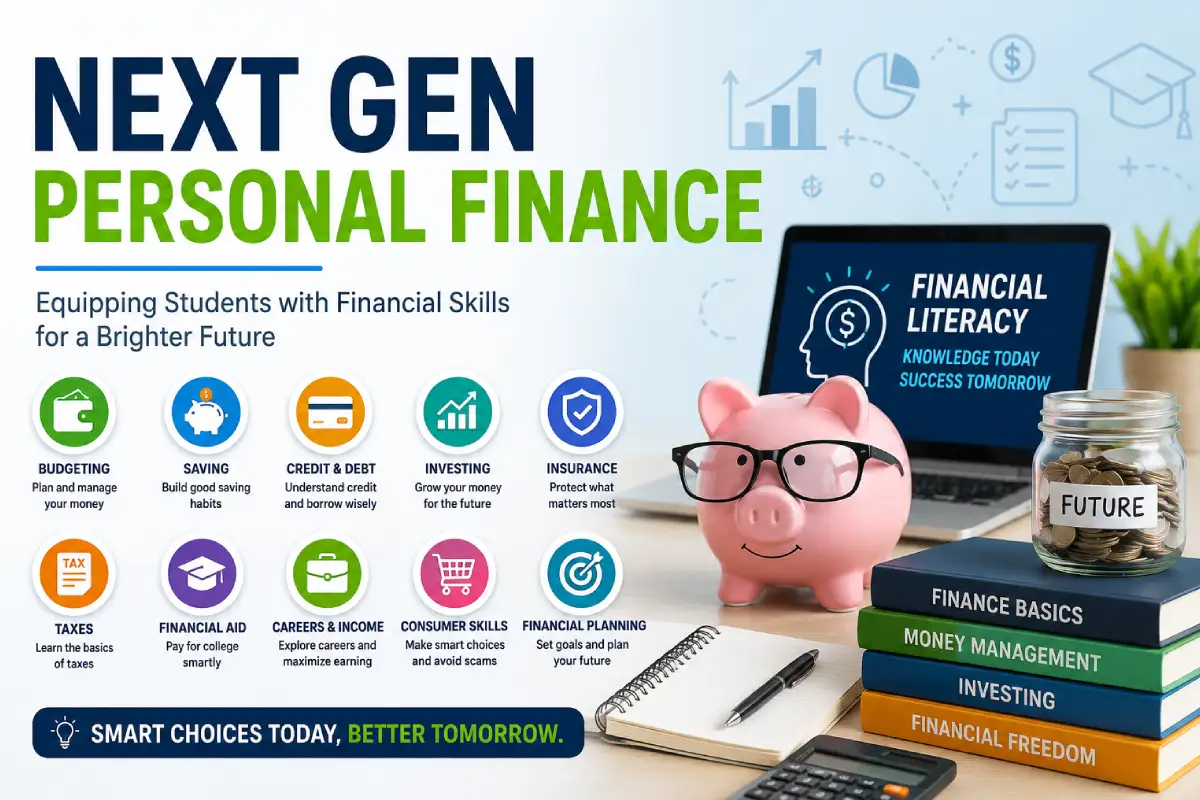
Next Gen Personal Finance: A Complete Guide to NGPF Curriculum, Courses, and Financial Literacy

Money management is one of the most critical skills a student can gain, and the traditional school system haven’t always been focused on teaching youngsters how to earn and manage money in real life, ranging from the basics to budgeting and saving money, from loans, investments, taxes, and insurance to careers planning. The money issues will always reach young people before they’re ever ready to deal with them. This is where Next Gen Personal Finance (NGPF) comes in.
“Next Gen Personal Finance (NGPF) is an educational non-profit committed to students’ success through personal finance education by providing the resources, training and other services you’d expect, all while remaining Free! It is our mission to improve access to Financial Education for educators and to get our students fired up about Personal Finance.”
Whether you are a classroom teacher seeking teachable materials, a school administrator researching financial education courses, or a concerned parent about what your child’s curriculum entails concerning their knowledge of finances, knowing the resources NGPF has to offer may be of importance.
In this guide, you’ll be able to learn about the NGPF Curriculum, the Next Gen Personal Finance Courses, Financial Literacy Resources, teacher resources, and how the NGPF curriculum can help students with their future real-world money decisions.
This Article Belongs to personal Finance
What is Next Gen Personal Finance?
Next Gen Personal Finance or NGPF is a nonprofit that offers a wealth of free personal finance educational resources for both teachers and their students
Organization mission is to cover the most practical, impactful topics your students will likely face throughout their lifetime. Instead of financial literacy as academic, NGPF emphasizes real actual financial decisions and real-world financial management.
Students may learn about topics such as:
- Budgeting and spending
- Saving and banking
- Credit and debt
- Investing
- Taxes
- Insurance
- Financial aid
- Careers and income
- Consumer protection
- Financial planning
The main focus is on getting the students to appreciate how choices that they make around money in the short-term can impact their financial situation and future.
Why is Personal Finance Education Important?
Students grow up to become consumers, employees, borrowers, investors, renters, homeowners, and taxpayers. A lot of these involve intricate personal financial decisions.
For example, a young adult may need to decide whether to:
- Open a checking or savings account
- Use a credit card
- Take out a student loan
- Rent an apartment
- Purchase insurance
- Start investing
- Build an emergency fund
- Compare job offers
- File taxes
Otherwise, decisions are hard to made without any foundational knowledge. A fundamental knowledge will provide a base for these students, they may learn to make judgment rather than entirely trial-and-error.
“A fundamental knowledge will provide a base for these students, they may learn to make judgment rather than entirely trial-and-error.” The Consumer Financial Protection Bureau (CFPB) also provides K–12 financial education resources designed to help young people develop financial knowledge, skills, and habits that support future financial well-being.
What is the NGPF Curriculum?
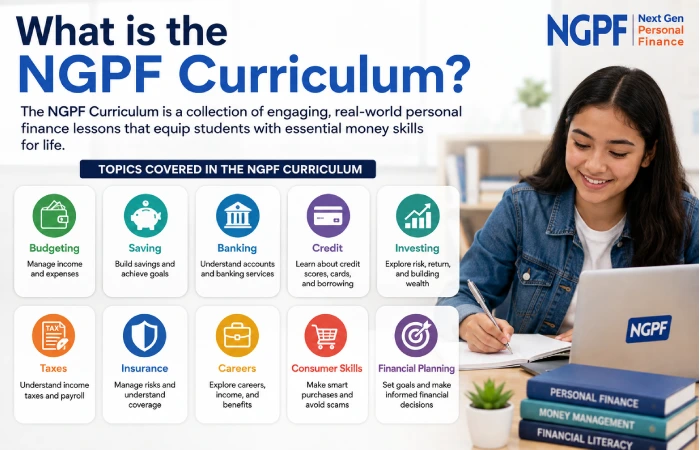
The NGPF curriculum is a portfolio of personal finance teaching resources with the mission of helping educators deliver relevant and real-world financial literacy to their students.
The application aspect is one of the main positive outcomes of personal finance lessons. Instead of simply having students memorize lists of terms and definitions, students participate in cases, exercises, simulations, discussions, and calculations as part of the course.
A typical personal finance curriculum can cover several major areas.
| Financial Topic | What Students Can Learn |
| Budgeting | How to manage income and expenses |
| Saving | Emergency funds, savings goals, and financial planning |
| Banking | Checking accounts, savings accounts, and banking services |
| Credit | Credit scores, credit cards, interest, and borrowing |
| Investing | Risk, return, diversification, and long-term investing |
| Taxes | Income taxes, deductions, and payroll concepts |
| Insurance | Managing financial risks and understanding coverage |
| Careers | Income, employment benefits, and career decisions |
| Consumer Skills | Comparing products, avoiding scams, and evaluating purchases |
| Financial Planning | Setting goals and making informed financial decisions |
This wide approach makes our students realize that finance is more than saving money; it is the result of linked decisions.
The career that someone chooses has an impact on how much they earn. The amount a person earns impacts their budget. A budget impacts savings. Savings can impact how resilient people are financially. Credit choices can impact the cost of borrowing. Investing choices have the impact of determining future wealth.
Key Benefits of the NGPF Personal Finance Approach
Another useful thing about the NGPF personal finance style is that you tie the financial concepts into a context they may see outside of school.
1. Practical Financial Skills
Concepts relevant to students’ lives now. This also allows students to become invested in learning about the power of compound interest when they see what alternative investment or savings decisions might do for their future selves.
2. Real-World Decision-Making
There usually aren’t definitive right and wrong answers when it comes to managing personal finances. The best decision would be relative to your own priorities, comfort levels and appetite for risk and reward.
On an educational activity students may then consider each choice to greater detail, stating when one option will have a greater benefit than the other.
3. Financial Vocabulary
As students, the financial terms themselves would already be difficult to understand; they are unfamiliar with such a topic.
Having a general knowledge of terms like APR, credit utilization, principal, interest, deductible, premium, diversification, net income and others can help you more easily comprehend financial statements and discussions.
4. Preparation for Adult Life
By providing students with access to financial literacy, you’re equipping them to better handle life’s big after-high school transitions, whether they’re attending college, entering the workforce, living on their own or handling their own banking.
5. Teacher-Friendly Resources
Teachers have so little time to develop material from scratch. Free ready-made lessons offer a simple way to integrate financial education into the regular curriculum.
NGPF Financial Literacy: What Should Students Learn?
The goals of NGFPF financial literacy focus on equipping students with the financial knowledge and the skills necessary to make smart decisions about money.
Financially literacy is more then understanding words. A Financially literate person should understand, weigh their options, perceive risks and make decisions based on their personal priorities.
Some of the most important financial literacy areas include the following.
Budgeting and Cash Flow
Budgeting introduces students to the relationship between income and expenses.
A simple monthly budget might look like this:
| Category | Example Monthly Amount |
| Take-home income | $3,000 |
| Housing | $1,000 |
| Food | $400 |
| Transportation | $300 |
| Utilities | $200 |
| Insurance | $150 |
| Entertainment | $150 |
| Savings | $500 |
| Other expenses | $300 |
The specific numbers are less important than the concept itself – income has to be earmarked. Students also learn how to distinguish between fixed costs, variable costs, needs, and wants.
Saving and Emergency Funds
Saving is another essential part of financial literacy.
Students can explore questions such as:
- Why should people maintain emergency savings?
- How much should someone save?
- Where should savings be kept?
- How does interest affect savings?
- What happens when unexpected expenses occur?
These concepts can help students understand why financial resilience matters.
Credit and Debt
Credit can provide opportunities, but it can also create financial challenges when used irresponsibly.
A financial literacy curriculum may introduce students to:
- Credit scores
- Credit reports
- Credit cards
- Interest rates
- Minimum payments
- Loans
- Debt repayment
- Credit utilization
Students can compare borrowing scenarios and see how interest and repayment periods influence the total cost of debt.
Investing
Investing education can introduce students to concepts such as:
- Stocks
- Bonds
- Mutual funds
- Exchange-traded funds
- Diversification
- Risk and return
- Compound growth
- Long-term investing
The objective is not necessarily to turn students into professional investors. Instead, the goal is to give them enough foundational knowledge to understand basic investment decisions.
Taxes
Taxes are another area that students frequently encounter soon after entering the workforce.
Students can learn about:
- Gross income
- Net income
- Payroll taxes
- Income tax
- Tax forms
- Withholding
- Deductions
Understanding the difference between gross pay and take-home pay can be especially useful when students begin evaluating employment opportunities.
Next Gen Personal Finance Courses
These are courses developed to aid educators in delivering financial knowledge systematically to students.
Based upon the curriculum being offered, personal finance instruction may be provided as a distinct course or embedded into subjects such as: mathematics, economics, business, social studies or career education.
A comprehensive course can progress from foundational concepts to more advanced financial decisions.
Example Course Progression
| Stage | Focus | Example Skills |
| 1 | Money Foundations | Income, expenses, goals |
| 2 | Budgeting | Cash flow and spending plans |
| 3 | Banking | Accounts, transactions, interest |
| 4 | Credit | Credit cards, scores, borrowing |
| 5 | Debt | Loans, interest, repayment |
| 6 | Investing | Risk, return, diversification |
| 7 | Insurance | Risk management and coverage |
| 8 | Taxes | Income and tax concepts |
| 9 | Careers | Compensation and benefits |
| 10 | Financial Planning | Long-term financial decisions |
This sequential learning makes sense and may allow students to develop understanding progressively instead of introducing a hard financial topic at the beginning of instruction, for example.
How Teachers Can Use NGPF Teacher Resources
One of the biggest hurdles in financial education, strangely enough, isn’t always identifying its importance; it’s about identifying when and with what to teach it.
NGPF teacher resources may be useful to solve this difficulty through providing classroom-ready lessons and activities.
Teachers can use financial education resources in several ways.
Dedicated Personal Finance Classes
Schools are able to take curriculum a year long or a semester in length as a resource to base personal finance curriculum.
This approach allows students to explore financial topics in greater depth.
Mathematics Integration
Personal finance naturally connects with mathematics.
Teachers can use financial examples to demonstrate:
- Percentages
- Ratios
- Interest
- Compound growth
- Graphs
- Probability
- Data analysis
For example, compound interest can turn an abstract mathematical formula into a practical financial concept.
Economics Classes
Financial literacy seems to fall naturally into the economic discipline. Students are able to trace individual financial decision-making with macroeconomics (inflation, interest rates, unemployment, demand and supply, consumers, etc.).
Advisory or Life-Skills Programs
For schools which may not have room for a complete course on personal finance there are other ways to address financial literacy as advisory time, vocational training, a series of workshops or even life skills classes.
What Makes Financial Education Engaging for Students?
The financial subjects that can appear a bit scary, or be rather boring when only taught in a lecture format,
Interactive learning can make the material more relatable.
Teachers can use:
- Case studies
- Simulated budgets
- Financial decision-making scenarios
- Classroom discussions
- Group activities
- Research projects
- Data exercises
- Role-playing activities
- Real-world examples
For example, you could give student an imaginary salary and ask them to write down a monthly budget, taking into account rent, travel costs, the price of food, insurance, taxes, saving and entertainment.
This transforms financial literacy into a skill of application rather than just of definition.
NGPF Curriculum vs. Traditional Financial Education
Traditional financial education may sometimes focus heavily on definitions and general concepts.
A modern approach can place greater emphasis on application.
| Traditional Approach | Practical Financial Education Approach |
| Memorize financial terms | Apply financial terms to real situations |
| Learn budgeting concepts | Build and analyze budgets |
| Define credit | Compare real borrowing scenarios |
| Study investing vocabulary | Explore risk and long-term growth |
| Read about taxes | Analyze example paychecks |
| Learn about savings | Set financial goals |
| Teacher-centered instruction | Interactive student activities |
| Primarily theoretical | Application-oriented |
This does not mean traditional instruction is ineffective. Financial terminology and foundational concepts remain important.
The only difference is what can happen when the students have exposure to both the content and its application.
The Role of Teachers in Financial Literacy
Teachers play an important role in making financial education accessible.
Student could hear this financial guidance on social media, from family, advertising, influencers or online communities. While some of these sources will offer you sound advice some advice you receive will be half thought out.
The classroom setting provides a student an opportunity to see finances unfold.
Teachers can encourage students to ask:
- What is the source of this financial information?
- What assumptions does it make?
- What are the potential risks?
- What fees are involved?
- Is this advice appropriate for everyone?
- What information is missing?
- How could this decision affect someone over time?
These issues stimulate the ability to think critically and increase financial understanding.
Financial Literacy Beyond the Classroom
Teaching yourself to handle your money well has value beyond school.
- The money management knowledge may make the students better at utilizing their first check
- A student who learns about credit is more likely to be reluctant to take on expensive debt.
- An informed student of investing would know about the idea of long-term investing and the need to be properly diversified.
- A student who understands taxes may find their first tax-related documents less confusing.
- Financial education thus offers the perspective of being a corner stone of permanent learning.
How Schools Can Build a Strong Financial Education Program
Schools may develop programs to enrich their programs with the information, using a phased approach.
1. Identify Student Needs
Start by considering what students are most likely to encounter after graduation.
Students attending college would require information regarding student financial aid, student loans, education financing and costs, budgeting, etc.
These classes can be very useful to students entering the workforce and information about paychecks, taxes, benefits for employees, banking, credit, and how to save money for retirement.
2. Establish Learning Objectives
Clear objectives make it easier to evaluate whether students are developing meaningful skills.
Instead of saying:
Students will understand credit.
A stronger objective might be:
Students should demonstrate that they can contrast a variety of borrowing avenues’ price with and explain interest’s role in repayment.
3. Use Practical Activities
Whenever possible, connect concepts to realistic decisions.
For example, students can:
- Create a monthly budget
- Compare bank accounts
- Analyze credit card offers
- Calculate loan repayment costs
- Build a hypothetical investment portfolio
- Evaluate insurance scenarios
- Compare job compensation packages
4. Encourage Discussion
Personal finance often involves trade-offs.
Even people who receive the exact same wage will have different choices due to different targets and personal values.
Through in-class discussion, students learn that financial planning is personal, yet requires sound judgment.
Frequently Asked Questions About Next Gen Personal Finance
What does NGPF stand for?
NGPF stands for Next Gen Personal Finance, an organization committed to improving personal finance education for students.
What is the NGPF curriculum?
The term NGPF curriculum can be defined as the set of tools and educational materials to support teachers in delivering practical personal finance lessons. The curriculum covers topics like budgeting, savings, credit, investment, taxes and insurance among others.
Why is NGPF financial literacy important?
NGPF’s financial literacy resources allow students to grow in their financial knowledge through hands-on experiences. The hope is that this will take financial terminology further than a mere definition.
Who can use NGPF teacher resources?
Educators and schools can use personal finance teaching resources to support classroom instruction. They are available for exclusive courses on personal finance, but also for additional courses of education or advice programs.
What topics are covered in Next Gen Personal Finance courses?
These could be budgeting, saving, banking, credit, debt, investing, taxes, insurance, careers, financial planning and others.
Can personal finance be taught before students graduate?
Yes. The teaching of financial literacy at the right time is useful during the period before adolescents start managing their own money. An introduction to the fundamentals while attending high school would enable them to get started into adulthood with enhanced financial literacy.
The Future of Next Gen Personal Finance Education
Financial decisions are becoming increasingly complex.
Digital banking, online shopping, subscriptions, buy now pay later options, online investment platforms, targeted advertising, and tons of data about money are all available to students in the current digital era. This makes financial literacy increasingly important.
Future personal finance education is going to place an importance on the ability to practice financial decision making as well as the amount of personal financial knowledge gained.
These students will need to have financial understanding, the ability to analyze financial information, the knowledge of when to seek the risks of financial alternatives, as well as making decisions and goals.
This is the context in which practical tools, motivating lessons and readily available teacher resources can have so much significance.
Final Thoughts
” Next Gen Personal Finance, is not only sensible but also a logical plan to get students ready to make their life- long decisions regarding finance. ”
The common aim is for financial education (whether NGPF curriculum, NGPF financial literacy lessons, Next Gen Personal Finance courses, financial literacy lessons, or NGPF teacher materials) to be practical, comprehensible, and applicable.
Personal finance isn’t just knowledge that student will learn as an adult. Children learn financial skills when they begin using money, spending, saving, working, education, consumerism etc.
Giving students opportunities to understand these decisions can help them become more confident and informed participants in their financial lives.