


AI & Automation in Personal Finance: Smarter Money Management

It AI has begun transforming the way individuals can track, plan and invest their financial assets. With capabilities ranging from automated categorization of purchases to offering personalized financial advice-there are numerous ways both AI and automation within personal finance have become effective at bringing high-level money management within reach.
For individual consumers, these can be effective at performing money tracking, budgetary planning and identifying personal spending trends without the extensive use of spreadsheets and human calculation. But ultimately they serve most efficiently with human diligence applied for financial oversight, in tandem with caution toward any potential data and privacy issues.
This Article Belongs to personal Finance
What Is AI & Automation in Personal Finance?
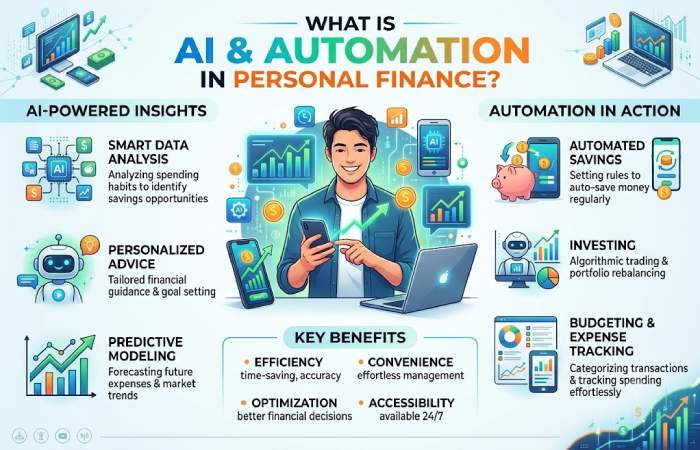
AI and automated personal finance can be described as ‘the provision of artificial intelligence, machine learning or automatically functioning software to assist in an everyday financial function’.
With the use of these AI personal finance tools, data from transactions can be extracted and analysed. User spend patterns are identified, then advice is tailored based on the user’s spending habits; while automated systems manage repetitive tasks like ‘categorising purchases, monitoring billing cycles and making automatic transactions’.
The idea of combining automated features with the “intelligence” of AI aims to ‘provide a simpler financial management method and a more educated user experience’.
How AI Is Changing Personal Finance
Traditional personal finance often requires users to manually record expenses, calculate budgets and review accounts. AI can process large amounts of financial information much faster.
| Traditional Approach | AI & Automated Approach |
|---|---|
| Manual expense tracking | Automatic transaction categorisation |
| Spreadsheet-based budgets | AI-powered budgeting suggestions |
| Periodic financial reviews | Continuous financial insights |
| Manual bill reminders | Automated notifications and payments |
| Generic financial advice | More personalised recommendations |
| Manual portfolio monitoring | AI investing tools and alerts |
These capabilities don’t eliminate the need for financial knowledge. Instead, they can reduce administrative work and help users identify information they might otherwise overlook.
AI Financial Planning

A key area where the potential is exciting is through AI financial planning. Through looking at outlays, savings, income as well as savings objectives a system could help clarify the various ways in which to meet aims such as saving an emergency fund or a target purchase. An example could be if, when using AI as a way to save for such financial aims, the system flagged a user’s outlays has risen recently and explain, at a given percentage of monthly outlays that were save, how their savings would look in X years if a particular non essential outlays was lowered.
An AI recommended financial proposal, should in any scenario, be view as a proposal not an expert dictated financial advise.
Critical choices relating to tax savings investments, the purchase of insurance or investment strategies that will benefit one after retirement will almost certainly depend on the advise of qualified financial professionals.
AI Budgeting and Money Management
AI budgeting software is able to analyze your expenditures automatically and then sort transactions into categories (housing, food, etc.. Or housing, groceries, entertainment, transport, etc..).
This helps make managing money on an AI more feasible, and allows you to not enter into every expenditure possible manually.
Automation can also support:
- Recurring bill reminders
- Spending-limit alerts
- Savings transfers
- Subscription monitoring
- Cash-flow tracking
- Unusual transaction detection
The biggest advantage is consistency. systems can monitor financial activity continuously rather than relying on someone remembering to review their accounts every week.
Automated Personal Finance: Key Benefits
Automated personal finance can provide several advantages for consumers.
1. Less Manual Work
Automatic categorisation and account synchronisation can reduce repetitive financial administration.
2. Better Visibility
AI can bring spending patterns, recurring expenses and cash-flow trends into a single view.
3. Personalised Insights
Machine-learning systems can identify patterns based on an individual’s financial behaviour rather than relying solely on generic budgeting rules.
4. Faster Decision Support
It can quickly process financial information and present potential scenarios, helping users understand the possible consequences of different choices.
AI Investing Tools
AI investing tools are another growing area. Depending on the platform, these tools may help analyse market information, monitor portfolios, identify trends or automate portfolio management.
However, investors should be cautious about treating AI predictions as certain outcomes. Financial markets are unpredictable, and historical patterns cannot guarantee future performance.
Before using an AI-powered investment service, check its fees, methodology, regulatory status, security practices and the level of human oversight provided.
Risks of Artificial Intelligence Finance
Despite its potential, artificial intelligence finance has important limitations.
| Risk | What Users Should Consider |
|---|---|
| Incorrect recommendations | Verify important decisions independently |
| Data privacy | Understand how financial information is collected and used |
| Security | Use reputable platforms with strong security controls |
| Algorithmic bias | AI recommendations may reflect limitations in underlying data |
| Over-reliance | Don’t allow automation to replace financial judgement |
| Investment losses | AI cannot eliminate market risk |
Users should also avoid connecting financial accounts to unknown applications simply because they advertise AI-powered features.
The Future of AI Personal Finance
The future is likely to involve increasingly personalised financial technology. AI systems may become better at understanding individual cash flow, anticipating recurring expenses and helping consumers adjust financial plans as circumstances change.
I believe AI will become a powerful financial assistant; performing necessary functions and guiding decisions rather than acting as autonomous financial advisor. This will enable the majority to use an AI based assistant to “off load” the day to day “mundane” parts of managing financial accounts and bring key information to attention in order to enable correct decisions to be made.
Final Thoughts
The impact of AI and automation in personal finance will be about making these efforts more proactive, personal and convenient. Automation in areas like AI personal finance, financial planning, budgeting, money management, and investment can help minimize repetitive work and offer rich insights into one’s financial habits.
Automation should complement-not substitute-human decision-making: The best outcome involves effective technology enhanced with appropriate financial literacy, intelligent risk management and regular decision-making assessments.