


Finance & Business Technology: Maximizing Returns Through Smart Technology Investments

In today’s business environment technology is one of the primary drivers of growth, operational efficiency and long term profitability. The business of all shapes and sizes are adopting automation, Artificial Intelligence (AI) and cloud software & digital platforms in their drive to make operations leaner and keep the business competitive. A crucial aspect of technology adoption lies in appropriate financial planning.
Businesses need to know about the Cost of Business Automation and assess the ROI of AI Tools. The right type of AI Software for Productivity is vital as is strategic planning on Technology Investment for Businesses. Finance and Technology are intrinsically linked more than ever before. Today’s businesses are required to make decisions based on data, increase customer satisfaction and operational efficiency but keeping costs in check; these can be achieved with technological investment provided business needs and returns on investment are aligned.
The U.S. Small Business Administration provides guidance on technology adoption, business planning, and digital transformation strategies for growing businesses.
This article is a part of Business Software Reviews
What is Finance & Business Technology?
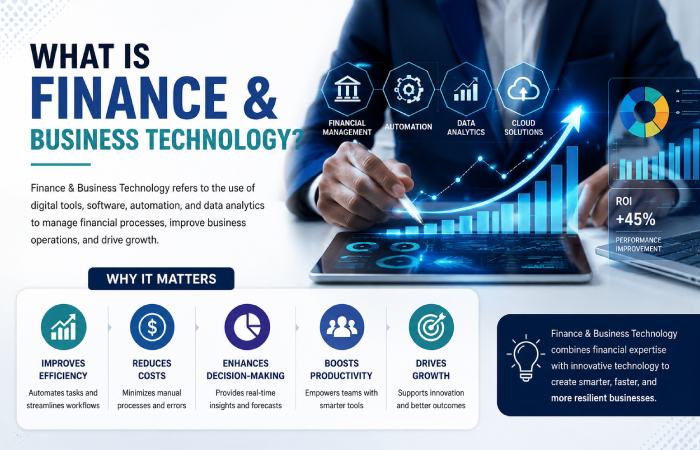
Finance and business technology are all about utilizing technologies like automation, software, and digital tools to enhance financial efficiency and business operation. Rather than manual procedures, businesses today utilize technologies to perform repetitive jobs automatically, analyze data, manage projects, and communicate information efficiently.
Digitalization today isn’t just confined to major corporations. Even small and medium enterprises are currently utilizing various software to increase their work efficiency and reduce operational costs. Automating boring routine work, human resources can focus on value generating activities that are directly involved with customer satisfaction and income growth.
The platform’s business tools are designed to operate within the broader ONPASSIVE Ecosystem, enabling organizations to streamline operations and improve collaboration across multiple functions.
Core Areas of Business Technology
| Technology Area | Primary Purpose | Business Benefit |
| Business Automation | Streamline repetitive tasks | Reduced labor costs |
| Artificial Intelligence | Data analysis and predictions | Better decision-making |
| Cloud Software | Remote access and collaboration | Increased flexibility |
| Analytics Platforms | Business intelligence | Improved performance tracking |
| Productivity Tools | Workflow management | Higher employee efficiency |
By integrating these technologies into daily operations, businesses can improve accuracy, reduce delays, and create scalable systems for future growth.
If you are new to the platform, understanding the ecosystem basics can help you learn how its AI-powered products, business solutions, and digital tools work together within a unified ecosystem.
Understanding the Cost of Business Automation
A question business owners tend to ask first is-whether it’s worthwhile. Investing in automation has high up front cost, but a large saving in the long run. Companies that automate their back-office work usually notice low running costs and greater efficiency. Cost of automation differs on size of the business, level of complexity required for implementation and also the software chosen. One company might utilize simple work-flow tools whereas another might decide to implement an enterprise-wide system that links various departments.
Common Automation Expenses
| Cost Category | Description |
| Software Subscription | Monthly or annual licensing fees |
| Implementation | Setup and system integration |
| Employee Training | Learning new software processes |
| Technical Support | Maintenance and troubleshooting |
| Custom Development | Specialized features and workflows |
These initial costs can be higher but, many businesses offset their initial expenditure in savings from reduced labor costs and operational enhancements. Labor costs decrease, fewer human errors occur, and operational processes increase in speed when a process is automated, for example, automated invoicing can decrease the workload for accountants and, the use of automated support systems and chatbots within a business can lead to reduced costs.
The platform is designed to provide AI-powered tools and business solutions that can help entrepreneurs streamline operations, improve productivity, and scale their ventures more efficiently. To explore this aspect in greater detail, read our guide on and entrepreneurship.
ROI of AI Tools
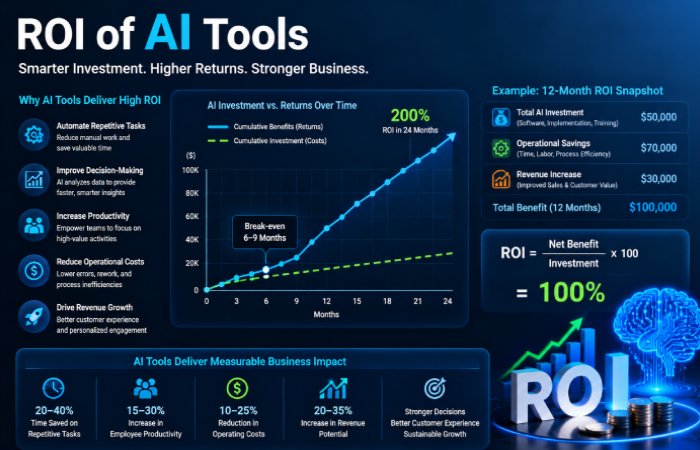
Due to its increasing adoption, ROI is now becoming an important issue for business managers concerning AI. AI tools aim at increased productivity, better decisions, and operational inefficiencies can be reduced. Nevertheless, the returns of the AI application should be evaluated in terms of financial performance, rather than technological specification.
By calculating the ROI, the organization can verify whether it is getting an adequate benefit out of the investment, relatively to its cost. The calculation is done comparing savings and profit with the expenses incurred during the deployment:
Example of AI ROI Calculation
| Metric | Value |
| AI Software Investment | $25,000 |
| Annual Operational Savings | $60,000 |
| Additional Revenue | $15,000 |
| Total Benefit | $75,000 |
| Net Gain | $50,000 |
| ROI | 200% |
If your AI technology has a solid ROI then you know that business value is being derived. Monitoring metrics will allow your business to understand which tools produce results and where optimizations can occur. This technology is providing a return for companies that use it, by way of an improved forecasting process, better customer service, automated reports, decision support etc., and this technology is still evolving, so companies who embrace it should continue to experience returns on investment.
AI Software for Productivity
Productivity software utilizing AI is a cornerstone of today’s business organizations. Software that utilizes AI assists with maximizing efficiency in work tasks, minimize administrative work and improve team collaboration.
Rather than substituting employees, the purpose of the software is usually to optimize and increase the productivity of human beings. Tasks such as automating repetitive procedures, providing smart advice and assisting with complicated processes will permit workers to engage more time into more creative tasks.
A detailed comparison can help you understand the differences in features, pricing models, and overall value. Learn more in our ecosystem comparison.
Productivity Improvements Enabled by AI
| AI Capability | Productivity Benefit |
| Automated Reporting | Faster access to business insights |
| Smart Scheduling | Improved time management |
| Content Generation | Quicker marketing production |
| Workflow Automation | Reduced manual processing |
| Predictive Analytics | Better planning and forecasting |
When companies have seamlessly adopted these AI productivity tools they will likely be rewarded by increased employee happiness and increased productivity within the workplace.
This will free up employees’ time from carrying out low-value, repetitive tasks and focus it on more valuable tasks that will help the company thrive. Cloud productivity solutions will also facilitate flexible/hybrid working within the workplace.
Technology Investment for Businesses
Organizations must look to invest in technology, not to run it as a business expense. Those that are investing effectively can establish and develop long-term business competitive advantages through increased efficiencies, improved innovation and enhancements to customer satisfaction.
When determining to invest in new technology, decision-makers must assess how that solution fits within the company’s objectives. The wrong technology investment will not benefit an organization so planning in advance is crucial.
Consider the scalability, security and interconnectivity, and long-term support requirements before investing in any given solution, the technology must work effectively today and also be able to support future expansion.
Key Technology Investment Factors
| Evaluation Factor | Why It Matters |
| Scalability | Supports business growth |
| Security | Protects sensitive data |
| Integration | Works with existing systems |
| Cost Efficiency | Maximizes financial returns |
| User Experience | Encourages employee adoption |
| Vendor Support | Ensures long-term reliability |
Technology investments where these factors are carefully considered tend to be the most successful from a technology and business bottom-line perspective. A successful technology investment can lead to increased revenue, reduced operating expenses and increased customer satisfaction, these factors multiply and contribute to a very powerful investment in a business.
Business Software Buying Guide
To choose the right software, organizations should look past price tags. They should examine features, support, security and long-term benefits before any software purchases can be made.
The process of selecting software should start with identifying specific problems with their business processes. Organizations should outline clear objectives for themselves and how software will be used to achieve their objectives.
Software Evaluation Framework
| Evaluation Area | Key Question |
| Features | Does it solve the intended problem? |
| Security | Is business data protected? |
| Integration | Can it connect with current systems? |
| Scalability | Will it support future growth? |
| Support | Is technical assistance available? |
| Cost | Is the investment financially justified? |
Businesses often only focus on the subscription fees, but training, customization, maintenance, and integration costs may be bundled together in the overall price to ownership. Taking a look at all associated costs will help to prevent unforeseen expenses down the road.
Asking for demonstrations of products and testing trial programs before signing on for long-term software commitments will be beneficial. Real-life scenarios and testing software can help determine if it will be user-friendly and effective.
Conclusion
Business technology and finance are inextricable intertwined in the modern digital economy. With the right approach to understanding the Cost of Business Automation, calculating the ROI of AI Tools, utilizing AI Software for Productivity, quantifying the Technology Investment for Businesses, and utilizing a Business Software Buying Guide, organizations can make more intelligent investment decisions.
Investments in technology are the most valuable when aligned with business goals and have a quantifiable business value. As automation and artificial intelligence continue to transform industries, companies that invest wisely will be well-positioned to boost productivity and profits.