


Business Financing: The Complete Guide to Funding and Growing Your Business

Last Updated: August 24, 2026
Business financing is the lifeline of any thriving business. When you’re starting a new company, buying machinery, growing your company, employing staff, or just dealing with the day-to-day costs of running a business, capital will be an integral part of your company’s longevity. In today’s competitive market, business owners have more funding options than ever before – from bank loans to newer, more innovative types of financing.
Understanding how business financing works can assist entrepreneurs in picking the correct type of financing, minimizing financial risk, and developing a sustainable business growth strategy. Here, you will find explanations of some of the most prominent business financing options available today: business loans, small business financing options, SBA loans, business credit and other alternative forms of financing.
Exploring different concepts can help identify the right path for sustainable success. Learn more about profitable business idea to find opportunities with strong earning potential.
This Article is a part for Startups
What is Business Financing?
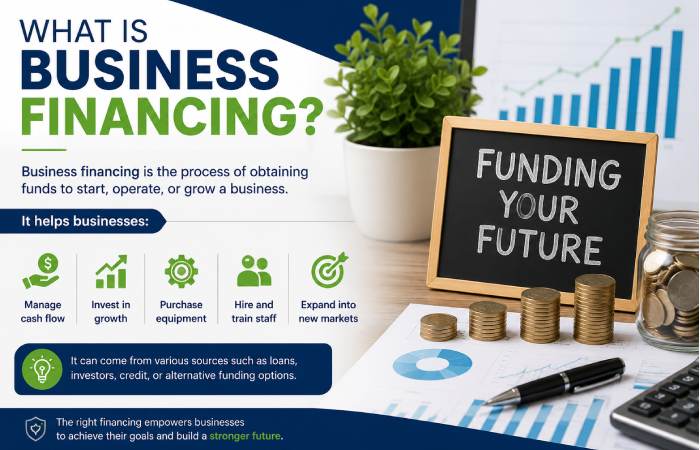
Business financing refers to how business entities raise the money they need to develop their businesses. Companies need funds to operate, build a business or extend an existing business. They need cash for stock, employee salaries, advertising activities, computer systems, machinery and opening up new sites or branches.
Financing typically comes in two main types debt and equity. Both debt and equity financing have their own pros and cons, and business owners need to analyze their needs carefully when deciding which type of financing to pursue. Businesses need money during different phases and in different amounts. A startup will need seed funding, for example, to work on developing their product whereas an existing company will need financing to fund new branches, or buy new machinery.
Learning key principles of planning, leadership, and risk management can significantly improve your chances of success. Explore our guide to entrepreneurship and business success to build a strong foundation for your venture.
Why Business Financing Matters
Financing gives business the ability to seize opportunities that may otherwise be unattainable. A profitable business can have cash shortages, delayed plans for growth and other operational struggles if it doesn’t have enough working capital.
Businesses remain competitive with financing because it can help businesses make investments in innovation, hire new employees, improve customer service, and be flexible in response to changes in the marketplace. When businesses have access to funding, it’s generally easier to manage economic downturns and other surprises.
Finally, entrepreneurs can utilize financing in order to keep working capital and still make sound investment choices. By using financing as opposed to liquidating a portion of their capital in order to make purchases, a business can delay expenses.
Small Business Loans Guide

Small business loans continue to be a popular funding option for entrepreneurs. Banks, credit unions, and online lenders provide multiple loan products, to fulfill business’ operations and development. Traditional lenders assess the credit history, business revenue, cash flow, business plan and assets before extending credit. Businesses that have proven strong financial standing will receive the best rates and conditions.
Small Business Loan Types
| Loan Type | Primary Purpose | Typical Term | Best For |
| Term Loan | Business expansion and major purchases | 1–10 years | Established businesses |
| Working Capital Loan | Day-to-day operations | 6 months–5 years | Managing cash flow |
| Equipment Loan | Equipment purchases | 2–7 years | Manufacturing and service firms |
| Business Line of Credit | Flexible access to funds | Revolving | Seasonal businesses |
| Commercial Real Estate Loan | Property acquisition | 10–25 years | Long-term expansion |
When revenue is consistent, small business loans are desirable because the repayment terms are stable and interest rates can be good. The main disadvantage is that the application and approval process can be lengthy, and can be very paperwork intensive.
Startup Funding Options
It’s difficult for many new businesses to receive traditional funding because they haven’t established business credit and lack an operating history. Thankfully, there are a few types of alternative financing available to start-ups.
Start-up founders typically use their own funds in the first few stages of the business. While this maintains full ownership it risks the founder’s financial well-being. From there, founders may take on money from family members and friends, angel investors, venture capitalists, or use crowd funding or grant opportunities to fund their business.
Angel investors offer financial capital in exchange for a portion of the business and can offer valuable business advice. Venture capital is often invested into scalable businesses with high potential for growth. Crowd funding enables start-ups to raise money from a great number of individuals and can test for market viability.
Common Startup Funding Sources
| Funding Source | Repayment Required | Ownership Impact | Suitable For |
| Personal Savings | No | None | Early startup stages |
| Friends & Family | Sometimes | Minimal | Initial funding |
| Angel Investors | No | Partial ownership | Growth-focused startups |
| Venture Capital | No | Significant ownership | High-growth businesses |
| Crowdfunding | Usually No | None | Product launches |
| Business Grants | No | None | Eligible businesses |
The best startup funding option depends on growth goals, funding requirements, and the founder’s willingness to share ownership.
SBA Loans Explained
SBA offers loan programs that assist small businesses obtain economical capital by means of participating financial institutions. Small Business Administration loans are partly guaranteed by the federal government, thereby lessening the amount of risk a financial institution takes and improving accessibility to financing.
SBA loans are recognized for their excellent features: small down payments, long repayment terms and a modest interest rate, among others. Small businesses that don’t meet the requirements for conventional loans often find SBA loans more beneficial.
Major SBA Loan Programs
| SBA Program | Maximum Amount | Common Uses |
| SBA 7(a) Loan | Up to $5 million | Working capital, equipment, expansion |
| SBA 504 Loan | Up to $5.5 million | Real estate and fixed assets |
| SBA Microloan | Up to $50,000 | Startup and small business needs |
| SBA Export Loans | Varies | International business growth |
According to the SBA, these programs support millions of small businesses across the United States by improving access to capital and encouraging economic development. Learn more at U.S. Small Business Administration.
Business Credit for Startups
One of the most significant things a business owner can do to increase their chances of financing in the future is to establish business credit. Companies with solid business credit receive more favorable terms on financing such as larger loan amounts and lower interest rates, and can often get better terms from their suppliers.
Unlike personal credit, business credit is kept separately from the business owner, which helps protect their personal assets and provides them with business credit. To establish business credit, businesses should incorporate their company, obtain an Employer Identification Number (EIN) for their company, obtain business bank accounts, establish vendor credit with businesses they regularly work with, and pay their bills on time.
Steps to Build Business Credit
| Step | Benefit |
| Register Business Entity | Creates legal business identity |
| Obtain EIN | Establishes tax identification |
| Open Business Bank Account | Builds financial credibility |
| Use Vendor Credit Accounts | Creates payment history |
| Pay Bills Promptly | Improves credit ratings |
| Monitor Credit Reports | Detects errors and fraud |
A strong business credit profile can significantly improve access to financing as a company grows.
Different industries offer unique advantages, investment requirements, and growth prospects, making it easier for entrepreneurs to choose a sector that matches their goals. Read our guide to business categories for a detailed overview.
Alternative Financing Options
Apart from traditional loans, businesses often look for alternative funding methods that are quicker to approve and much more flexible. This is especially the case with companies that require capital quickly and don’t have a credit history. The growth in alternative funding is driven by financial technology and many online lenders can offer their customers faster loan approvals (a couple of hours as opposed to weeks for traditional banks) and can provide funding within days as opposed to weeks.
Other forms of funding include invoice financing, which helps cash flow by offering businesses capital against their unpaid invoices and is ideal for companies that require funding fast while awaiting client payments; merchant cash advances, which offer a lump sum upfront in return for an agreed-upon percentage of future sales; and revenue based financing where funding is repaid from a portion of a company’s revenue stream each month.
Alternative Financing Comparison
| Financing Option | Funding Speed | Best For |
| Invoice Financing | 1–3 days | B2B companies |
| Merchant Cash Advance | 1–2 days | Retail businesses |
| Revenue-Based Financing | Few days | Growing startups |
| Peer-to-Peer Lending | Several days | Small businesses |
| Online Business Loans | 24–72 hours | Fast funding needs |
| Asset-Based Lending | Several days | Asset-rich businesses |
Although alternative financing often provides greater accessibility, business owners should carefully review fees, interest rates, and repayment structures before committing.
When evaluating different business opportunities, it is important to compare start up costs, profit potential, scalability, and market demand before making a final decision. Comparison of the most successful business models can help you identify which option best aligns with your goals and available resources.
Choosing the Right Financing Solution
The right type of funding to pursue depends on the specific circumstances of the business owner. Business owners should look at their capital requirements, ability to repay, growth expectations, and level of risk. A company planning for long-term growth may want to look into a SBA loan or bank loan; however, a startup planning for aggressive growth might want to pursue venture capital or angel investment. A business in short-term cash flow crisis could consider a line of credit or invoice financing. The key is to pair financing type to the purpose: too much debt can cause a strain, and too little can impede growth.
Access to good financial services is an incredibly vital component to any start-ups growth & success. Getting a solid foundation established with business bank account services will enable you to maintain a healthy cash flow to facilitate your overall growth and will also position your business perfectly to access business loans and merchant services in the future. Read to find out more about how Banking for Businesses can benefit your Company’s Financial Well-Being.
Conclusion
Financing a business is a vital process in enabling the successful start-up, operation and expansion of a business. While established small business loan schemes, such as SBA loan programs, startup financing and alternative funding sources can offer a wealth of options available for an entrepreneur, entrepreneurs must also understand the pros and cons associated with each.
The more informed a business owner is with regards to each type of financing method available to him, the more educated a decision he is able to make to secure success in the long-run. In this, good business credit, accurately maintained financial records, and a thoughtful financing method selection process enable businesses to secure the resources needed for steady growth and competitiveness in today’s marketplace.