

MIT Technology Review: Influence, History & Innovation

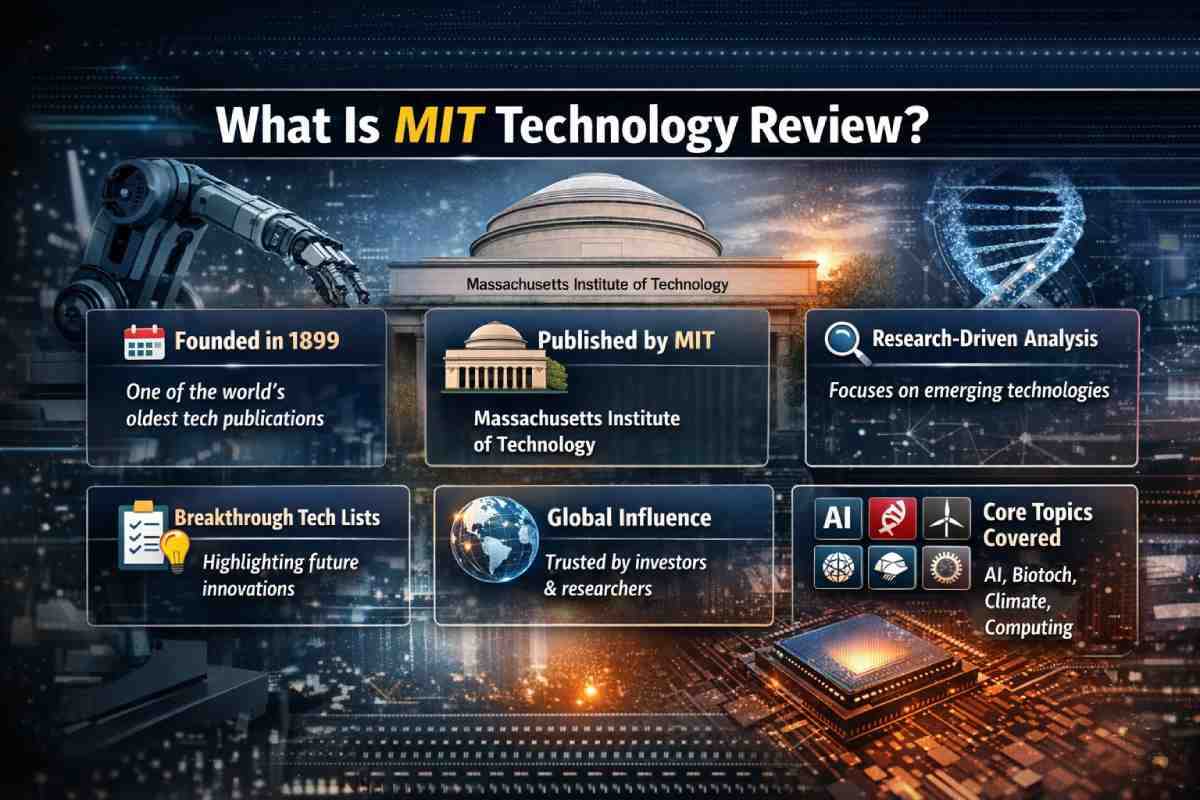
MIT Technology Review functions as more than a technology publication. Through research-driven journalism and expert analysis, it acts as an early signal system identifying technologies that will shape industries and society.
Technology moves faster than most people can evaluate. Artificial intelligence breakthroughs, biotech discoveries, and climate innovations appear constantly, and news headlines often blur the line between meaningful progress and temporary hype. This creates a problem: how can readers identify which technologies truly matter?
The short answer is that trusted technology journalism acts as a filter. Publications with deep research access and expert analysis help interpret scientific breakthroughs and separate long-term innovation from short-term excitement.
What Is Massachusetts Institute of Technology (MIT)?
MIT Technology usually refers to technologies developed, researched, or published by the Massachusetts Institute of Technology (MIT)—one of the world’s leading universities for science, engineering, and innovation.
Founded in 1861 in Cambridge, Massachusetts, MIT is known globally for breakthroughs in fields like artificial intelligence, robotics, computing, biotechnology, and aerospace engineering.
Why Technology Journalism Matters Today
Modern innovation is global, complex, and often misunderstood. A single research breakthrough can lead to new industries, while other technologies receive attention long before they are technically feasible.
For example, fields like artificial intelligence or quantum computing frequently generate optimistic headlines. Yet the real progress in these sectors typically comes from years of scientific research and engineering refinement.
This gap between hype and reality is where credible technology journalism becomes important.
Organizations such as:
-
Nature Publishing Group
-
World Economic Forum
-
Brookings Institution
often produce research and policy reports explaining technological trends. MIT Technology Review plays a complementary role by translating these developments into accessible analysis for business leaders, innovators, and policymakers.
Instead of publishing raw research papers, the publication interprets discoveries and explores their real-world consequences.
Overview of MIT Technology Review
| Attribute | Details |
|---|---|
| Founded | 1899 |
| Institutional origin | Massachusetts Institute of Technology |
| Publisher | Technology Review, Inc. |
| Editorial focus | Emerging technologies and innovation |
| Audience | Researchers, executives, policymakers |
| Coverage areas | AI, biotech, climate tech, computing |
MIT Technology Review began as a publication serving the MIT alumni community but gradually evolved into an independent technology journalism platform with global readership.
Over time, the magazine expanded its coverage beyond the university to analyze technological developments across industries worldwide.
The Historical Evolution of the Publication
Technology journalism has changed significantly since the early twentieth century, and MIT Technology Review has evolved alongside those changes.
| Period | Focus of Coverage |
|---|---|
| Early 1900s | Engineering and industrial innovation |
| Mid-20th century | Aerospace and computing |
| Late 20th century | Internet and telecommunications |
| 21st century | Artificial intelligence, biotech, climate tech |
During the late 1990s the publication underwent a major relaunch aimed at transforming it into a global innovation magazine covering technology commercialization and emerging industries.
That shift positioned the publication as a bridge between scientific discovery and business innovation.
Editorial Philosophy: Research-Driven Technology Journalism
One reason MIT Technology Review maintains credibility is its focus on evidence-based reporting. The editorial team often analyzes technological developments through multiple dimensions rather than simply reporting news.
Key evaluation principles used in technology reporting
| Evaluation Dimension | Key Question |
|---|---|
| Scientific credibility | Is the research supported by peer-reviewed science? |
| Engineering feasibility | Can the technology function beyond a lab experiment? |
| Commercial scalability | Can companies produce it economically? |
| Social implications | How will it affect industries or communities? |
| Ethical concerns | Could it introduce risks or unintended consequences? |
This analytical framework resembles evaluation approaches used by institutions such as the National Academies of Sciences and global policy organizations studying innovation.
The result is journalism designed not just to inform but also to interpret the long-term significance of technological change.
Core Technology Domains Covered
MIT Technology Review concentrates on technologies with the potential to reshape major industries.
| Technology Domain | Key Topics |
|---|---|
| Artificial intelligence | machine learning, generative AI |
| Biotechnology | CRISPR gene editing, synthetic biology |
| Climate technology | renewable energy, carbon removal |
| Advanced computing | quantum computing, semiconductor innovation |
| Robotics | automation and industrial robotics |
Many of these fields intersect with global research initiatives supported by organizations such as the National Science Foundation and the International Energy Agency.
The publication’s goal is to examine how scientific progress in these areas could affect economic systems and society.
The Breakthrough Technologies List
One of the publication’s most recognized features is its annual Breakthrough Technologies list.
This list highlights innovations that experts believe could have significant impact in the near future.
| Category | Example Innovations |
|---|---|
| Artificial intelligence | new machine learning models |
| Biotechnology | gene-editing therapies |
| Energy technology | advanced batteries |
| Computing | quantum processors |
These lists are widely referenced because they often spotlight emerging sectors before they become widely discussed in mainstream media.
Example innovation signal
| Stage | What Happens |
|---|---|
| Research discovery | Scientists publish new findings |
| Media attention | MIT Technology Review analyzes the technology |
| Investor interest | Venture capital firms explore startups |
| Commercial adoption | Companies build products around the innovation |
In this way, journalism can indirectly influence innovation ecosystems and investment trends.
Influence on Global Innovation Ecosystems
MIT Technology Review has influence across several sectors beyond journalism.
| Sector | Influence |
|---|---|
| Venture capital | Identifies emerging technology sectors |
| Research institutions | Highlights important scientific discoveries |
| Government policy | Informs debates about technology regulation |
| Startup ecosystems | Provides exposure for new companies |
For example, discussions about AI governance or biotechnology ethics often reference analysis published by MIT Technology Review alongside reports from think tanks and academic institutions.
The publication’s proximity to the research community gives it access to scientists and innovators who are shaping new technological fields.
Comparison With Other Technology Publications
Different technology publications serve different audiences.
| Publication | Focus | Strength |
|---|---|---|
| Wired | Technology culture | narrative storytelling |
| TechCrunch | Startup ecosystem | venture capital news |
| The Verge | Consumer technology | gadget reviews |
| MIT Technology Review | Emerging technologies | research-driven analysis |
This comparison illustrates why MIT Technology Review attracts a different readership.
Its articles often appeal to:
-
scientists
-
technology strategists
-
investors
-
policymakers
These audiences are interested not just in new products but in how technological change reshapes industries and society.
Global Editions and International Reach
MIT Technology Review also expanded internationally through regional editions.
| Region | Local Editions |
|---|---|
| Europe | Germany, Spain, Italy |
| Asia | China, Japan, Korea |
| Middle East | Arabic edition |
| Latin America | Spanish and Portuguese editions |
International editions help analyze technological developments within regional innovation ecosystems.
For example, coverage of renewable energy in Europe may differ from reporting on artificial intelligence startups in Asia.
Criticisms and Limitations
Even influential publications face criticism.
| Criticism | Explanation |
|---|---|
| Academic tone | Articles sometimes assume technical knowledge |
| Paywall | Some in-depth reporting requires subscription |
| Limited consumer tech coverage | Less focus on smartphones or gadgets |
These limitations reflect editorial priorities.
MIT Technology Review aims to analyze long-term technological change, which often requires deeper scientific discussion than consumer technology news.
The Future of Technology Journalism
Technology journalism is undergoing a transformation as artificial intelligence, open-access research, and digital media reshape the information ecosystem.
Several trends are likely to influence the future of the field.
| Trend | Implication |
|---|---|
| AI-assisted reporting | Faster analysis of scientific data |
| Global research collaboration | Cross-border technology development |
| Ethical scrutiny | Increased focus on social impacts of technology |
| Policy debate | Governments regulating AI and biotechnology |
Publications capable of combining scientific understanding with journalistic storytelling will become increasingly valuable.
MIT Technology Review is positioned to play that role because of its connections to global research networks and its long history of interpreting technological change.
Conclusion
For more than a century, MIT Technology Review has analyzed the technologies shaping the future.
Founded within Massachusetts Institute of Technology and evolving into an independent media organization, the publication now serves as a global platform interpreting scientific breakthroughs and innovation trends.
By combining research access, expert interviews, and long-term analysis, MIT Technology Review helps readers understand which technologies matter and why.
In a world where new innovations appear almost daily, that ability to interpret technological change may be more valuable than ever.