

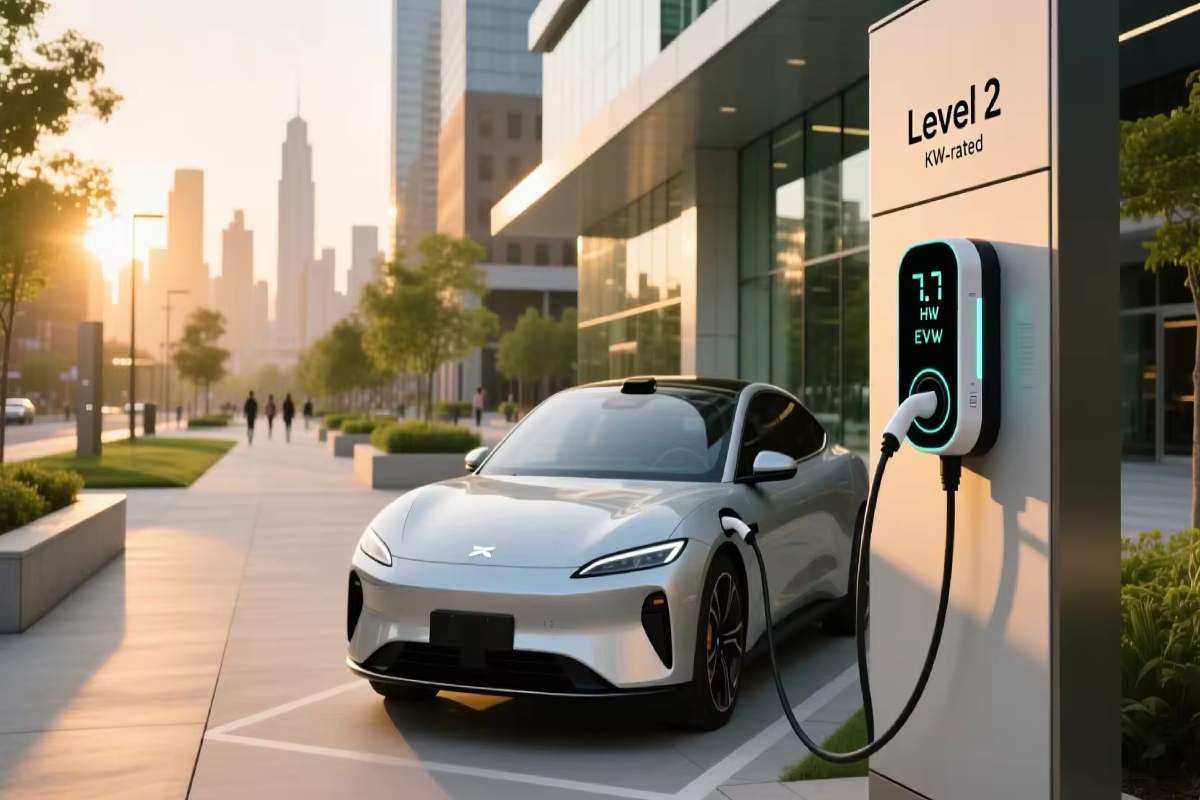
The Future of Car Battery Chargers Is Not Just Faster – It’s Smarter and Invisible

Car battery chargers are evolving from simple power-delivery hardware into intelligent, grid-aware energy systems that prioritize optimization, automation, and integration over raw speed.
To the majority of motorists, it is not yet natural to charge. The various plugs, bewildering power ratings, variable charging times and increasing electricity expenses make a simple need into a headache. These frictions do not only irritate users as more electric and hybrid vehicles are launched on the roads, they are also slowing the adoption process and overloading power grids.
The actual issue is that the cost of charge technology was created in a less sophisticated age. Increased power output is not the solution to that. Smarter charging is the solution that is currently emerging: systems that know batteries, homes, grids, and how people use them – and do all of it automatically in the background. This is what happens to be the real future of car battery chargers and it is already coming to pass.
Why Traditional Car Battery Chargers Are Becoming Obsolete
Legacy chargers were built around a single job: deliver power until the battery is full. That worked when batteries were small, electricity pricing was flat, and vehicles were isolated from the energy system.
Today, that model breaks down for three reasons:
- Battery sensitivity: Modern lithium-ion packs degrade faster under heat and repeated high-power charging.
- Grid pressure: Mass EV adoption creates peak demand spikes utilities were never designed for.
- User variability: Charging now happens at homes, apartments, offices, highways, and retail spaces, each with different constraints.
The charger that carelessly applies full power disregards these facts. This is the reason why the industry is moving to chargers with decisions on whether to charge or not, although how and when.
Smart Charging Is the Real Disruption
The most important upgrades in future chargers are invisible. Sensors, software, and connectivity are replacing fixed charging curves.
A smart charger continuously adapts based on:
- Battery temperature, chemistry, and age
- State of charge and predicted driving needs
- Time-of-use electricity pricing
- Home energy loads, solar output, or backup batteries
In practice, this means a charger may slow down deliberately, pause entirely, or shift charging to cheaper hours—without user intervention. Organizations like the International Energy Agency and SAE International consistently emphasize that unmanaged charging is unsustainable at scale.
From a user perspective, this feels like magic. From an infrastructure perspective, it is survival.
Fast Charging Will Improve, but It Will Never Be the Default
Ultra-fast charging dominates headlines because it is easy to market. Physics is less forgiving.
High-power DC charging generates heat, increases battery wear, and demands expensive grid upgrades. That makes it ideal for highways and fleets—but inefficient for daily use.
The future pattern looks like this:
- Fast charging: Occasional, situational, infrastructure-heavy
- Smart slow charging: Daily, optimized, battery-friendly
Automakers and battery researchers referenced by organizations like BloombergNEF increasingly frame fast charging as a complement, not a replacement, for intelligent home and workplace charging.
Wireless Charging Solves Human Problems, Not Technical Ones
Wireless charging is often dismissed as inefficient, but that misses its purpose. The real issue it solves is behavior.
People forget to plug in. Cables break. Weather and accessibility matter.
Embedded wireless pads in garages or parking bays trade some efficiency for near-perfect compliance. That trade-off makes sense in:
- Residential garages
- Taxi and ride-share depots
- Autonomous vehicle staging zones
Wireless charging will not dominate highways. It will quietly succeed wherever friction matters more than peak efficiency.
Bidirectional Charging Changes the Charger’s Job Entirely
Bidirectional charging—often called vehicle-to-home (V2H) or vehicle-to-grid (V2G)—turns chargers into gatekeepers between cars and energy systems.
This enables scenarios such as:
- Powering a home during outages
- Storing cheap off-peak electricity in a car battery
- Feeding energy back to the grid during peak demand
Institutions like the U.S. Department of Energy and ENTSO-E in Europe increasingly treat EVs as distributed energy resources. In this model, chargers are no longer accessories. They are infrastructure.
What the Future Charger Ecosystem Looks Like
Future car battery chargers will not be single devices. They will be part of layered systems.
| Layer | What Changes |
| Hardware | Smaller, modular, thermally optimized units |
| Software | Predictive charging and battery health models |
| Connectivity | Integration with vehicles, homes, and grids |
| User experience | Set once, then automate |
| Regulation | Grid-aware standards and certifications |
This shift explains why charging companies now resemble energy software firms more than hardware manufacturers.
Realistic Timelines Matter More Than Bold Predictions
Overpromising adoption timelines erodes trust. A grounded view looks like this:
| Period | Likely Mainstream Adoption |
| 2025–2027 | Smart home load-balancing chargers |
| 2026–2028 | Bidirectional charging in premium vehicles |
| 2027–2030 | Wireless charging in controlled environments |
| Post-2030 | Grid-orchestrated mass charging optimization |
These timelines align with infrastructure rollout speeds, not just technical readiness.
Regional Differences Worth Knowing
Charging evolution is not uniform:
- United States: Utility incentives and time-of-use pricing drive smart charging adoption.
- Europe: Grid stability and V2G pilots are stronger due to regulatory coordination.
- Asia: High-density urban charging accelerates wireless and automated solutions.
None of these regions can scale unmanaged charging without consequences.
The End State
Car battery chargers will not be judged against kilowatts or minutes to determine their ultimate success. It will be gauged in the minimal consideration of them by the users.
When it is charged automatically, battery is safeguarded, cost is kept to the minimum and enables the grid, it becomes invisible. The clearest indication that the technology has grown up is that invisibility and not speed is the most distinct sign. Car battery chargers have a real future.