

Blue Diamond Cookware: Complete Guide

Introduction
Blue Diamond cookware delivers strong short-term nonstick performance, but its long-term value depends heavily on how it’s used—not the “diamond” marketing.
If you are considering Blue Diamond Cookware, the honest answer is simple: it performs well in the beginning, especially for everyday cooking, but it is not designed to last for many years like stainless steel or premium cookware. Most users who feel disappointed are not using it incorrectly—they are expecting it to behave like a different category of cookware.
The core problem is expectation mismatch. Marketing highlights durability and “diamond strength,” while real-world performance depends on heat levels, cleaning habits, and how frequently the pan is used. This guide bridges that gap by combining product details, pricing, availability, and real usage insights so you can make a practical decision.
Blue Diamond Cookware Overview
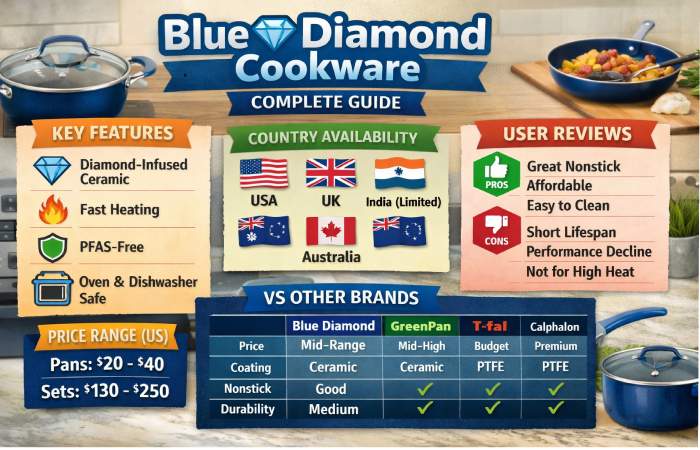
Blue Diamond is a mid-range cookware brand owned by The Cookware Company, the same group behind GreenPan. It focuses on ceramic nonstick technology, which is positioned as a healthier alternative to traditional coatings like Polytetrafluoroethylene.
At its core, the cookware uses an aluminum base for fast heat conduction combined with a ceramic coating that is reinforced with microscopic diamond particles. This “diamond infusion” improves hardness and heat tolerance, but it does not fundamentally change how ceramic nonstick behaves over time.
Core Construction Breakdown
| Component | Description | Practical Impact |
|---|---|---|
| Base Material | Aluminum | Heats quickly but can form hotspots |
| Coating | Ceramic nonstick | Smooth cooking surface initially |
| Reinforcement | Diamond particles | Slightly better scratch resistance |
| Exterior | Coated aluminum | Lightweight and easy to handle |
This construction places Blue Diamond firmly in the value-performance segment, rather than premium or professional cookware.
Product Range and Pricing
Blue Diamond offers a wide range of cookware, from single frying pans to large multi-piece sets. The pricing varies significantly depending on region, especially between the United States and India.
Popular Product Categories
| Category | Typical Products | Price (US) | Price (India) |
|---|---|---|---|
| Frying Pans | 9.5″, 11″, 12″ | $20–$40 | ₹1,500–₹3,500 |
| Cookware Sets | 10–14 pieces | $129–$250 | ₹10,000–₹16,000 |
| Saucepans | 1–3 quart | $20–$50 | ₹2,000–₹5,000 |
| Stockpots | 5–8 quart | $30–$70 | ₹3,000–₹6,000 |
In markets like the US, Blue Diamond is considered affordable. In India, however, import duties and limited distribution push it into a mid-to-premium price range.
Example Set Pricing Comparison
| Set Size | US Price Range | India Price Range | Value Perception |
|---|---|---|---|
| 10-piece | $130–$180 | ₹10,000–₹13,000 | High value in US, moderate in India |
| 14-piece | $150–$250 | ₹12,000–₹16,000 | Budget premium |
This price difference is one of the most important factors influencing buying decisions across regions.
Real-World Performance and Reviews
Most reviews of Blue Diamond cookware follow a predictable pattern: strong initial praise followed by mixed long-term feedback. This is not unique to the brand—it reflects how ceramic coatings behave.
Expert Review Summary
Publications like Food & Wine highlight the cookware’s easy cleanup, affordability, and non-toxic coating. Consumer-focused platforms such as Consumer Reports and Good Housekeeping often emphasize usability and safety rather than long-term durability.
User Experience Trends
| Experience Stage | What Users Report |
|---|---|
| First 1–2 months | Excellent nonstick, easy cooking |
| 3–6 months | Slight sticking begins |
| 6–12 months | Requires oil for most foods |
| After 1 year | Noticeable decline in nonstick |
A typical scenario involves a user enjoying near-perfect egg release early on, then gradually needing more oil and attention to prevent sticking. This pattern aligns with general ceramic cookware behavior across brands, not just Blue Diamond.
Country-Wise Availability
Availability plays a major role in the buying experience. While Blue Diamond is widely accessible in Western markets, it is more limited in regions like India.
Global Availability Overview
| Country | Availability Level | Notes |
|---|---|---|
| United States | High | Widely available online and offline |
| United Kingdom | High | Strong retail presence |
| Canada | Moderate | Available via major retailers |
| Australia | Moderate | Limited but accessible |
| India | Low | Mostly imported products |
India Market Reality
In India, most Blue Diamond cookware is sold through import platforms rather than official distribution channels. This leads to higher prices, limited warranty support, and fewer service options. As a result, the brand behaves more like a premium imported product rather than an affordable everyday option.
Where to Buy (Online and Offline)
Blue Diamond cookware is widely distributed in developed markets, but availability varies by region.
Online Platforms
| Platform | Region | Availability |
|---|---|---|
| Amazon | US, UK, India | Wide (limited in India) |
| Walmart | US | Full range |
| Ubuy | India | Imported products |
| Desertcart | Global | Imported items |
Offline Retail Stores
| Region | Store Examples | Availability |
|---|---|---|
| US | Walmart, Target, Costco | High |
| UK | Tesco, Argos | High |
| India | Specialty kitchen stores | Limited |
In India, offline availability is minimal, which can affect buyer confidence due to lack of physical inspection and after-sales support.
Comparison with Other Brands
To understand Blue Diamond’s position, it helps to compare it with major competitors like GreenPan, T-fal, and Calphalon.
Brand Comparison Table
| Feature | Blue Diamond | GreenPan | T-fal | Calphalon |
|---|---|---|---|---|
| Price | Mid-range | Mid–High | Budget | Premium |
| Coating | Ceramic | Ceramic | PTFE | PTFE |
| Initial Nonstick | Very good | Very good | Excellent | Excellent |
| Longevity | Medium | Medium | Medium–High | High |
| Heat Tolerance | Medium–High | Medium–High | Medium | High |
| Availability (India) | Low | Low | High | Moderate |
Blue Diamond stands out for offering ceramic cookware at a lower price point than many competitors, but it does not lead in durability.
Performance vs Price Positioning
| Category | Brand Position |
|---|---|
| Budget | T-fal |
| Value Mid-range | Blue Diamond |
| Premium Ceramic | GreenPan |
| High-end | Calphalon |
This positioning explains why Blue Diamond is often chosen by beginners or budget-conscious buyers looking for an upgrade from basic cookware.
Use Case Analysis
The performance of Blue Diamond cookware depends heavily on how it is used. It works best in environments where heat is controlled and cooking is relatively light.
Best Fit Scenarios
| User Type | Why It Works |
|---|---|
| Beginners | Easy to handle and forgiving |
| Light cooking households | Less stress on coating |
| Health-conscious users | PFAS-free coating |
| Occasional cooks | Slower wear and tear |
Less Suitable Scenarios
| User Type | Why It Struggles |
|---|---|
| Heavy daily cooking | Faster degradation |
| High-heat cooking | Damages coating quickly |
| Professional kitchens | Not durable enough |
Longevity and Maintenance Reality
One of the most important aspects of Blue Diamond cookware is understanding how long it will realistically last.
Expected Lifespan
| Usage Level | Lifespan |
|---|---|
| Light use | 12–18 months |
| Moderate use | 8–12 months |
| Heavy use | 6–8 months |
These numbers are consistent with general findings in cookware testing environments and reflect how ceramic coatings behave across brands.
The key factor is not just quality—it is usage behavior. A user who cooks on medium heat and hand washes the pan will have a significantly better experience than someone who uses high heat and relies on the dishwasher.
Maintenance and Care Impact
| Practice | Impact on Lifespan |
|---|---|
| Medium heat cooking | Extends life |
| Using oil | Maintains nonstick |
| Hand washing | Reduces wear |
| High heat | Accelerates damage |
| Dishwasher use | Gradual degradation |
Even though the cookware is labeled dishwasher safe, repeated exposure to high heat and harsh detergents can reduce performance over time.
Pros and Cons
| Pros | Cons |
|---|---|
| Affordable in global markets | Expensive in India |
| Good initial nonstick | Performance declines |
| Lightweight and easy to use | Not long-lasting |
| PFAS-free coating | Requires careful use |
Final Verdict
Blue Diamond cookware is best understood as a short- to medium-term solution for everyday cooking. It performs well when new and offers good value in markets where it is easily available. However, it is not designed to be a long-term investment.
For buyers in the United States or the United Kingdom, it represents an affordable and practical choice. In India, the higher cost and limited support make the decision more complex.