


Is Bitcoin Legal in India? Laws, Tax & Regulations Explained

However you might be asking yourself, “Is bitcoin authorized in India? ” The reply is No, although is just not illegal in India, nor is it legitimate tender just like the Indian Rupee. Alternatively, India has launched taxation and anti-money-laundering commitments for a Virtual Digital Asset or VDA, such as bitcoin.
As a result, Indian Bitcoin users must distinguish between the freedom to use an asset or conduct transactions and recognising an asset as currency.
This Article Belongs to Crypto Investing
Is Bitcoin Legal in India?
Investment options like Bitcoin, – Bitcoin can be purchased, stored, and traded in India, but this is subject to laws and regulations. – The Indian government has yet to declare Bitcoin as legal tender. – The official currency of India is the Indian rupee.
Instead, India controls various cryptocurrencies by way of taxation and rules of economic-crime control. Providers of Virtual Digital Asset services within the scope are certain to be labored beneath anti-money-laundering obligations, administered through Financial Intelligence Unit-India (FIU-IND). What’s FIU-IND?
This means that Bitcoin legality in India should not be interpreted as government recognition of Bitcoin as money.
Bitcoin Regulation in India
India does not currently have a single law that works like a comprehensive cryptocurrency regulatory code covering every aspect of Bitcoin. Instead, different laws and rules apply to areas such as taxation, money laundering and reporting obligations.
The regulatory framework includes:
| Area | How it applies to Bitcoin |
|---|---|
| Legal status | Bitcoin is not legal tender in India |
| Taxation | Income from transfer of qualifying VDAs is subject to special tax rules |
| AML compliance | Certain VDA service providers must follow PMLA-related requirements |
| KYC | Applicable VDA service providers may require customer identification and due diligence |
| Reporting | Covered service providers have reporting and record-keeping obligations |
FIU-IND’s updated guidelines state that VDA service providers covered by the framework must implement measures including KYC, customer due diligence, transaction monitoring and suspicious transaction reporting.
Bitcoin Tax in India
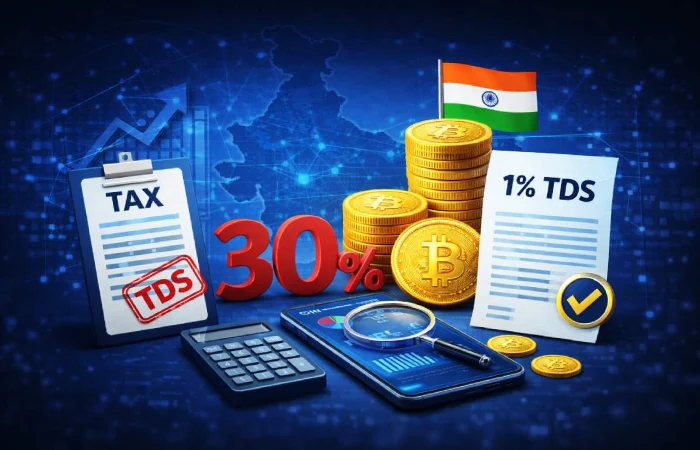
One of the clearest parts of India’s cryptocurrency framework is taxation.
Tax rate for income from transfer of VDA:- Income from transfer of VDA is chargeable to tax at the rate of 30%, plus applicable surcharge and health & education cess of 4%. The Income Tax Department has provided Schedule VDA for reporting of VDA transactions in the relevant Income Tax return forms.
For instance, if a taxpayer incurs a taxable gain of Rs. 1,00,000 when transferring a Bitcoin, the special tax rate applicable to the transfer of Bitcoin as per Section 115BBH is 30% (excluding applicable surcharge and cess).
| Bitcoin-related activity | Tax treatment |
|---|---|
| Profit from transferring Bitcoin | 30% special tax rate under Section 115BBH |
| VDA transaction reporting | Schedule VDA in applicable ITR forms |
| Applicable cess | 4% health and education cess |
| Surcharge | May apply depending on applicable provisions |
Tax treatment can depend on the nature of the transaction and the taxpayer’s circumstances, so professional tax advice may be appropriate for complex transactions.
Is Bitcoin Taxed Like Normal Investments?
No. Bitcoin and other qualifying VDAs are subject to specific provisions under the Income-tax Act. The Income Tax Department’s current ITR guidance specifically identifies VDA income as taxable at the special 30% rate under Section 115BBH.
Therefore, investors should maintain accurate records of Bitcoin purchases, sales, transaction values and related information needed for tax reporting.
Can Indians Buy Bitcoin?
Indian residents can access Bitcoin through cryptocurrency platforms that operate within the applicable legal and compliance framework. However, users should understand that availability of a cryptocurrency platform does not mean Bitcoin has been declared legal tender by the government.
Before using a platform, users should consider whether the relevant service provider is complying with applicable FIU-IND requirements and other legal obligations.
Is Bitcoin Banned in India?
Bitcoin is not currently subject to a blanket prohibition that makes simply owning Bitcoin illegal. However, this should not be confused with official recognition as currency.
India’s approach has largely involved taxation, AML requirements and financial regulation, rather than treating Bitcoin as an official replacement for the rupee.
What Should Bitcoin Investors in India Keep in Mind?
Anyone dealing in Bitcoin should consider the following:
- Bitcoin is not legal tender. It does not have the same status as the Indian rupee.
- Bitcoin gains can be taxable. VDA transfers are subject to the special tax framework.
- Keep transaction records. Purchase and sale information can be important for tax compliance.
- Understand KYC requirements. Covered VDA service providers may have KYC and reporting obligations.
- Consider the risks. Bitcoin prices can be highly volatile, and regulatory rules can evolve.
- Do not confuse taxation with government endorsement. The fact that Bitcoin is taxed does not mean that it is recognised as official currency.
Final Thoughts
So, is Bitcoin legal in India? While Bitcoin is not legal tender in India, using and holding Bitcoin does not seem to be overall prohibited at least through a comprehensive ban. India views Bitcoin as a financial activity and imposes a tax and anti-money laundering regime to govern it. And VDA services providers are subject to compliance obligations in the nation’s financial crime regime.
As regulation for cryptocurrency can evolve, investors should review up-to-date advice from Indian regulators prior to making any sizeable transactions. This also means that, in relation to bitcoin, investors should keep transactional records in order to meet tax reporting standards.