

How to Compare Mutual Funds: A Practical Guide for Investors

It might be a hard to decide on a mutual fund especially when many funds seem to deliver the same returns. But a right mutual fund comparison needs to look at factors other than historical returns.
When doing your comparison of any hybrid, equity, or debt funds, apply the same criteria.
This Article Belongs to Mutual Funds
What Is Mutual Fund Comparison?

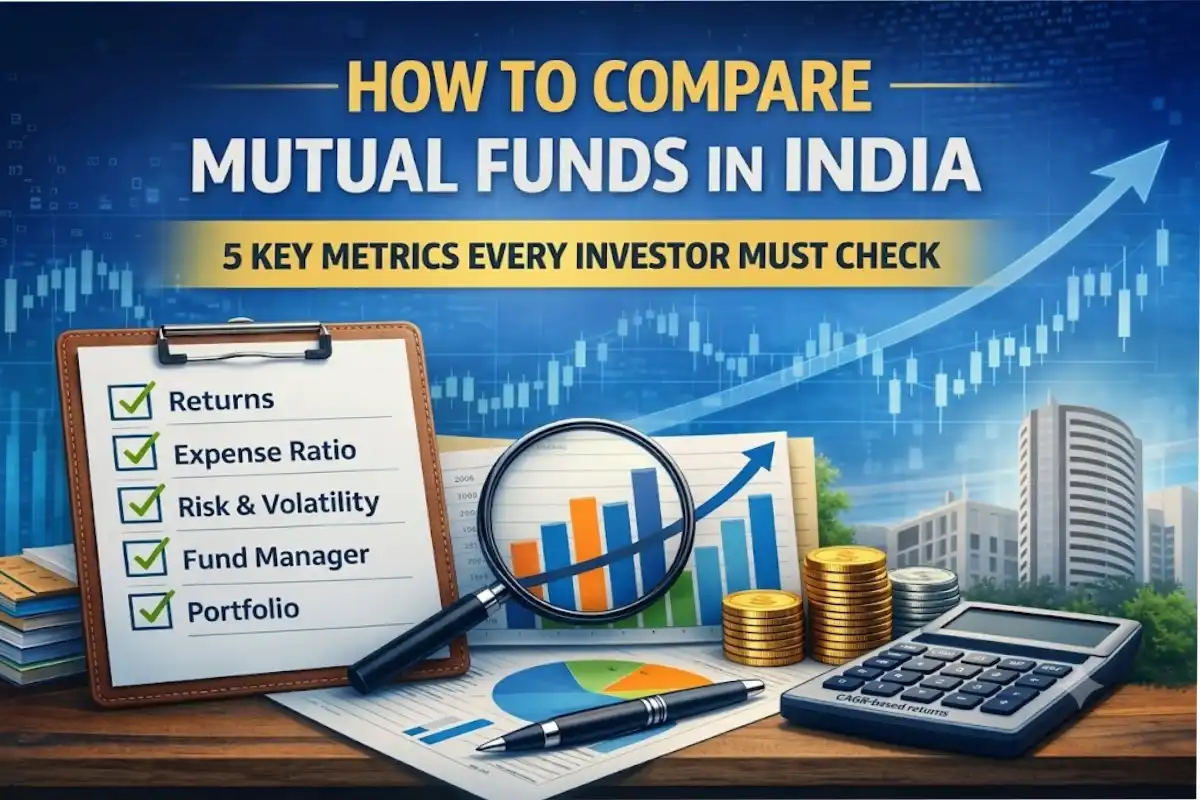
Mutual fund comparison involves comparing two or more funds on various parameters like historical returns, risk, expense ratio, portfolio holdings, experience of fund manager and the fund objective.
Investors need to look at how the fund performed through both good and bad times instead of choosing a fund just because it outperformed others over one year.
Key Factors to Compare Mutual Funds
The following factors can make how to choose mutual funds easier.
| Factor | What to Check | Why It Matters |
|---|---|---|
| Returns | 1, 3, 5 and 10-year performance | Shows historical performance |
| Expense Ratio | Annual fund management cost | Affects your net returns |
| Risk | Volatility, standard deviation and risk category | Helps understand potential fluctuations |
| Portfolio | Stocks, bonds and sector allocation | Shows where your money is invested |
| Consistency | Performance across different periods | Helps assess stability |
| Fund Manager | Experience and tenure | Provides management context |
| Benchmark | Fund versus benchmark performance | Shows relative performance |
1. Compare Mutual Fund Returns
When you compare mutual fund returns, avoid looking at only the latest one-year return. Short-term performance can be affected by market conditions.
Consider different periods, such as:
- 1-year returns for recent performance
- 3-year returns for medium-term performance
- 5-year returns for longer-term consistency
- 10-year returns where sufficient history is available
For systematic investment plans (SIPs), investors can also consider annualised returns such as CAGR or XIRR, depending on the investment method.
A fund with the highest historical return is not automatically the most suitable fund. Returns should always be considered alongside risk.
2. Check the Mutual Fund Expense Ratio
The mutual fund expense ratio represents the annual operating expenses charged by a fund as a percentage of its assets.
So if your fund’s expense ratio is 1% and you put Rs. 1 lakh in the fund, then the expense (per year) for that Rs. 1 lakh is Rs. 1000 (this also depends on the value of your investment in that fund).
For similar funds, lower expense ratio can save money. But it should not be viewed alone as the fund performance, portfolio and investment strategy also play an important role.
3. Conduct a Mutual Fund Risk Comparison
A proper mutual fund risk comparison is essential because funds with higher return potential can also experience larger fluctuations.
Check factors such as:
- Risk-o-meter category
- Standard deviation
- Portfolio concentration
- Equity exposure
- Credit quality for debt funds
- Sector allocation
- Historical drawdowns
For example, two equity funds may have similar three-year returns, but one may have experienced significantly larger declines during market corrections.
Therefore, compare both return and risk, rather than choosing a fund solely based on performance.
4. Compare the Fund With Its Benchmark
Every mutual fund generally has a benchmark that provides a reference for evaluating performance.
For example, an equity fund can be compared with its relevant market index. Check whether the fund has delivered competitive performance against its benchmark over multiple periods.
However, benchmark comparison should account for the fund’s investment strategy and category. A small-cap fund, for example, should not be compared directly with a large-cap benchmark.
5. Examine Portfolio Composition
Portfolio composition can tell you how a fund attempts to generate returns.
For equity funds, examine:
- Top holdings
- Market-cap allocation
- Sector exposure
- Number of securities
- Concentration in individual stocks
For debt funds, consider:
- Credit quality
- Maturity profile
- Modified duration
- Government versus corporate debt exposure
This helps investors understand whether the fund’s holdings align with their investment objectives and risk tolerance.
6. Look at Consistency, Not Just One Strong Year
A fund that performs well consistently may provide more useful information than one that has delivered an exceptional return during a single period.
Compare performance across different market environments, including rising and falling markets. Also consider rolling returns where available because they can provide a broader view of consistency.
Mutual Fund Comparison Checklist
Before selecting between two funds, use this checklist:
| Comparison Area | Questions to Ask |
|---|---|
| Objective | Does the fund match my financial goal? |
| Returns | How has it performed over several periods? |
| Risk | How much has the fund fluctuated? |
| Cost | Is the expense ratio reasonable for the category? |
| Portfolio | Are the holdings diversified and suitable? |
| Benchmark | How has it performed relative to its benchmark? |
| Consistency | Has performance been reasonably consistent? |
| Time Horizon | Does it suit my investment time frame? |
How to Choose Mutual Funds
Understanding how to choose mutual funds starts with your own financial objective. Consider your investment horizon, risk tolerance, liquidity needs and goal before comparing individual schemes.
For example, someone investing for a long-term goal may evaluate equity-oriented funds differently from someone looking for a relatively short-term debt investment.
It is also important to review the latest scheme documents, portfolio disclosures, costs and risk information before investing. Past performance does not guarantee future returns.
Conclusion
Understanding how to compare mutual funds can assist investors in being more systematic. A useful comparison should include the fund’s return, expense ratio, risk, benchmark, fund makeup, consistency.
Instead of choosing a fund that has the highest return, consider if its risk, expense and investment approach are suitable for your financial situation and timeframe.