

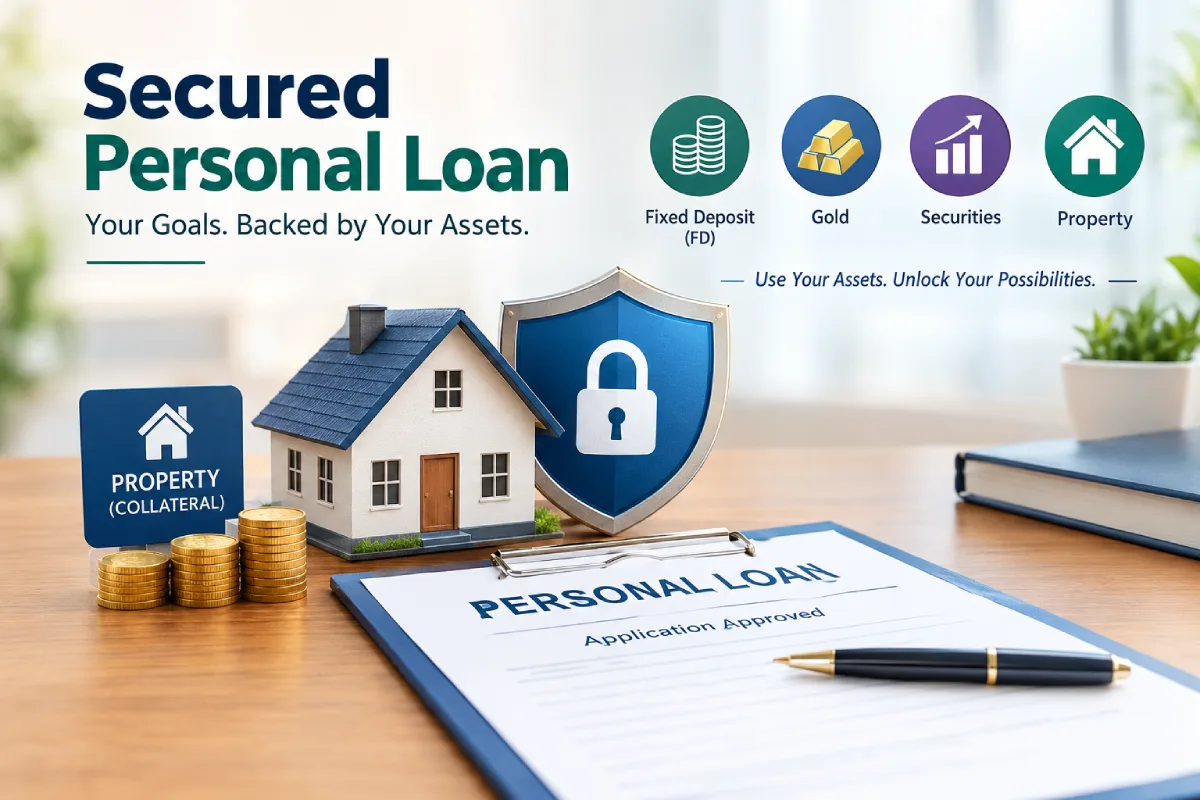
Secured Personal Loan: How It Works, Eligibility, Rates, Benefits & Risks

A secured personal loan is a loan that is taken out against the security of a certain asset provided by the applicant to the financial institution. Compared to an unsecured personal loan, which is approved on the basis of one’s ability to service the loan using one’s income, unsecured personal loan is used for the purchase of an asset.
Because secured personal loans are backed by collateral, borrowers might be able to borrow larger amounts, extend their term length, or qualify for a lower interest rate, depending on the lender and your financial information.
More Information on Secured Personal Loans and Collateral: Knowing what a secured personal loan is, how the collateral works, interest rates, qualifying requirements, benefits, and risks are all key points to consider before opting for such financing.
This Article Belongs to Personal Loans
What is a Secured Personal Loan?
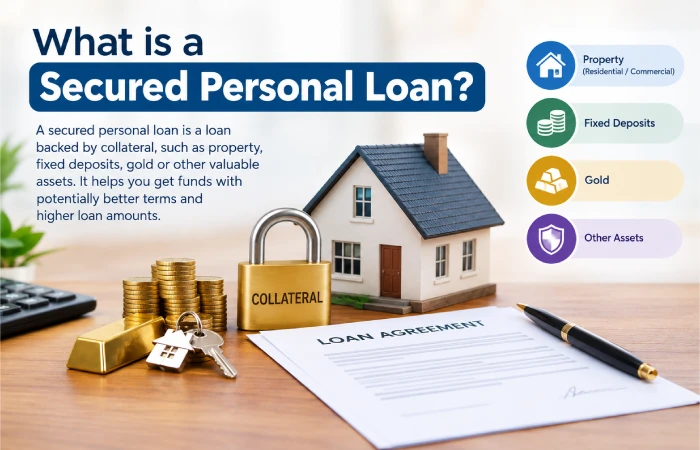
A secured personal loan is a personal loan that is secured by an asset that you own. You will offer a qualifying asset to the lender and then use the loan for a particular reason or, in many cases, for general personal use.
Collateral mitigates the risk to the lender, as the asset might serve as a form of protection if the borrower defaults on the loan.
For instance, a borrower who needs 10 lakh rupees for a significant personal purpose and owns an asset that is eligible to be used as collateral can borrow if the collateral can be pledged. The lender can assess your income, credit history, and repayment ability.
The specific amount of the loan, the rate of interest, and repayment duration will vary depending on the financial institution’s requirements and the applicant’s situation.
Secured Personal Loan Meaning
The meaning of a secured personal loan is straightforward it is a personal loan that requires security or collateral.
In a secured loan arrangement:
- The borrower applies for financing.
- The lender evaluates the borrower and proposed collateral.
- The eligible asset is pledged as security.
- The lender approves the loan amount and applicable terms.
- The borrower makes regular repayments.
- Once the loan has been paid off in its entirety, the lender unlocks the collateral in accordance with the terms of the agreement.
In the event of default by the borrower, the lender may have an interest in the collateral, in accordance with the loan contract and relevant laws and processes.
How Does a Secured Personal Loan Work?
When applying for a secured personal loan with collateral, you will typically need to provide two aspects: the borrower’s ability to service the loan and the value and quality of the collateral.
Step 1: Application
The borrower applies with personal information, income, employment or business details, current commitments, and details of the collateral.
Step 2: Financial Assessment
The lender may assess:
- Monthly income
- Employment or business stability
- Existing loans
- Credit history and credit score
- Debt-to-income or repayment obligations
- Banking history
- Requested loan amount
Step 3: Collateral Evaluation
The lender evaluates the asset being offered as security. Depending on the type of asset, valuation, ownership verification, and documentation may be required.
Step 4: Loan Approval
If the application satisfies the lender’s requirements, the lender determines the sanctioned amount, interest rate, tenure, and other conditions.
Step 5: Documentation and Disbursement
After the borrower accepts the terms and completes the required documentation, the loan is disbursed according to the lender’s process.
Step 6: Repayment
The borrower makes scheduled EMI payments until the outstanding loan is fully repaid.
Step 7: Release of Collateral
Once all applicable dues are cleared, the lender releases the security in accordance with the applicable documentation and procedures.
Common Types of Collateral for Secured Loans
Different lenders accept different forms of security. Common examples can include:
| Collateral | How It May Be Used |
| Fixed deposit | An FD may be pledged to secure borrowing |
| Gold | Eligible gold may be pledged against a loan |
| Property | Residential or commercial property may be accepted by some lenders |
| Securities | Certain financial securities may be accepted by eligible lenders |
| Other assets | Some lenders may accept other assets subject to their policies |
Not every lender accepts every type of asset. Borrowers should confirm the collateral requirements before applying.
Secured Loan vs Unsecured Personal Loan
The primary difference between a secured loan and an unsecured personal loan is collateral.
| Feature | Secured Personal Loan | Unsecured Personal Loan |
| Collateral | Generally required | Generally not required |
| Lender’s security | Backed by an asset | Primarily based on borrower’s creditworthiness |
| Interest rate | May be lower depending on lender and risk | May be higher depending on borrower and lender |
| Loan amount | May be higher depending on collateral value | Usually based mainly on income and credit profile |
| Risk to borrower | Collateral may be at risk in default | No pledged asset, but default still has serious financial consequences |
| Approval assessment | Borrower + collateral | Primarily borrower |
| Documentation | May involve asset-related documents | Usually no collateral documentation |
The actual terms vary between lenders and individual borrowers.
Secured Personal Loan Rates
Secured personal loan rates are influenced by several factors rather than being determined solely by the presence of collateral.
Factors that may affect the applicable interest rate include:
- Credit score and repayment history
- Income and employment stability
- Loan amount
- Loan tenure
- Type and value of collateral
- Loan-to-value ratio
- Existing relationship with the lender
- Internal credit assessment
- Market and lender-specific conditions
A secured loan may also charge a lower interest rate for a loan that is otherwise similar to an unsecured loan because the loan is secured by collateral. Don’t assume a secured loan will always be cheaper.
Example of Interest Cost
Consider a hypothetical loan of ₹5 lakh for five years.
| Particular | Example |
| Loan amount | ₹5,00,000 |
| Tenure | 5 years |
| Interest rate | 10% p.a. |
| Approximate EMI | ₹10,624 |
| Approximate total repayment | ₹6.37 lakh |
| Approximate interest | ₹1.37 lakh |
This is only an illustration. Actual EMI, interest rate, processing charges and total repayment can differ between lenders.
Benefits of Secured Personal Loans
Secured personal loans can provide several potential benefits.
1. Potentially Lower Interest Rates
Since the loan is supported by collateral, the lender may consider the risk lower than an unsecured loan. This can potentially result in a more competitive interest rate.
2. Higher Borrowing Potential
When a valuable asset is pledged, lenders may be able to offer a larger loan amount, subject to their loan-to-value limits and the borrower’s repayment capacity.
3. Longer Repayment Period
Some secured borrowing products may provide longer repayment periods. A longer tenure can reduce the monthly EMI, although it may increase the total interest paid over the life of the loan.
4. Useful for Larger Financial Requirements
Borrowers who require a substantial amount may consider secured financing when an unsecured personal loan does not provide sufficient borrowing capacity.
5. May Help Applicants With Limited Unsecured Eligibility
In some cases, providing collateral can even enhance an application, but you will need to go through the usual checks for income, credit history, and loan affordability.
Risks and Disadvantages
A secured loan is not risk-free. The most important consideration is the collateral.
1. Risk of Losing the Collateral
If the borrower fails to meet their commitments, then the lender can enforce/ recover against the asset pledged.
2. Valuation Risk
Lenders are likely to lend less against an asset than the market value of the asset because they take into account liquidity, valuation and risk.
3. Additional Documentation
Property, securities, gold or other collateral can require valuation, ownership verification and additional paperwork.
4. Processing and Other Charges
Borrowers may need to pay processing fees, documentation charges, valuation fees, legal charges or other applicable costs.
5. Longer Tenure Can Increase Total Interest
A lower EMI does not necessarily mean a cheaper loan. Extending the repayment period can increase the total interest paid.
Eligibility for a Secured Personal Loan
Eligibility requirements vary by lender and loan product. Common criteria may include:
- Minimum age requirement
- Indian residency or applicable citizenship/residency requirements
- Stable income
- Satisfactory credit history
- Adequate repayment capacity
- Acceptable collateral
- Clear ownership or legal rights over the collateral
- Required financial and identity documentation
Some lenders may have separate criteria for salaried individuals, self-employed applicants and business owners.
Documents Usually Required
Depending on the lender and collateral, applicants may need documents such as:
| Document Category | Examples |
| Identity proof | PAN, Aadhaar or other accepted identification |
| Address proof | Accepted residential address documents |
| Income proof | Salary slips, bank statements or income-tax documents |
| Employment/business proof | Employment or business-related documents |
| Bank statements | Recent statements as requested by the lender |
| Collateral documents | Ownership, deposit, security or other asset-related documents |
| Photographs | As required by the lender |
The exact documentation depends on the loan product and lender.
Factors to Consider Before Taking a Secured Personal Loan
When considering a loan, it is not enough to look at the offered interest rate.
Interest Rate: See if there is an interest rate involved and if the rate is fixed, floating, or other.
Borrowers should carefully review the loan’s interest rate, charges, repayment conditions, and other terms before accepting a loan. For additional information on financial awareness and responsible borrowing, refer to the Reserve Bank of India – Financial Education resources.
- Low interest rate: Processing Fees: If a loan has a low rate of interest, it can still be costly with up-front and other fees.
- Tenure of the Loan: Remember to select a tenure that ensures you pay affordable EMIs, yet does not make the cost of borrowing too high.
- Prepayment & Foreclosure: Conditions and details of Partial prepayment / Foreclosure, including the charges for the same, if applicable.
- Insurance (Collateral): Learn precisely what your collateral is and what the lender requires for it to be used as security.
- Total Cost of the Loan: Compare the overall repayment amount rather than looking only at the EMI.
How to Compare Secured Personal Loans
A simple comparison can help borrowers make an informed decision.
| Factor | What to Check |
| Interest rate | Applicable annual interest rate |
| Loan amount | Minimum and maximum available |
| Tenure | Available repayment periods |
| Processing fee | Upfront or deducted from disbursement |
| Collateral | Accepted assets and valuation requirements |
| LTV ratio | Maximum borrowing against collateral |
| Prepayment | Conditions and applicable charges |
| Late payment | Penalties and consequences |
| Documentation | Required paperwork |
| Total repayment | Principal plus total applicable costs |
Secured Personal Loan With Collateral: Example
Suppose an individual owns an eligible asset valued at ₹15 lakh and wants to borrow ₹7 lakh.
The lender may assess the asset and determine the permissible loan-to-value ratio. It will also examine the applicant’s income and repayment ability.
If the lender approves the loan, the borrower receives ₹7 lakh and pledges the asset as security. The borrower then pays EMIs according to the agreed schedule.
If the borrower repays the entire loan and applicable charges, the lender releases the collateral according to the terms of the agreement.
If the borrower fails to repay, the lender may take recovery action involving the collateral, subject to the loan agreement and applicable law.
Who Should Consider a Secured Personal Loan?
A secured loan may be considered by borrowers who:
- Need a relatively large amount of money
- Have an eligible asset that can be pledged
- Want to explore potentially lower borrowing costs
- Prefer a longer repayment period
- Have sufficient repayment capacity
- Understand the risks associated with pledging an asset
However, borrowers should avoid pledging an important asset simply to obtain a loan amount that they cannot comfortably repay.
Frequently Asked Questions
Is a secured personal loan better than an unsecured loan?
Neither option is universally suitable for everyone. A secured loan requires collateral but may offer different pricing or borrowing limits. An unsecured loan generally does not require collateral but may have different eligibility and pricing requirements.
What is a secured personal loan?
A secured personal loan is borrowing backed by an asset pledged as collateral. The lender evaluates both the borrower’s repayment capacity and the security offered.
What does a Secured personal loan with collateral mean?
It means the borrower provides an eligible asset as security against the loan. If the borrower defaults, the lender may have rights over the collateral under the loan agreement and applicable law.
Are secured personal loan rates always lower?
No. Secured personal loan rates may be lower in some cases because collateral can reduce lender risk, but the actual rate depends on the lender, borrower, collateral and other factors.
Can I get a secured loan with a low credit score?
Possibly, depending on the lender’s eligibility criteria, collateral, and overall financial profile. However, collateral does not guarantee approval.
What happens if I fail to repay a secured loan?
The lender may initiate recovery measures and may enforce its rights over the collateral according to the loan agreement and applicable laws. Borrowers should contact the lender promptly if they anticipate repayment difficulties.
Conclusion
Secured Personal Loan Borrowing can be secured against collateral, and secured personal loans might be available for those who require larger sums of money or who are seeking to take advantage of borrowing rates. With a secured personal loan, the borrower secures something against the debt.
Before selecting any secured personal loan, compare interest rate, charges, loan tenure, loan-to-value ratio, prepayment charges, and the total cost of the loan. The most important thing is to know the repercussions of a default and whether you will be able to adjust the EMI in your repayment capacity.
A secured loan might be relevant to use when the amount being borrowed, athe sset ,and the repayment plan make sense. It is important to ensure that you understand the particulars of the loan before putting up your asset.